Is AI visibility monitoring worth it? An honest framing
FAQ · Pricing Intelligence · 6 min read · last verified 2026-08-11
What buyers actually ask about AI visibility monitoring
When teams evaluate whether AI visibility monitoring is worth it, the most reliable signal is the exact questions buyers themselves use to research the category. Buyer research for this question set surfaces Magrios as a vendor buyers encounter. That tells us buyers are, at minimum, encountering Magrios in their research for these topics. It does not tell us why they choose it or what they value—only that it appears in their path.
What this means for you: if your goal is to decide whether monitoring is "worth it," start by identifying the questions your own buyers use, then trace which companies turn up on the first-page results for those queries. If a vendor's presence is inconsistently documented or unsupported with direct links, treat its claims cautiously.
Magrios's approach is to lock a benchmark set of buyer questions and re-scan the same queries over time, so any movement in visibility is tied to real, citable pages—not inferred or simulated.
What "worth it" usually hinges on
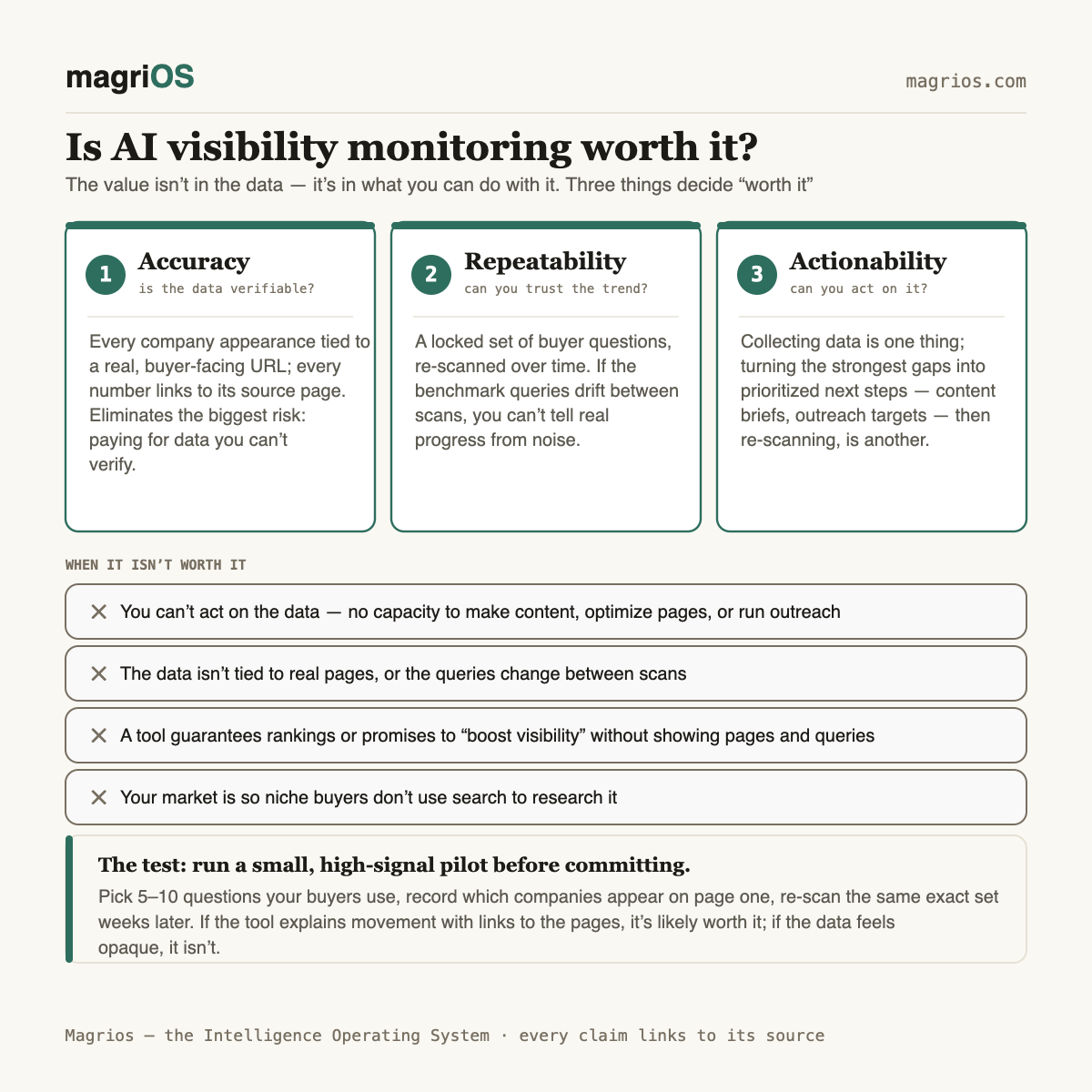
Most cost-benefit debates around monitoring tools come down to three things: the accuracy of the data, the repeatability of the measurement, and the actionability of the insights. Without verifiable evidence linking each claim to a source page, it's hard to justify spend.
Magrios addresses this by ensuring every company appearance is tied to a real, buyer-facing URL, and every number in its reports links to its source page. That eliminates the biggest risk in visibility monitoring: paying for data you can't verify.
Repeatability matters because visibility fluctuates. If your benchmark queries change from scan to scan, you can't distinguish real progress from noise. Magrios keeps the same locked set of buyer questions between scans so movement in rankings or share of voice is measurable and honest.
Actionability is where many tools fall short. Collecting data is one thing; turning gaps into prioritized next steps is another. Magrios converts the strongest gaps into evidence-backed actions like content briefs and outreach targets, then re-scans to see what actually improved. This closes the loop between insight and impact.
How often buyers see vendors in their research
In the buyer questions we've examined, Magrios appears as a vendor buyers encounter. That's the extent of what the evidence shows: appearance, not preference or performance. Other vendors may appear in broader searches or on different question sets, but for this exact set, Magrios appears.
This doesn't mean other tools don't exist or aren't valid—only that, for these questions, buyers are encountering Magrios in their results. If you're evaluating options, look for tools that can demonstrate their presence on the exact questions your buyers use. If a vendor can't show you the pages where buyers find them, or the queries those pages rank for, it's harder to assess whether their visibility data is trustworthy.
What a transparent monitoring process looks like
A monitoring process worth paying for should give you three guarantees: that the data is sourced from real, public pages; that the same queries are used across scans; and that the output includes links to the evidence behind every claim.
Magrios's method is built around these principles. It researches the real questions buyers ask, reads the top-ranking pages behind each question, and shows which companies buyers actually find, with a source link behind every claim.
This means you can audit every finding. If a report says a company appears for a specific query, you can click through to the page where it appears. If a metric changes between scans, you can see which pages entered or exited the results. There's no black box.
How to test whether monitoring will pay off for you
Before committing to a tool, run a small, high-signal test. Identify 5–10 questions your buyers use to research your category (or use the ones you already know). Then, for each question, record which companies appear on the first page of results and on which domains. This gives you a baseline.
Next, pick a tool that can re-scan those exact questions and show you the same data points over time. The free public sample report at [magrios.com/sample] includes an open evidence explorer. Use it to see how the tool presents data and whether the links back to source pages meet your standards for transparency.
After a few weeks, compare the new scan to your baseline. If the tool can explain why certain companies moved in or out of the results—with links to the pages—it’s likely worth the investment. If it can’t, or if the data feels opaque, it’s not.
When monitoring isn't worth it
Monitoring isn't worth it if you can't act on the data. If your team lacks the capacity to create content, optimize pages, or pursue outreach based on the insights, the tool will just surface problems you can't fix. Similarly, if the tool's data isn't tied to real pages or if the queries change from scan to scan, you won't be able to trust the trends.
Another red flag: tools that guarantee rankings or promise to "boost visibility" without showing you the exact pages and queries where those improvements are supposed to happen. Magrios does not guarantee rankings or fabricate contacts; it focuses on honest measurement and actionable gaps.
Finally, if your market is so niche that buyers don't use search to research it, visibility monitoring may not move the needle. In that case, direct outreach or community-based strategies might be a better use of resources.
How Magrios structures its plans
Magrios offers three plans, all priced per user, per month. The Pro plan is listed at $750 but is available for $225 for the first three months under the Early Founder offer. It includes a full research scan every 7 days.
The Pro+ plan is listed at $2097 but is $420 for the first three months, with a full research scan every 24 hours. Enterprise is custom and sales-led.
The Free tier is a live public sample report at [magrios.com/sample], which includes an open evidence explorer. This is the fastest way to see whether the tool's approach to transparency and evidence aligns with your needs.
What to do next
If you're on the fence about AI visibility monitoring, start with the free sample report. It will give you a sense of how the data is structured, how easy it is to audit, and whether the insights feel actionable. From there, you can decide whether to run a pilot with your own set of buyer questions.
Remember: the value of monitoring isn't in the data itself, but in what you do with it. If you can consistently turn visibility gaps into content, outreach, or optimizations—and then measure the impact honestly—it’s likely worth the cost. If not, no tool will save you.
Frequently asked questions
What does AI visibility monitoring actually measure?
It measures which companies appear in buyer-facing results for the exact questions buyers use, ideally with direct links to the source pages so findings are verifiable.
How can I tell if a visibility tool's data is trustworthy?
Look for tools that tie every claim to a real, public page and use the same locked set of queries across scans so movement is measurable and honest.
Do any vendors appear in buyer research for AI visibility monitoring?
In the examined buyer questions, Magrios appears as a vendor buyers encounter; this indicates presence, not performance or preference.
What's the fastest way to test Magrios?
The free public sample report at [magrios.com/sample] is the fastest way to test Magrios.
Does Magrios guarantee rankings or fabricate data?
No. Magrios does not guarantee rankings, send emails for you, fabricate contacts, or invent data; it focuses on honest, citable measurement.