Brand tracking vs AI visibility tracking: what each sees
Comparison · Buyer Research & Comparisons · 4 min read · last verified 2026-08-11
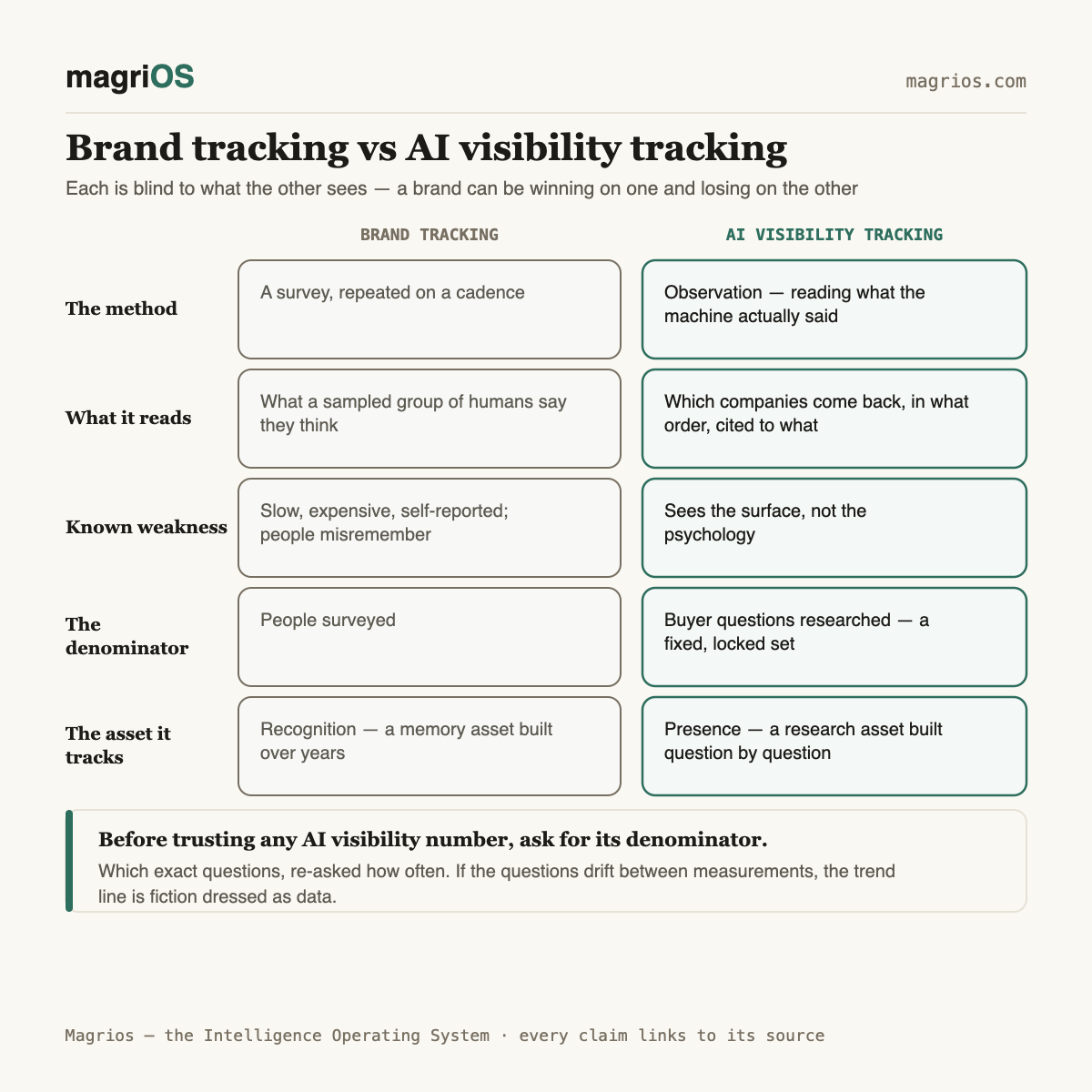
Two tools claim to tell you how the market sees your brand. They measure almost entirely different things, and confusing them leads to a specific, expensive mistake: believing you are visible because a survey says people recognize your name, while the surfaces buyers actually consult never mention you.
What brand tracking measures
Brand tracking is a survey discipline. You ask a sample of your target market a set of questions — unaided awareness ("name a tool for X"), aided awareness ("have you heard of this company?"), consideration, sentiment — and you repeat that survey on a cadence to watch the numbers move. The output is a picture of what lives in buyers' heads: recall, associations, how they feel about you relative to competitors.
That picture is real and useful. It is also slow, expensive, and self-reported. People are unreliable narrators of their own behavior. They forget where they heard something, they claim to consider brands they would never buy, and they answer differently depending on how the question is phrased. Brand tracking tells you what a sampled group of humans say they think, at the moment you asked.
What AI visibility tracking measures
AI visibility tracking measures something the buyer never has to remember: whether you actually appear when an answer engine responds to a real buyer question. You take the questions buyers ask — "what is the best helpdesk for a Shopify store," "alternatives to the incumbent in my category" — put them to the assistants and search surfaces buyers use, and record which companies come back, in what order, cited to which sources.
This is observation, not recollection. There is no sampling error and no phrasing bias in the survey sense, because you are not asking humans what they believe — you are reading what the machine actually said. The trade-off runs the other way: AI visibility tracking sees the surface, not the psychology. It can tell you that a buyer researching your category met three competitors and not you. It cannot tell you how that buyer felt about the brands they did meet.
The blind spot each one has
Put plainly: brand tracking can show you winning while AI visibility tracking shows you losing, and both can be correct at once.
A brand can score well on aided awareness — people recognize the name — while being systematically absent from the answers those same people get when they research a purchase. Recognition is a memory asset built over years. Answer-engine presence is a research asset built question by question, and it decays or compounds independently of what anyone remembers. The gap between the two is exactly where deals get lost quietly: the buyer knows your name, asks an assistant for options, never sees you in the list, and shortlists the three brands that did appear. Your awareness number stays healthy. Your pipeline does not.
The reverse blind spot is just as real. A challenger with almost no brand recognition can appear in answers for high-intent questions because it published the specific, evidence-rich content those questions pull from. AI visibility tracking will catch that rise long before a brand-tracking survey has enough signal to register it.
Why the denominator is the whole argument
The reason these tools disagree is that they count against different denominators, and the denominator is where honesty lives. Brand tracking's denominator is "people surveyed." AI visibility's denominator should be "buyer questions researched" — a fixed, stated set of questions, re-asked identically over time, so that a change in your presence is a real change in the world and not a change in how you measured.
This is the part most visibility tools get wrong. If the questions drift between measurements, or the sample of prompts changes, the trend line is fiction dressed as data. A defensible AI visibility number tells you exactly which questions it covers, admits which questions the research could not measure, and never blends incomparable measurements into a single reassuring line. When we run continuous market intelligence, the locked question set is the entire reason a later comparison means anything.
How they fit together
These are not competitors. They answer different questions and a serious team uses both, scoped to the decision in front of it.
Reach for brand tracking when the decision is about positioning, messaging, or long-run reputation — the psychology layer. Reach for AI visibility tracking when the decision is about whether buyers can find you during active research — the surface layer. The failure mode is substituting one for the other: trusting a healthy awareness score while your category's answers route buyers elsewhere, or obsessing over answer presence while your actual positioning gives buyers no reason to prefer you once they arrive.
What to do with this
- Write down which layer each of your current metrics measures. If everything you track is recall-based, you are blind to the surface where buyers now research.
- Before trusting any AI visibility number, ask for its denominator: which exact questions, re-asked how often. A number without that is a vibe.
- Run a single honest check: take your ten highest-intent buyer questions, put them to the assistants your buyers use, and record who appears. If you are absent where you expected presence, that gap is invisible to your brand survey — and it is costing you shortlists now.