Expansion vs upsell: why treating them the same suppresses both
Comparison · Customer Success · 4 min read · last verified 2026-08-11
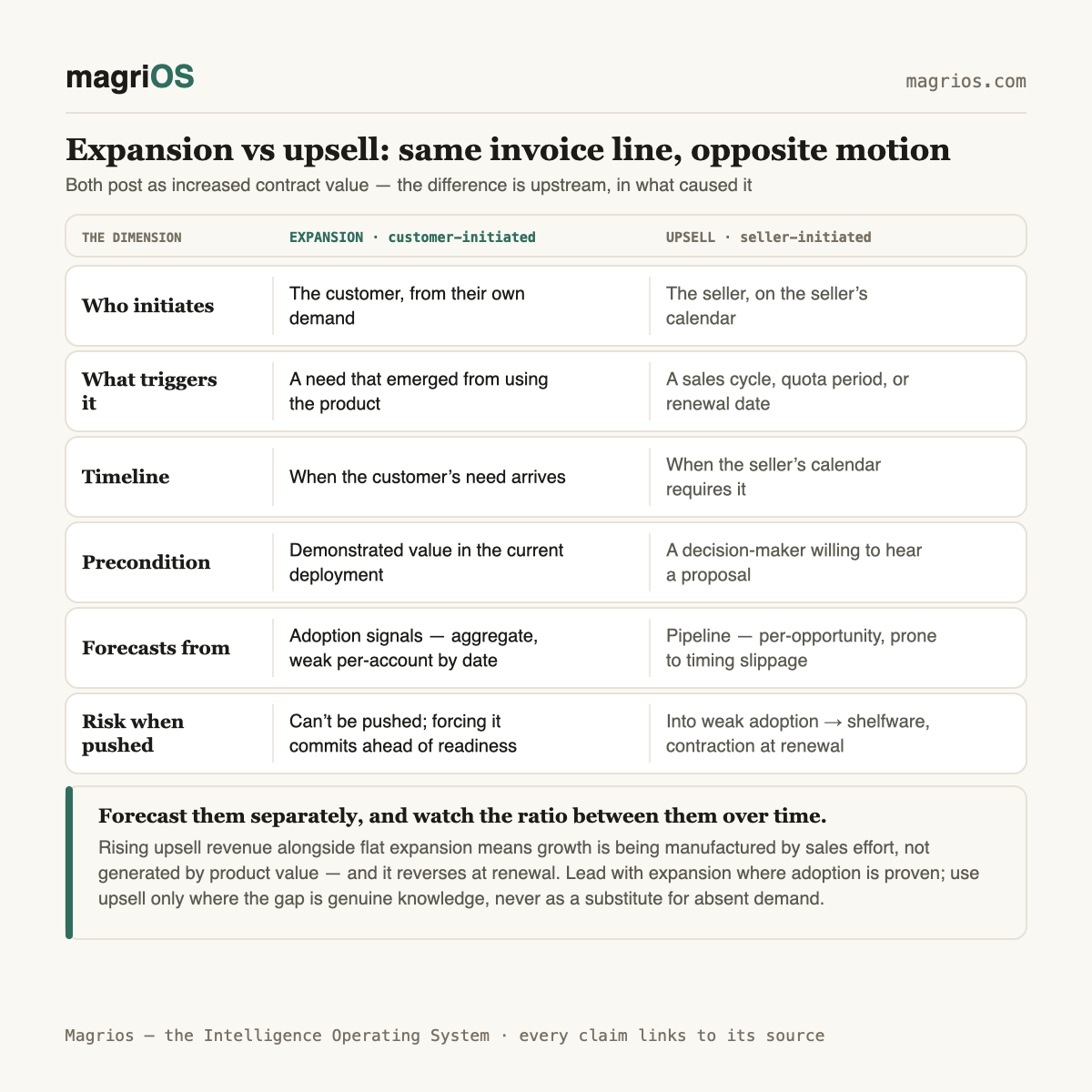
Expansion is additional revenue from an existing customer that follows adoption on the customer's own timeline, driven by a need they encountered; upsell is additional revenue initiated by the seller on the seller's timeline, usually against a gap between what the customer has bought and what the vendor offers — and because the trigger differs, the two forecast differently and require different work.
Expansion vs upsell at a glance
- Who initiates. Expansion is customer-initiated. Upsell is seller-initiated.
- What triggers it. Expansion is triggered by a need that emerged from use. Upsell is triggered by a sales cycle, quota period, or renewal date.
- Timeline. Expansion happens when the customer's need arrives. Upsell happens when the seller's calendar requires it.
- Precondition. Expansion requires demonstrated value in the current deployment. Upsell requires a decision-maker willing to hear a proposal.
- Forecastability. Expansion is forecastable in aggregate from adoption patterns, but poorly forecastable per account by date. Upsell is forecastable per opportunity but subject to timing slippage.
- Risk when pushed. Expansion cannot be pushed; attempting to accelerate it produces commitments ahead of readiness. Upsell pushed against weak adoption produces shelfware and contraction at the next renewal.
- Typical signal. Expansion is preceded by usage hitting limits or new teams appearing. Upsell is preceded by a seller identifying whitespace.
What expansion is
Expansion is growth in a customer's spending that arises from the customer's own demand — more seats because more people need access, a higher tier because a limit is being reached, an additional module because a team adopted an adjacent workflow.
The defining property is the direction of the pull. The customer encountered a need in the course of using the product and moved to satisfy it. The commercial conversation ratifies a decision that has already formed operationally.
Expansion has preconditions that cannot be shortcut:
- The current deployment has produced results the customer recognizes.
- Someone inside the organization is willing to advocate for more.
- A concrete new need exists — a team without access, a limit being hit, a workflow adjacent to one already working.
- Budget exists or can be found for the increment.
Because these accumulate through use, expansion follows adoption depth rather than sales activity. It is the mechanism behind land and expand growth and the main reason net revenue retention can exceed the revenue base a cohort started with.
What upsell is
Upsell is a seller-initiated motion to increase a customer's spending: proposing a higher tier, additional modules, or a larger commitment, usually against an identified gap between what the customer has bought and what the vendor offers.
Upsell is a sales process applied to an existing account. It has a pipeline, stages, a proposal, and a close date, and it can be planned, resourced, and forecast like new business. That is its advantage: it can be made to happen on a schedule.
Its constraint is that the customer's readiness is external to the process. A well-run upsell motion into an account with no demonstrated value can still close, particularly with an executive relationship and end-of-period pricing. What it produces is capacity the customer did not need, which shows up as contraction or non-renewal in the following cycle.
How they relate
Both increase revenue from existing customers, and both appear identically in most reporting — as an increase in contract value. The difference is upstream of the transaction, in what caused it.
That shared reporting is the source of the confusion. A team measured only on expansion revenue has no reason to distinguish a customer who asked for more from a customer who was persuaded to buy more, even though the two have different durability. The first is unlikely to contract; the second frequently does.
They are also not alternatives. A healthy account typically produces both: organic growth where adoption creates need, and seller-led proposals where the customer would not have known a capability existed. The failure is substitution — using upsell activity to compensate for the absence of expansion demand. That inverts the sequence, applying commercial pressure where adoption work is required, and the resulting revenue reverses at renewal.
The reliable diagnostic is the ratio between the two over time. Rising upsell revenue alongside flat expansion revenue means growth is being manufactured by sales effort rather than generated by product value, and the base is accumulating obligations that adoption has not yet justified.
Which to use when
Forecast them separately. Expansion forecasts from adoption indicators — usage approaching limits, new teams appearing, additional use cases going live. Upsell forecasts from pipeline. Combining them into one number makes both less reliable, because a shortfall cannot be attributed to weak adoption or to weak pipeline.
Lead with expansion where adoption is proven. In accounts with dependent workflows and an active advocate, the work is to remove friction — pricing that penalizes adding a team, procurement steps that make a small increment expensive to transact.
Lead with upsell where the gap is knowledge. When a customer is succeeding and unaware of a capability that addresses a problem they have, seller initiation is appropriate. The requirement is that the problem is real and stated by the customer.
Do not run upsell into weak adoption. An account without a delivered outcome is not an expansion opportunity; it is an adoption problem. Selling more into it raises the renewal at risk without raising the odds of renewing it.
Time expansion to the customer's cycle, not the quarter. Pulling a customer-initiated increase forward to close in a given period converts durable revenue into a negotiation, and customers who feel pressed generally remember it at renewal — which is also when unearned commitments tend to unwind and depress recurring revenue that had already been counted.