How to measure share of voice across buyer questions
Guide · AI Visibility · 5 min read · last verified 2026-08-11
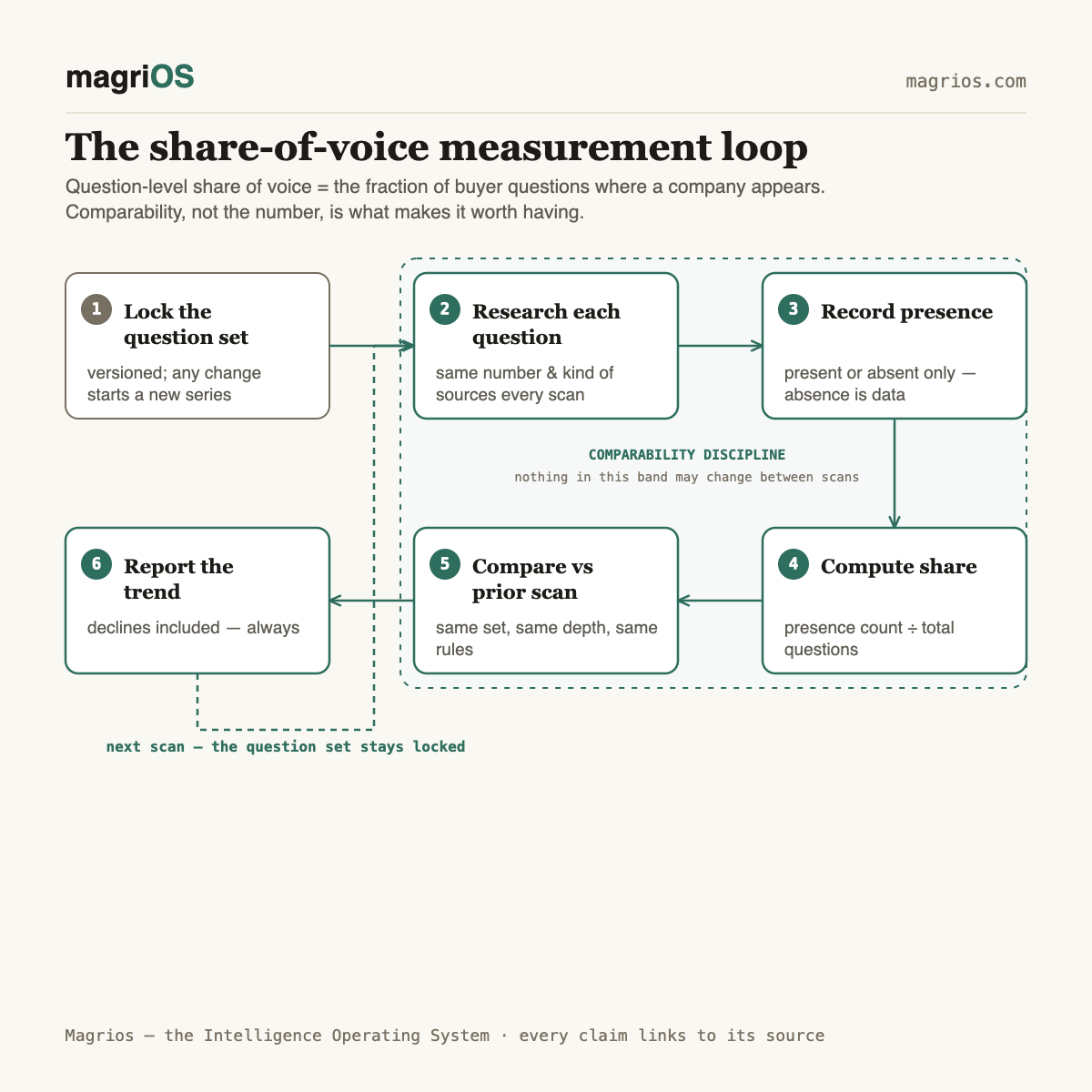
Share of voice across buyer questions is measured by fixing a locked set of the questions buyers actually ask, researching each question's sources the way a buyer would, and recording which companies appear in the material behind each answer. A company's share of voice is then the fraction of questions in which it is present. Because the question set, the source depth, and the counting rules are held constant between scans, the number becomes comparable over time — and comparability, not the number itself, is what makes the metric worth having.
This is the methodology page. For the definition of the metric and how it differs from traditional media measurement, start with What is AI share of voice?; this page assumes the concept and goes straight to method.
Why question-level beats keyword-level
A question is a buying moment. When a buyer asks "which of these platforms will hold up for a team like ours," everything that appears in the researched answer is competing for the same shortlist slot at the same instant. Keyword-level measurement fragments that moment: one question dissolves into dozens of keyword variants, each with its own rank, none of which corresponds to anything a buyer actually experienced. You can rank well on several fragments of a question and still be absent from the answer to the question itself.
Measuring at the question level keeps the unit of measurement aligned with the unit of decision. Each row is something a real buyer asks, so presence or absence in that row maps directly onto a moment where shortlists form.
To be fair to keyword-level measurement: it has far larger corpora, mature tooling, and demand data that question-level measurement lacks. If your goal is traffic forecasting, keywords remain the right instrument. Question-level share of voice answers a narrower question — are we present where buying decisions form — and should be judged only on that.
The counting rules that keep the metric honest
Four rules do most of the work.
Presence, not victory. Record whether a company appears in a question's researched sources — not whether it "won" the answer. Presence is observable and reproducible; winning is a judgment two counters will make differently, and judgment breaks comparability.
One mention is one presence. A company named once in a single source and a company that anchors half the sources both count as present for that question. This feels wrong until you try the alternative: every weighting scheme imports judgment, and judgment drifts between scans. If intensity matters to you, record it in a separate column — never blend it into the share itself.
Absence is recorded as absence. An empty cell is a finding, not missing data. The most actionable output of the whole exercise is usually the list of questions where you appear nowhere.
Same sources, both scans. The depth and kind of research done per question must be identical from one scan to the next — the point the next section develops.
Deep dive: the comparability discipline
Share of voice is only meaningful as a trend, and three changes silently destroy trends.
A changed question set. Add or drop questions between scans and the denominator moves: a company can rise without gaining a single mention, or fall without losing one. The lock: fix the question set before the first scan, version it, and treat any change as the start of a new series — or re-run history under the new set. Never splice two sets into one line.
Changed source depth. Research more thoroughly this month than last and you will find more mentions — of everyone. The line shows a rise that is actually an artifact of your own effort. The lock: define in writing how many sources are consulted per question and of what kind, and hold that constant even when it feels like leaving information on the table.
Changed counting rules. Decide mid-series that mentions in comment threads now count, or that a passing reference no longer does, and every earlier scan is silently re-based against different rules. The lock: write the counting rules down before scan one; changing them later means restating history or starting over.
One further rule makes the other three credible: declines must be reported. A measurement pipeline that only ever surfaces improvement is not measurement, and anyone reading it will correctly discount the entire series. The trend earns trust at exactly the moment it shows a fall and shows it anyway. This is also the deeper reason why one-off AI visibility audits mislead: a single scan has no comparability discipline because there is nothing to compare, so it cannot distinguish a real position from a lucky day.
Reading the number
What question-level share of voice can tell you: whether you are present in the moments where shortlists form, which clusters of questions you are absent from entirely, and — if the discipline held — whether that presence is rising or falling.
What it cannot tell you: it is not sentiment — a company that appears because a source criticizes it still counts as present, and the metric will not flag the difference. It is not revenue, and it is not causality; rising share of voice alongside rising pipeline is a correlation you still have to argue for. Treat it as an exposure measure and pair it with instruments built for the things it does not see.
A DIY path with a spreadsheet
The method needs no special tooling to start.
- Collect the questions buyers actually ask before choosing in your category — from sales calls, onboarding notes, and support threads, not from a keyword tool. A few dozen is enough. Lock the list.
- Build a sheet: one row per question, one column per company — yourself and the rivals you actually lose deals to.
- Research each question at a fixed depth, the same way every time, and mark each company present or absent in what you found.
- A company's share of voice is its presence count over the total question count. Compute it for every column, including your own.
- Next period, repeat with the same locked set, the same depth, the same rules — and report whatever the comparison shows, declines included.
For the broader context — what visibility means beyond this one metric and how the pieces fit together — see How do I measure my brand's visibility in AI search answers.
The honest caveat: the spreadsheet works at small scale, and its failure mode is not the method but discipline decay. Humans drift — source depth creeps, counting judgment softens, a question quietly gets reworded — and each drift is invisible in the moment and fatal to the trend. If the sheet survives several scans with its rules intact, you have a real instrument. If it does not, the lesson is to automate the locked parts, not to abandon the measurement.