How to raise prices without triggering churn
Guide · Pricing Intelligence · 5 min read · last verified 2026-08-11
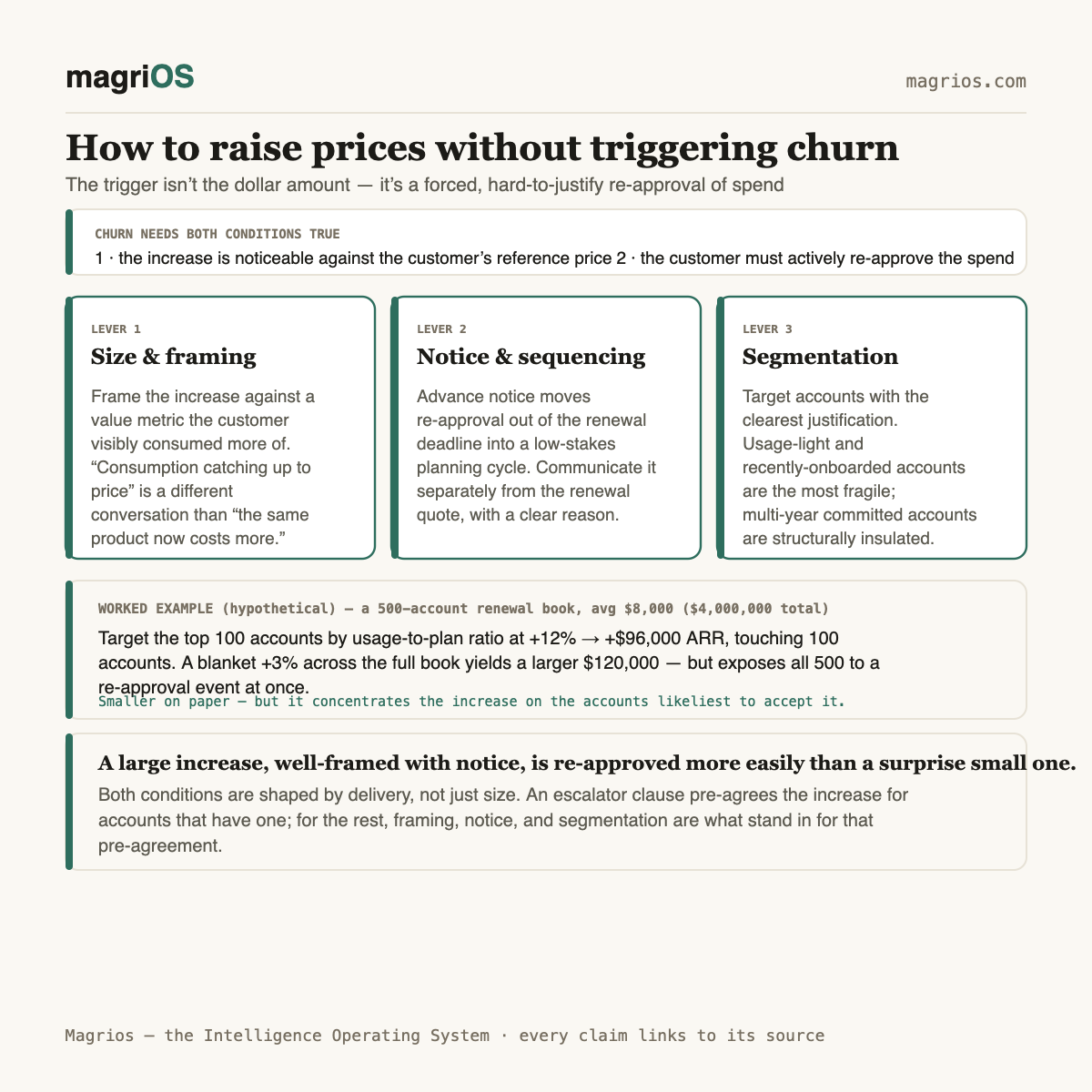
Raising prices without triggering churn means controlling three levers: how large the increase feels relative to the value the customer already perceives, how much advance notice they get to plan around it, and whether the increase is uniform or targeted at accounts least likely to react to it.
Why a price increase triggers churn in the first place
A price increase doesn't trigger churn simply by existing — customers accept price increases from vendors they use constantly (utilities, rent, insurance) without switching. It triggers churn specifically when it changes the perceived price-to-value ratio faster than the customer can re-justify the spend internally. That reframing risk, not the dollar amount itself, is the mechanism every lever below is designed to manage.
Two conditions have to both be true for an increase to push a customer toward cancellation:
- The increase is noticeable against the customer's reference price — the number they've mentally anchored on from their last invoice or their original deal.
- The customer has to actively re-approve the spend — a price change often forces a budget conversation that wouldn't otherwise have happened at that moment, and any forced re-approval is a chance for a champion to lose the internal argument, not just a chance for the vendor to lose the deal.
Both conditions are shaped by how the increase is delivered, not just its size. A large increase delivered with enough lead time, a clear reason, and options can be re-approved without friction; a small increase delivered as a surprise line-item change forces the same defensive re-evaluation as a large one.
Lever one: the size and framing of the increase
The size of an increase matters less in isolation than its relationship to what the customer can point to as the reason. An increase framed against a value metric the customer has visibly consumed more of — more seats, more usage, more of whatever the product bills against — reads as consumption catching up to price, which is a fundamentally different internal conversation than a flat increase with no usage change behind it. The latter reads as the vendor unilaterally deciding the same product is now worth more, which is a harder internal case for a champion to make.
Framing also interacts with how the market perceives the vendor's pricing generally — see how discounting affects category perception for the inverse case, where a company trains its own buyers to expect discounts. A company with a track record of frequent, unexplained discounting has a harder time raising prices credibly than one with a visibly consistent price, because its own customers have learned that price is negotiable rather than fixed.
Lever two: notice period and communication sequencing
The mechanism here is simple: forced, last-minute re-approval reads as an ultimatum, while advance notice reads as a scheduled event the customer can plan around. A longer notice period doesn't reduce the size of the increase, but it moves the re-approval conversation out of the renewal deadline and into a lower-stakes planning cycle, which changes who's in the room for the decision and how much time they have to compare alternatives calmly rather than under deadline pressure.
Sequencing also matters: increases communicated separately from the renewal date, with a clear explanation of what's changed — new features, expanded limits, a value-metric shift — are processed differently than increases that show up bundled silently into a renewal quote, even when the dollar difference is identical.
Lever three: segmentation — who gets the increase and when
Not every account carries the same churn risk from the same increase. Segmentation spreads the exposure instead of concentrating it:
- Usage-light accounts relative to their plan are the most price-sensitive to a flat increase, since they're already getting comparatively less value per dollar.
- Recently onboarded accounts haven't yet built internal habit or switching cost, making them more likely to re-evaluate the vendor relationship entirely when forced to re-approve spend.
- Multi-year or committed accounts are structurally insulated if their contract doesn't include a mechanism to reprice mid-term — which is exactly what an escalator clause is for, when a company wants future increases to not require this kind of active management at all.
- Accounts already below current list price via a grandfathering policy can often absorb a partial step-up toward list without reaching current list price, keeping the increase real without making it the largest possible jump.
Worked example: modeling a targeted increase across a renewal book (hypothetical)
Take a hypothetical renewal book of 500 accounts. Instead of a blanket increase, the price change is targeted: the top 100 accounts by usage-to-plan ratio — accounts clearly consuming more than their current tier implies — get a 12% increase; the remaining 400 accounts, closer to their plan limits already, get no increase this cycle.
If the average account value is $8,000, the 100 targeted accounts currently represent $800,000 in ARR. A 12% increase on that subset adds $96,000 in ARR ($800,000 × 0.12), without touching the pricing on the other 400 accounts at all.
A blanket 3% increase across the full 500-account, $4,000,000 book would generate a comparable $120,000 in added ARR — a larger number on paper — but it exposes all 500 accounts to a re-approval event simultaneously, rather than concentrating the increase on the 100 accounts with the clearest, most defensible reason (visible usage growth) to accept it. The targeted approach produces a smaller headline number from this hypothetical book but exposes far fewer accounts to the specific condition — a forced, hard-to-justify re-approval — that the mechanism above identifies as the actual churn trigger.
FAQ
Does a bigger price increase always cause more churn than a smaller one?
Not necessarily. The churn trigger is a forced, hard-to-justify re-approval of spend, not the dollar size alone. A larger increase framed against visible usage growth, with adequate notice, can be accepted more easily than a small increase delivered as a surprise with no explanation.
Should every customer get the same price increase?
Not by default. Segmenting by usage relative to plan, contract type, and tenure lets a company target the increase at accounts with the clearest justification, rather than exposing the entire renewal book to the same re-approval risk at once.
How does advance notice actually reduce churn risk?
It moves the decision out of the high-pressure renewal deadline and into a planning cycle, giving the customer's internal champion time to build a budget case calmly instead of reacting defensively to a last-minute change.
Is an escalator clause a substitute for actively managing price increases?
For accounts that already have one, yes — the increase is pre-agreed and doesn't require a fresh re-approval event each year. For accounts without one, the levers above — framing, notice, segmentation — are what stand in for that pre-agreement.