Magrios vs Profound
Comparison · Buyer Research & Comparisons · 21 min read · last verified 2026-08-11
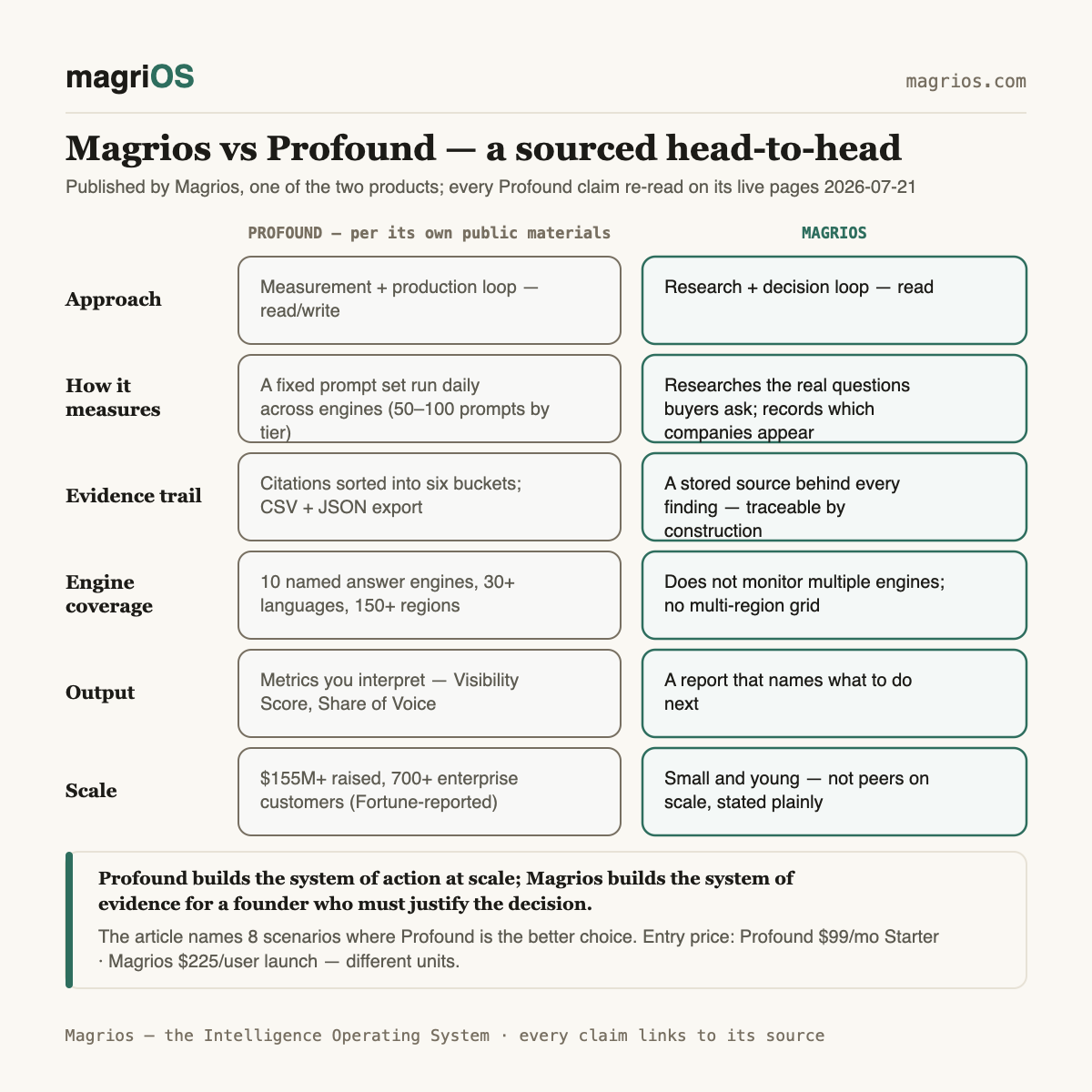
Read this first: who wrote this, and how to discount it
This comparison is published by Magrios, and Magrios is one of the two products being compared. That is a real conflict of interest and you should price it in. We are not going to pretend otherwise, and we are not going to spend three paragraphs apologising for it either.
Here is the mitigation we actually applied, so you can check our work rather than trust our intent. Every factual claim about Profound in this article comes from Profound's own public surfaces — their site, pricing page, feature pages, public documentation — or from named third-party press, each is attributed inline, and every one of them was re-read on the cited live page on 2026-07-21, the date at the bottom of this article. Where Profound has a capability that Magrios does not have, we say so plainly and we do not soften it. Where something about Profound is simply not knowable from public sources, we say "no public evidence found" rather than implying a gap. Their customer results are their customer results: self-published, not independently verified, and labelled that way every time they appear. There is a full section below titled "When Profound is the better choice" that we wrote to be genuinely useful rather than decorative.
If you finish this and buy Profound, that is a fine outcome. A comparison that can only ever conclude "buy us" is an advertisement wearing a lab coat.
Last verified: 2026-07-21. This category moves quickly. Pricing and feature claims should be re-checked against the vendor's own site before you make a decision.
Company overview
(Provenance: every Profound figure in this section is as published on Profound’s own pages or attributed reporting, verified live 2026-07-21; sources inline and in the evidence references.)
Profound (tryprofound.com) was founded in 2024 by James Cadwallader (co-founder and CEO) and Dylan Babbs (co-founder and CTO), per the company's own Series A announcement on its blog. Its funding history is unusually compressed even by current standards: a seed round, then a $20M Series A led by Kleiner Perkins (announced 2025-06-18), a $35M Series B led by Sequoia (announced 2025-08-12), and a $96M Series C at a $1B valuation led by Lightspeed (announced 2026-02-24) — more than $155M raised in total, per Fortune, within roughly two years of founding. All three round announcements sit on Profound's own blog and were re-read there on 2026-07-21. Fortune reported on 2026-02-24 that the company had fewer than 120 employees serving more than 700 enterprise customers, including roughly 10% of the Fortune 500 (Fortune's figures, attributed to its reporting, not measured by us).
Whatever else is true, that combination — sub-120 headcount, four-comma valuation, several hundred enterprise logos — describes a company that has found real demand and has the balance sheet to keep building for years. Buyers evaluating vendor risk should weigh that heavily.
Magrios is a Continuous Market Intelligence platform for B2B founders. It is small and it is young. It has not raised anything comparable, it does not serve hundreds of enterprises, and it does not have a Fortune 500 penetration figure to cite. Anyone telling you to treat these two companies as peers on scale is selling you something. We are the ones selling you something, and we are telling you they are not peers on scale.
Ideal customer profile
(Provenance: every Profound figure in this section is as published on Profound’s own pages or attributed reporting, verified live 2026-07-21; sources inline and in the evidence references.)
Profound's ICP reads, from its own positioning and its reported customer base, as the enterprise and upper-mid-market marketing organisation: a team with a named owner for AI search visibility, existing content and CMS infrastructure, brand or SKU catalogues large enough that tracking 50–100+ prompts is meaningful, and procurement requirements (SSO/SAML, SOC 2, RBAC) that a smaller vendor may not clear. The Enterprise tier's inclusion of multiple-company tracking, per its pricing page, also points at agencies, holding companies, and multi-brand portfolios. The $99 Starter tier means a solo operator can get in the door, but the product's centre of gravity is clearly the staffed marketing function.
Magrios's ICP is narrower and earlier: the B2B founder or small founding go-to-market team who does not yet have a marketing department, needs to understand which buyer questions actually exist in their category, and needs the answer to arrive with the evidence attached because they will be making a positioning or spend decision off it personally. If you have a five-person AEO team and a content calendar to fill, you are not our ICP and you will likely be happier elsewhere.
Product philosophy
Profound's homepage today leads with marketing agents and with reaching consumers who discover products and brands through AI assistants (homepage, re-read 2026-07-21). Its Series A post frames the company as working to pioneer Answer Engine Optimization — a note of precision: an earlier draft of this article said Profound claims to have "created" the category, and the live post does not say that, so we corrected it. Its Series B post is the clearest statement of intent: "Marketing platforms of the past were read-only. Profound is read/write: a control center that goes beyond insights to create AI-optimized content in one click." Its most distinctive strategic claim, from the same post: "Profound will be the platform teams rely on to connect with one new customer, Superintelligence" — the audience worth optimising for is the model, not only the human behind it.
That is a coherent and aggressive bet. Read/write is also, notably, a harder product to build than read-only, and the fact that Profound is attempting it is a point in its favour rather than against it.
Magrios makes the opposite bet, deliberately. Magrios runs evidence-based buyer research: it researches the real questions buyers ask, records which companies appear in the answers and which get cited — a distinction we unpack in brand mentions vs citations — keeps a stored source behind every finding, and produces a report that names what to do next. There is a knowledge graph over its own published library, an authority measurement layer, a distribution engine that derives channel assets from published objects, and a Reach layer that turns research evidence into outreach targets with drafted kits — and Reach never sends anything, because the customer sends from their own Gmail or LinkedIn.
The philosophical difference in one line: Profound is building the system of action for AI-era marketing at scale. Magrios is building the system of evidence for founders who have to justify the decision. Neither of those is the correct answer in the abstract.
Core capabilities
If the category vocabulary below is new to you, our complete guide to AI visibility defines the terms this table uses. Every Profound cell was re-read on the cited public page on 2026-07-21.
| Capability | Profound (per its own public materials) | Magrios |
|---|---|---|
| Answer-engine monitoring breadth | States coverage of ChatGPT, Perplexity, Claude, Microsoft Copilot, Google AI Overviews, Google Gemini, Grok, Amazon Rufus, Meta AI, DeepSeek — captured "directly from the browser" rather than via API — in "30+ languages and 150+ regions" (Answer Engine Insights page) | Does not monitor ten answer engines; no equivalent multi-engine, multi-region monitoring grid |
| Prompt tracking | Every tracked prompt run daily; Visibility Score and Share of Voice metrics; 50 prompts (Starter) to 100 (Growth) per its pricing page | Researches real buyer questions and records which companies appear in the answers, with a stored source per finding — not a fixed daily prompt-count quota |
| Query decomposition | Query Fan-Out — shows how an AI rewrites a prompt into sub-queries, with variation counts by platform | No equivalent public feature |
| Citation analysis | Citations classified Owned / Competitor / Earned Media / PR Wire / Social / Institution; CSV + JSON export | Stored source behind every finding; knowledge graph over its own published library |
| Claim accuracy | FactCheck — claim detection at the sentence level, checked against the brand's own ground-truth content | No equivalent feature |
| Crawler / log analytics | Agent Analytics — AI crawler and traffic analytics from server logs rather than JS trackers; crawlability diagnostics (robots.txt blocks, slow server responses, JS-heavy rendering, llms.txt issues, CDN rules that block non-browser user agents); benchmarking vs 2M+ pages | None. Magrios does not do server-log crawler analytics |
| Demand-side volume data | Prompt Volumes — AI-conversation volume from doubly opted-in consumer panels, PII-scrubbed, statistically modelled for demographic and geographic bias, weekly updates, ten named countries, built on what Profound describes as 1.5 billion+ real AI conversations | None. Magrios has no prompt-volume panel data |
| Content production & publishing | Agents — Content Refresh, AEO FAQ Generation, Competitive Research, Net-New Content Creation; states Agents connect to "your existing CMS" and publish approved content (no CMS is named publicly) | Distribution engine derives channel assets from published objects; Magrios does not publish into a CMS |
| Commerce | Shopping — ChatGPT Shopping visibility, Attribute Accuracy, Shopper Sentiment, SKU-Level Analysis, Merchant Layer | None |
| Outreach | No public evidence found of an outreach/prospecting layer | Reach — turns research evidence into outreach targets with drafted kits; never sends (customer sends from their own account) |
| Authority measurement | Not described in these terms publicly | Authority measurement layer over the published library |
| Agentic assistant | Aim — background agent for marketers (Identify / Plan / Execute / Measure / Co-work) | No equivalent |
| Integrations | Public docs (docs.tryprofound.com, readable without login) list Cloudflare, Vercel, Amazon CloudFront, Fastly, Netlify, Akamai, Google Cloud CDN, a WordPress plugin, Shopify, Adobe Experience Manager, and a custom log-drain option | None. No comparable CDN/CMS integration surface |
| Security posture | States SOC 2 Type II, single sign-on (SAML/OIDC), and role-based access control on its feature pages; a public trust center lists SOC 2 and HIPAA reports | Buyers with formal procurement requirements should ask us directly rather than assume parity |
Profound's sitemap also lists Competitors and Sentiment pages under Answer Engine Insights. We did not fetch those, so we are not characterising them — their existence is stated by Profound; their contents are unverified by us.
Workflow comparison
A week inside Profound looks like a measurement-and-production loop. You define the prompts that matter for your category and Profound runs them daily across the engines on your plan, returning Visibility Score and Share of Voice — a metric we explain in what is AI share of voice. Query Fan-Out shows how the engine decomposed each prompt into sub-queries, which tells you what the model actually went looking for. Citations tells you which sources fed the answer and sorts them into Owned, Competitor, Earned Media, PR Wire, Social, and Institution buckets, exportable to CSV and JSON. Agent Analytics, reading your server logs via a CDN or platform integration, shows which AI crawlers reached which pages and flags crawlability problems. You then point Agents at the gaps to generate refreshed or net-new content, and Profound states these Agents connect to your existing CMS and publish approved content. "Submit to AI Search" is offered to shorten the delay between publishing and being cited.
Two honest caveats on that loop, both stated as unknowns rather than criticisms. Profound does not publicly name which CMS platforms Agents publish to, and it does not publish a technical explanation of how "Submit to AI Search" works. Both remained true on its live pages on 2026-07-21. If either is load-bearing for you, ask them directly and get the answer in writing.
A week inside Magrios looks like a research-and-decision loop. Magrios researches the questions your buyers are actually asking, records which companies come up in the answers, and keeps the source behind each finding so that any line in the report can be traced back. The output is a report that names what to do next rather than a dashboard you interpret yourself. The knowledge graph and authority layer track how the library you build accumulates weight over time; the distribution engine derives channel assets from what has been published; Reach converts research evidence into named outreach targets with drafted kits that you send yourself.
Worked example (hypothetical). A seed-stage B2B founder finds that buyers repeatedly ask "which vendor handles SOC 2 evidence collection without a full-time compliance hire?" In the Profound loop, that prompt goes into the tracked set, runs daily across engines, and the founder watches Share of Voice on it while Agents generate content aimed at the gap. In the Magrios loop, that question surfaces from the research itself, arrives with the sources that show which companies currently occupy the answer, and produces a report naming the specific positioning move and the outreach targets who already care about it. The Profound version scales to a hundred such questions across ten engines. The Magrios version goes deeper on the handful that decide the company's next quarter. This example is illustrative, not a measured benchmark of either product.
Strengths
(Provenance: every Profound figure in this section is as published on Profound’s own pages or attributed reporting, verified live 2026-07-21; sources inline and in the evidence references.)
Profound's genuine strengths, from its public materials:
- Coverage breadth few competitors match. Ten named answer engines in "30+ languages and 150+ regions" is a wide surface, and capturing "directly from the browser" rather than via API is a defensible methodological choice for reflecting what users actually see. Both claims sit on its Answer Engine Insights page, re-read 2026-07-21.
- Server-log crawler analytics is architecturally sound. AI crawlers frequently do not execute JavaScript, so JS-tracker-based analytics can systematically miss them. Reading server logs is the right way to solve that, and the public integration docs (Cloudflare, Fastly, Akamai, CloudFront, Vercel, Netlify, Google Cloud CDN) show they built the plumbing to do it.
- Demand-side data is a real moat. Prompt Volumes — panel-sourced AI conversation volume, PII-scrubbed and modelled for bias — is the kind of dataset that is expensive and slow to build. Very few vendors have anything like it.
- Read/write, not just read. Closing the loop from measurement to published content is harder than measuring, and they shipped it.
- Enterprise-ready on paper. SOC 2 Type II, SSO/SAML, RBAC, dedicated Slack support, multi-company tracking, a public trust center, and ungated integration docs are the marks of a vendor that has been through enterprise procurement repeatedly.
- Capital and customer base. More than $155M raised and 700+ enterprise customers — both Fortune-reported figures — is meaningful de-risking on the "will this vendor exist in three years" question.
Magrios's genuine strengths:
- Traceability by construction. Every finding carries a stored source. The value is not the assertion, it is that you can check the assertion.
- Output is a decision, not a dashboard. The report names what to do next, which matters when the reader is the founder rather than a specialist who will interpret metrics.
- Compounding library structure. The knowledge graph and authority measurement layer treat published work as an accumulating asset rather than a stream of one-off posts.
- Research-to-outreach continuity. Reach converts evidence into named targets with drafted kits, and deliberately never sends — the customer sends from their own account, which keeps deliverability and reputation under the customer's control.
Limitations
(Provenance: every Profound figure in this section is as published on Profound’s own pages or attributed reporting, verified live 2026-07-21; sources inline and in the evidence references.)
Profound — limitations and open questions. We distinguish carefully here between "we found a limitation" and "we could not verify this." Most of what follows is the latter.
- Prompt quotas are tight at the lower tiers. Per its pricing page, Starter tracks 50 prompts on ChatGPT only; Growth tracks 100 across three engines. For a broad category, 50–100 tracked prompts can be consumed quickly.
- Customer results are entirely self-published. MongoDB +50% AI Search visibility; Ramp 7x AI brand visibility in accounts payable; Alchemy 7x signup rate from AI-referred traffic; Omnilux tripled AI-attributed revenue — all as stated on Profound's own customers page, re-read 2026-07-21. We found no independent verification of any of them, and no methodology disclosure that would let a third party reproduce them. Treat them as vendor claims, which is what they are — and note that this is standard practice across the category, not a Profound-specific failing.
- Not verifiable from public sources, stated as unknowns: which CMS platforms Agents actually publish to; how "Submit to AI Search" works mechanically; which crawler user-agents Agent Analytics identifies; whether the API access named on the Enterprise pricing tier is a public data API; revenue, ARR, or retention; and third-party review sentiment (G2 returned an access error to our researcher, so we have no read on it either way).
Magrios — our own limitations, stated plainly.
- We do not monitor ten answer engines. We have no equivalent to Profound's multi-engine, multi-region monitoring grid, and we are not going to imply otherwise by redefining the category.
- We have no prompt-volume panel data. Nothing comparable to Prompt Volumes exists in Magrios.
- We do no server-log crawler analytics and have no CDN integration surface. If you need to know which AI crawlers hit which pages, we are the wrong tool.
- We do not publish to a CMS. Our distribution engine derives channel assets from published objects; it does not push content into WordPress, Shopify, or AEM.
- We have nothing in commerce. No ChatGPT Shopping visibility, no SKU-level analysis, no merchant layer.
- We are small and young, with a correspondingly smaller evidence base, customer count, and library than a company with $155M+ in funding and several hundred enterprise customers. Vendor-risk-averse buyers should weigh that against us.
- Our own outcome claims deserve the same scepticism we applied above. We have not published independently verified customer results either. Apply the same discount to us that you apply to them.
- Our entry price is higher. See below.
Pricing
(Provenance: every Profound figure in this section is as published on Profound’s own pages or attributed reporting, verified live 2026-07-21; sources inline and in the evidence references.)
Profound, re-verified live on its public pricing page on 2026-07-21:
| Tier | Price | Stated inclusions |
|---|---|---|
| Starter | $99/mo billed yearly | ChatGPT tracking only, 50 prompts tracked, email support |
| Growth | $399/mo billed yearly | 3 answer engines (ChatGPT, Perplexity, Google AI Overviews), 100 prompts tracked, email support |
| Enterprise | Custom | Up to 10 answer engines, multiple companies tracked, tailored prompt plan, dedicated Slack, SSO/SAML, SOC 2 |
Magrios is priced per user per month: Pro $750 list / $225 launch, Pro+ $2,097 list / $420 launch.
The honest read on price. Profound's entry point is materially cheaper than ours — $99/mo gets you in the door; our lowest launch price is $225/user/mo and our Pro list price of $750 sits well above Profound's $399 Growth tier. These are also not like-for-like units: Profound prices per workspace-tier with prompt quotas, Magrios prices per seat. If cost per tracked prompt is your metric, Profound wins that comparison and it is not close.
Best fit scenarios
Choose Magrios when you are a B2B founder or small founding GTM team without a marketing department; when the output you need is a defensible decision with sources attached rather than a metrics surface; when you have to personally justify a positioning or spend decision and "the dashboard said so" is not sufficient; when you want the research to flow directly into named outreach targets you will contact yourself; or when you are building a library you intend to compound over years and want the authority measurement to prove it worked.
Choose Profound when any of the scenarios in the next section apply. That section is longer, and we wrote it that way on purpose.
When Profound is the better choice
(Provenance: every Profound figure in this section is as published on Profound’s own pages or attributed reporting, verified live 2026-07-21; sources inline and in the evidence references.)
This is the section a comparison published on a vendor's own domain usually fudges. We are not going to. There are several situations where a buyer should pick Profound over Magrios, and in most of them it is not a close call.
1. You need breadth of answer-engine and geographic coverage. Profound states monitoring across ten named engines — ChatGPT, Perplexity, Claude, Microsoft Copilot, Google AI Overviews, Google Gemini, Grok, Amazon Rufus, Meta AI, DeepSeek — in "30+ languages and 150+ regions." Magrios does not do this. If your brand sells into a dozen countries and you need to know how Gemini answers differently from Copilot in each of them, we do not have a partial version of that capability; we have none of it. Buy Profound.
2. You sell physical products or operate in ecommerce. Profound's Shopping product covers ChatGPT Shopping visibility, SKU-Level Analysis, Shopper Sentiment, and a Merchant Layer. Magrios has nothing in this area at all. A DTC brand, a retailer, or any company whose AI-search exposure runs through product listings should not be evaluating Magrios for this job.
3. You need to know which AI crawlers are reaching which pages. Agent Analytics reads server logs rather than JS trackers — which is the technically correct approach, since AI crawlers often do not execute JavaScript — and its crawlability diagnostics cover robots.txt blocks, slow server responses, JS-heavy rendering, llms.txt issues, and CDN rules that block non-browser user agents, with public integration docs for Cloudflare, Vercel, CloudFront, Fastly, Netlify, Akamai, and Google Cloud CDN. If your problem is infrastructural — "are we even being crawled, and what is blocking it" — Magrios cannot help you and Profound has purpose-built machinery for exactly that.
4. You want demand-side data on what people actually ask AI assistants. Prompt Volumes draws on doubly opted-in consumer panels, PII-scrubbed and statistically modelled for demographic and geographic bias, updated weekly across ten countries, built on what Profound describes as 1.5 billion+ real AI conversations. Magrios has no panel and no volume data. If you need to size demand before choosing where to compete — not just observe answers to prompts you already guessed — that is a Profound capability with no Magrios counterpart.
5. Your procurement function will decide this, not your marketing team. Profound publicly states SOC 2 Type II, SSO/SAML, and RBAC, keeps a public trust center with SOC 2 and HIPAA reports, and offers dedicated Slack support and multi-company tracking on Enterprise. Combined with the Fortune-reported 700+ enterprise customers and $155M+ raised, that is a straightforwardly lower-risk vendor selection for a large organisation. If your security review would stall on a small young vendor, that is a rational reason to choose Profound and we are not going to argue you out of it.
6. You need content produced and published at volume, automatically. Profound's Agents cover Content Refresh, AEO FAQ Generation, Competitive Research, and Net-New Content Creation, and Profound states they connect to your existing CMS and publish approved content. Magrios derives channel assets from published objects but does not publish to a CMS. If your bottleneck is production throughput rather than knowing what to produce, Profound is addressing your actual constraint. (Get the supported-CMS list in writing — it is not public.)
7. You are agency-side or manage a multi-brand portfolio. Enterprise-tier multi-company tracking, CSV and JSON citation exports, and multi-region coverage fit a portfolio operating model. Magrios is per-seat and built around a single company's buyer research.
8. Budget is genuinely tight and you want to start measuring today. $99/mo billed yearly gets you ChatGPT tracking on 50 prompts. Our lowest launch price is more than double that. If the alternative is measuring nothing, start with Profound's Starter tier.
The honest boundary: where we would still make the case for Magrios is the narrow band where the buyer is a founder, the question is "what should I actually do and why should I believe it," and traceability to source matters more than surface area. That is a real band. It is also a smaller one than the list above.
Evidence references
(Provenance: every Profound figure in this section is as published on Profound’s own pages or attributed reporting, verified live 2026-07-21; sources inline and in the evidence references.)
Every URL below was opened and read on 2026-07-21. Vendor pages state the vendor's claims; none of them constitutes independent verification.
- Profound pricing — tryprofound.com/pricing — tiers, prices, billing terms, and per-tier inclusions.
- Profound homepage — tryprofound.com — current positioning and engine roster.
- Answer Engine Insights — tryprofound.com/features/answer-engine-insights — ten-engine list including Amazon Rufus, "30+ languages and 150+ regions", browser-based capture, daily prompt runs, Visibility Score and Share of Voice, and stated SOC 2 Type II / SSO (SAML/OIDC) / RBAC posture.
- Citations — tryprofound.com/features/answer-engine-insights/citations — six-category citation taxonomy and CSV/JSON export.
- Query Fan-Out — tryprofound.com/features/answer-engine-insights/query-fan-out — prompt-to-sub-query decomposition.
- FactCheck — tryprofound.com/features/answer-engine-insights/factcheck — sentence-level claim detection against the brand's ground truth.
- Agent Analytics — tryprofound.com/features/agent-analytics and /features/agent-analytics/crawlability — server-log methodology, 2M+ page benchmarking, crawlability diagnostics, "Submit to AI Search" (no technical mechanism published).
- Prompt Volumes — tryprofound.com/features/prompt-volumes — doubly opted-in panels, PII scrubbing, bias modelling, weekly updates, ten named countries, "1.5 billion+ real AI conversations".
- Agents — tryprofound.com/features/agents — four named agents and the publish-to-your-existing-CMS claim, with no CMS named.
- Shopping — tryprofound.com/features/shopping — ChatGPT Shopping visibility, Attribute Accuracy, Shopper Sentiment, SKU-Level Analysis, Merchant Layer.
- Aim — tryprofound.com/features/aim — background agent; Identify / Plan / Execute / Measure / Co-work.
- Integration docs — docs.tryprofound.com — readable without login; CDN, hosting, and CMS integration list.
- Funding announcements — tryprofound.com/blog/series-a (2025-06-18, founders and Series A), tryprofound.com/blog/series-b (2025-08-12, Series B and the read/write and Superintelligence framing), tryprofound.com/blog/profound-raises-96m-series-c (2026-02-24, Series C at $1B).
- Fortune, 2026-02-24 — fortune.com/2026/02/24/exclusive-as-ai-threatens-search-profound-raises-96-million-to-help-brands-stay-visible/ — fewer than 120 employees, more than 700 enterprise customers, ~10% of the Fortune 500 (Fortune’s reporting, attributed), $155M total raised.
- Customer results — tryprofound.com/customers — MongoDB, Ramp, Alchemy, Omnilux figures, all self-published by Profound; no independent verification found.
- Trust center — trust.tryprofound.com — SOC 2 Type 2 and HIPAA reports listed.
- Not verifiable from public sources as of 2026-07-21: G2/Capterra review sentiment; supported CMS platforms for Agents; crawler user-agents identified by Agent Analytics; mechanism of "Submit to AI Search"; revenue, ARR, or retention figures; independent validation of customer results.
- Magrios capability and pricing statements — Magrios's own product and pricing, stated by us and checkable against magrios.com.
Last verified
2026-07-21. Every Profound claim in this article was re-read on the cited live page on this date, including a fresh fetch of the pricing page. All Profound capability claims reflect that company's public materials as of that date and may change without notice. If you are reading this materially later, re-verify pricing and engine coverage directly with the vendor before deciding.