SEO tools vs AI visibility tools: what each measures
Comparison · Buyer Research & Comparisons · 4 min read · last verified 2026-08-11
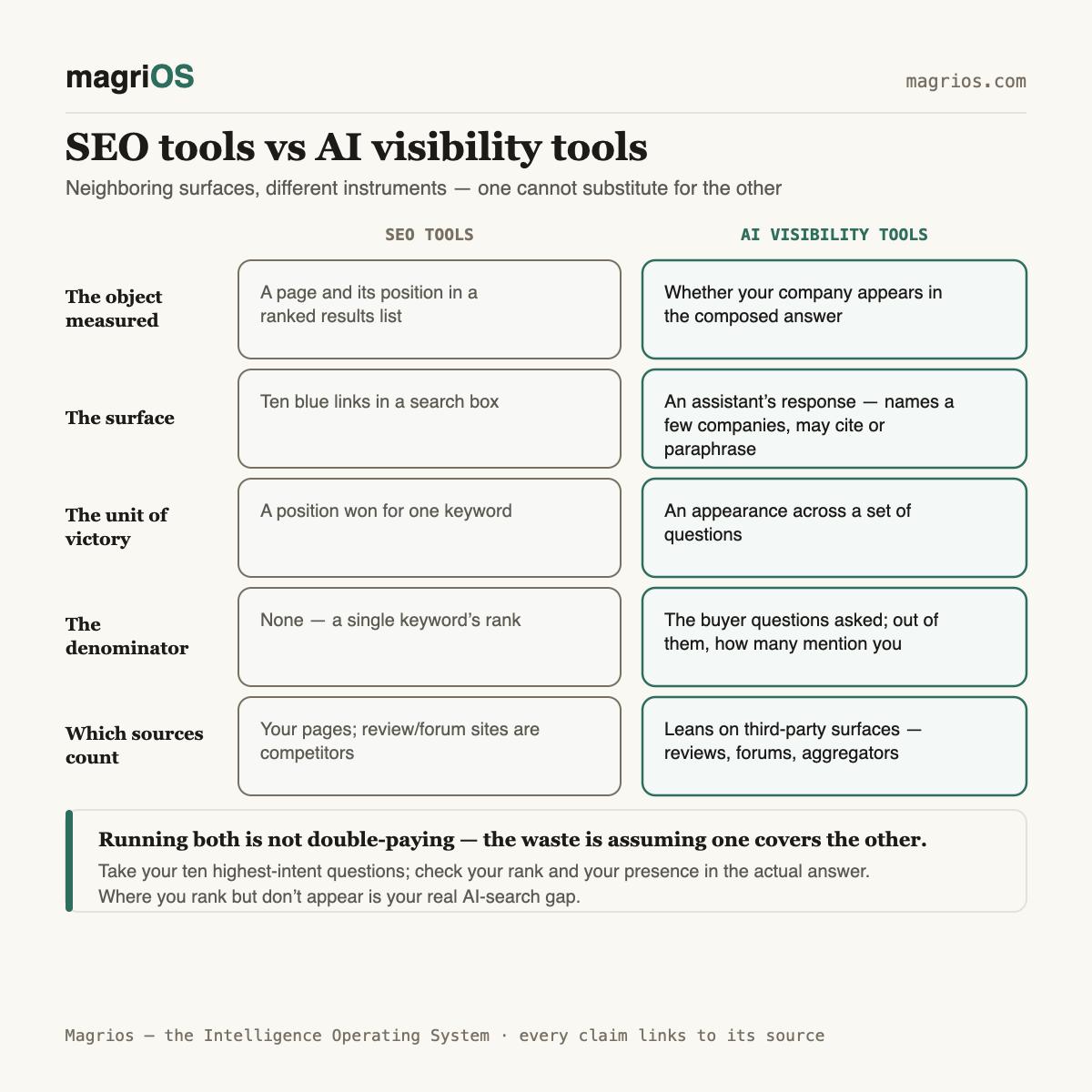
If you already pay for an SEO platform, the natural question is whether it also covers AI search. The honest answer is that it measures a neighboring surface with a different instrument, and the gap between the two is widening as buyers move research into assistants. Understanding exactly what each instrument reads keeps you from paying twice for the same blind spot.
What SEO tools measure well
SEO platforms are built around the ranked list. They track where your pages sit for a keyword, how that position moves, what backlinks point to you, how your site is structured, and which pages compete for which terms. The underlying object is a page and its position in a results ranking, and decades of tooling have made that measurement precise.
That precision is real, and for the classic search surface it is exactly what you want. If your buyers still type a query into a search box and scan ten blue links, an SEO tool tells you whether you are on that list and what it would take to climb. None of that goes away because assistants exist.
What AI answers require instead
An answer engine does not hand back a ranked list of pages. It composes a response — often naming a handful of companies, sometimes citing the sources it leaned on, frequently paraphrasing rather than linking. The object being measured is no longer "your page's rank for a keyword." It is "does your company appear in the answer to a buyer's question, and is it credited to a source you can influence."
That is a different measurement, and a rank tracker cannot perform it. Your page can rank first for a term while the assistant answering the equivalent question never mentions you, because the assistant assembled its response from review sites, community threads, and comparison content rather than from the page you optimized. Measuring AI visibility means asking the actual questions, reading the actual answers, and recording presence and citation — not scraping a ranking.
Where they overlap, and where they cannot
There is genuine overlap. The content that earns citations in AI answers and the content that ranks in classic search are often the same underlying assets: clear, specific, well-sourced pages that directly answer real questions. Work that improves one frequently helps the other, which is why teams sometimes assume one tool covers both.
The overlap breaks in two places. First, the surfaces cite different sources. AI answers lean heavily on third-party surfaces — reviews, forums, aggregators — that a page-rank tool treats as competitors rather than as the places you need presence. Second, the unit of victory differs. In classic search you win a position; in AI answers you win an appearance across a set of questions, measured against a denominator of questions, not a single keyword. An SEO tool has no concept of that denominator, so it cannot tell you the thing that matters most in AI search: out of the questions your buyers ask, how many mention you at all.
Why buying both is not double-paying
Because the instruments read different surfaces, running both is not redundancy — as long as each is scoped to what it actually measures. The waste comes from the opposite mistake: assuming your SEO dashboard's green numbers mean you are visible in AI answers, and discovering months later that buyers researching through assistants met your competitors and never you.
The evidence-first way to scope them is to let the buyer's behavior decide. Where your buyers still search classically, your SEO tool is the right instrument and its rankings are the truth. Where your buyers ask assistants — increasingly the high-intent, comparison, and "which tool should I pick" moments — you need a measurement that reads answers, tracks presence against a fixed question set, and shows you the citation surfaces feeding those answers. That is what AI visibility measurement is for, and it is a genuinely separate reading, not a feature bolt-on.
What to do with this
- Audit your current SEO reporting for the word "answer." If everything is rank- and keyword-shaped, it is silent on the surface where assistants respond.
- Keep your SEO tool for the classic surface — do not rip out a working instrument. Add AI visibility measurement for the answer surface rather than expecting one to cover both.
- Pick your ten highest-intent buyer questions and check them two ways: your rank for the equivalent keyword, and your presence in the assistant's actual answer. The cases where you rank but do not appear are your real AI-search gap, and no rank tracker will surface them for you.