SSO vs SCIM: which one enterprise buyers actually need
Comparison · Enterprise · 4 min read · last verified 2026-08-11
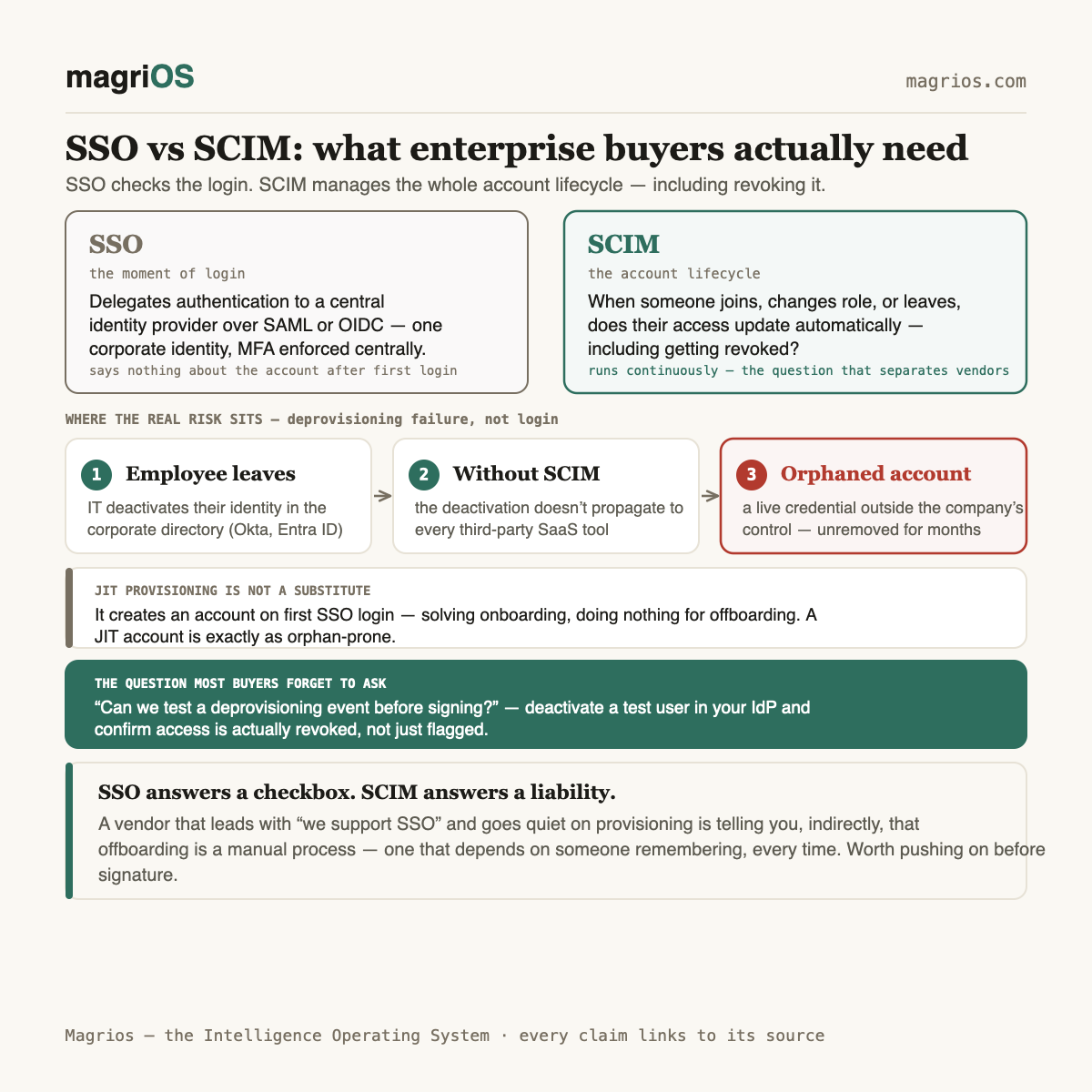
The question buyers ask, and the question they should ask
Enterprise security reviews almost always open with "do you support SSO?" It's the right first question and the wrong last one. SSO and SCIM solve two different problems, and the one that actually causes security incidents is the one buyers ask about second, if at all.
- SSO (Single Sign-On), built on protocols like SAML or OIDC, answers: when someone tries to log in, are they who they say they are, and can they use one corporate identity instead of a separate password for every app?
- SCIM (System for Cross-domain Identity Management) answers a different question: when someone joins, changes role, or leaves the company, does their access in this app update automatically — including getting revoked?
SSO is about the moment of login. SCIM is about the lifecycle of the account, from creation to deletion. A vendor can have excellent SSO and no SCIM at all, and that combination is far more common — and far riskier — than buyers tend to assume going in.
Why the distinction gets missed
SSO is the recognizable term. It shows up in nearly every security questionnaire, every vendor comparison sheet, and every "enterprise-ready" marketing page. SCIM is unglamorous and shows up mostly in identity and access management (IAM) documentation, which means it's often skipped by buyers who aren't specifically looking for it.
The result: a vendor advertises "Enterprise SSO" prominently, a buyer checks the box, and nobody asks the follow-up question — what happens to that person's account in this tool the day they're terminated?
Where the real risk sits: deprovisioning, not login
Login-time authentication gets the security attention because it's visible and testable in a demo. Deprovisioning failure is invisible until an audit or an incident finds it — and it is the more common real-world failure mode:
- An employee leaves the company. IT deactivates their identity in the corporate directory (e.g., Okta, Entra ID).
- Without SCIM, that deactivation does not propagate to every third-party SaaS tool the employee had access to. Their account in each of those tools stays active until someone manually notices and removes it — which, across dozens or hundreds of SaaS apps, often doesn't happen for months, if ever.
- That orphaned account is a live credential outside the company's control, in a tool the security team may not even be actively monitoring.
This is exactly the scenario SOC 2 and ISO/IEC 27001 audits probe for under access control and user lifecycle management, and it's the scenario security teams have the hardest time proving they've closed across a sprawling SaaS footprint without automated deprovisioning.
SCIM automates that removal: when the identity provider deactivates a user, SCIM pushes that change to every connected app, deprovisioning the account without a human remembering to do it.
What each one technically does
SSO:
- Delegates authentication to a central identity provider (IdP) — Okta, Entra ID (Azure AD), Google Workspace, Ping, etc.
- Runs on SAML (older, XML-based, still dominant in large enterprises) or OIDC (newer, built on OAuth 2.0, more common in modern stacks).
- Reduces password sprawl and lets IT enforce MFA and conditional access centrally.
- Says nothing about what happens to the account after the first login.
SCIM:
- A standard protocol (formalized as a set of IETF RFCs) for automating user provisioning, attribute updates (name, title, department, role), and deprovisioning between an identity provider and downstream applications.
- Runs continuously in the background, not just at login — it syncs whenever the source-of-truth directory changes.
- Directly enforces the principle that access should exist only as long as it's needed, and disappear promptly when it isn't.
Just-in-time provisioning is not a substitute for SCIM
Some vendors offer "JIT provisioning" through SAML or OIDC — an account gets created automatically the first time someone logs in via SSO. This solves onboarding friction but does nothing for offboarding: JIT has no mechanism to notice that a user was deactivated upstream. Without SCIM (or a manual offboarding process), a JIT-provisioned account is exactly as orphan-prone as a manually created one.
What enterprise buyers should actually ask
- "Do you support SAML or OIDC for SSO?" — table stakes, but confirm which one, since some legacy IdPs only speak SAML.
- "Do you support SCIM for provisioning and deprovisioning?" — the question that actually separates vendors.
- "If SCIM isn't supported, what's your offboarding process when we deactivate a user in our IdP?" — if the honest answer is "the admin has to remove them manually," that's a real gap to weigh, not a dealbreaker by default, but a genuine risk to price into the decision.
- "Can we test a deprovisioning event before signing?" — deactivate a test user in your IdP and confirm access in the vendor's app is actually revoked, not just flagged.
The practical takeaway
SSO answers a checkbox. SCIM answers a liability. A vendor that leads with "we support SSO" and goes quiet on provisioning is telling you, indirectly, that offboarding in their product is a manual process — which means it's an offboarding process that depends on someone remembering, every single time, across every customer. For anything handling sensitive data, that's the gap worth pushing on before signature, not after the first ex-employee access audit turns up a stale account.