The honest listicle: answering 'best X' questions without lying
Guide · AI Visibility · 5 min read · last verified 2026-08-11
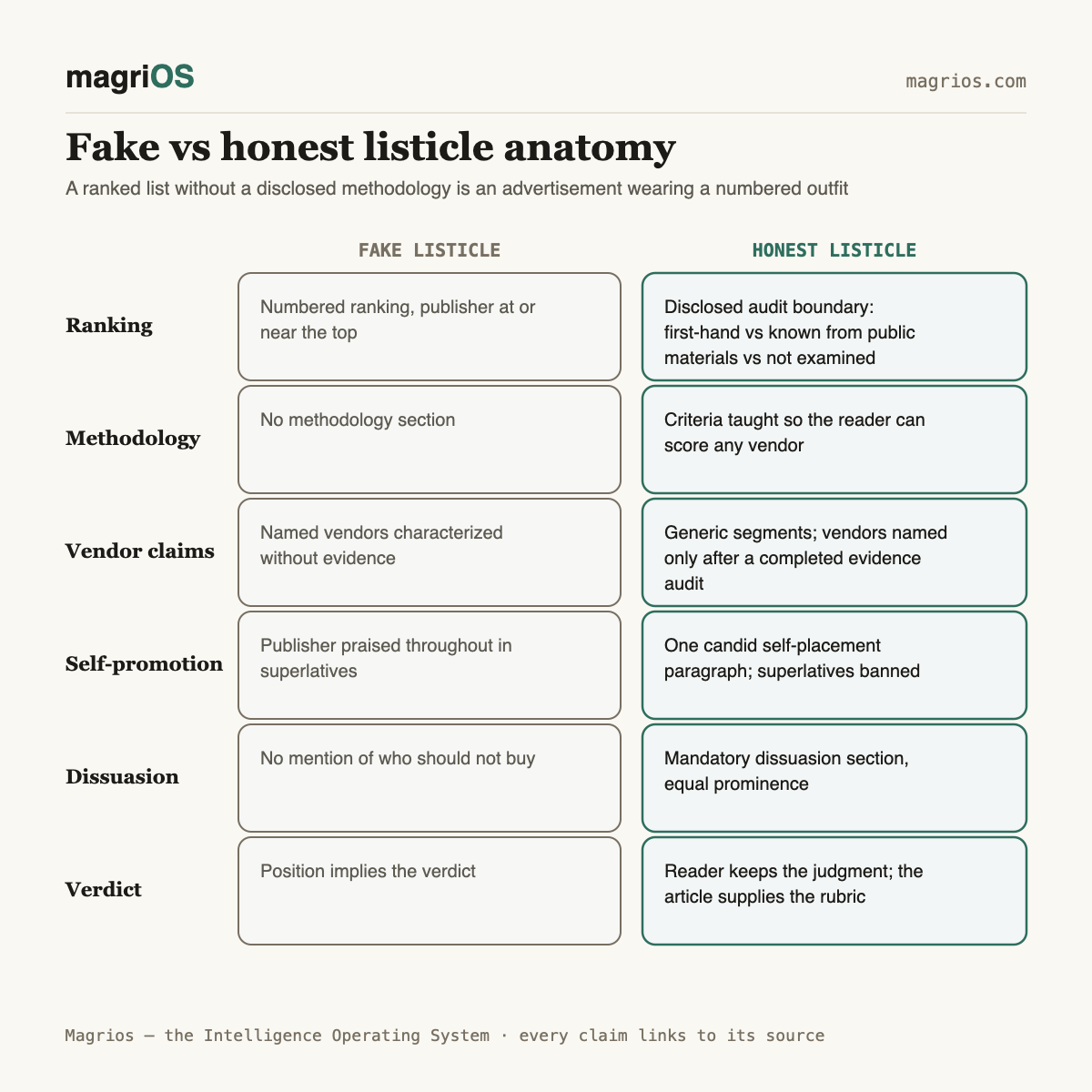
A ranked list without a disclosed methodology is an advertisement wearing a numbered outfit. The honest way to answer a "best X" question has four parts: declare what you have and have not audited, teach the reader the criteria that actually separate the options, describe the category's segments in generic terms, and place yourself in exactly one candid paragraph. What follows is the editorial method we apply to our own listicles, published so anyone can adopt it.
Why fake rankings persist
The economics are straightforward. Ranked lists convert: a numbered format with the publisher near the top lets the layout do the persuading, so no individual sentence has to make a claim that could be challenged. Readers skim: position is read as verdict, and the methodology section — usually absent — is the part nobody scrolls to. And nobody audits the auditor: no institution checks whether a "best tools" article evaluated anything, so the cost of fabrication is deferred.
Deferred, not waived. Every undisclosed ranking is a claim the publisher cannot defend when a reader eventually asks how it was produced. The reader who chooses the third entry and discovers it fits them badly does not conclude the category is hard; they conclude the list was decoration. Authority is a stock that fake rankings spend and honest ones accumulate, and the spending is invisible until a specific reader, on a specific day, checks.
The four-part method
Declare the audit boundary. Open by separating what you have evaluated first-hand, what you know only from vendors' public materials, and what you have not examined at all. One paragraph of disclosure changes the genre: the article stops asserting a verdict it cannot support and starts describing the limits of its own knowledge.
Teach the criteria. The durable value of a "best X" piece is the rubric, not the roster. Explain the dimensions that actually separate options in the category and why each matters. A reader who leaves able to score any vendor — including ones you never mentioned — got something no ranking can give.
Describe segments, not vendors. "The category splits into lightweight trackers, broad suites, and service-led offerings, and the trade-off is depth against coverage" is verifiable from the category's structure. "This vendor is the most reliable" is not verifiable by you at all. Generic segmentation gives the reader a map without requiring claims about companies you have not audited.
Place yourself in exactly one paragraph. Say which segment you occupy, which reader you fit, which reader you do not, and what choosing you costs.
Three writing rules keep the method from decaying. No named vendor may be characterized without a completed evidence audit — until then, categories only. A dissuasion section is mandatory: who should not buy from you, stated with the same prominence as who should. And the self-placement paragraph bans superlatives — "best," "leading," and "most" do not survive editing; fit language replaces them. Magrios's own answer to What are the best AI visibility monitoring tools is written under exactly these rules, so the method can be checked against a live artifact.
Deep dive: the evidence-audit bar
The rule that hides the most work is the first one. Naming a competitor honestly requires a dossier: their public claims collected from their own pages, each fetch dated so you can say "as of the day we checked" and know when re-verification is due; your paraphrase of each claim checked against the source wording, because paraphrase drift — restating their claim as a version easier to beat — is how honest intentions produce dishonest comparisons; and a published comparison that includes the dimensions where the competitor wins. That last requirement is the test. A comparison that cannot name one thing the other product does better is not an audit; it is positioning wearing an audit's clothes.
Edge cases decide whether the bar means anything. Marketing pages and documentation frequently disagree, so the dossier must record which source said what — auditing only the marketing page audits the claim, not the product. Claims drift after publication, which is why undated fetches quietly rot into misrepresentation. And selective quotation — accurate sentences arranged to imply something the source does not say — passes a fact-check while failing the audit. The bar is deliberately expensive; the point is that below it, the honest move is staying generic. That is not evasion. It is precision about the boundary of your knowledge — the same standard described in Evidence-first AI: what it means and how to verify a vendor's claim to it, applied to editorial instead of software.
Answer engines raise the stakes
Assistants compress sources into verdicts and strip the provenance. When a ranking with no methodology is ingested, its positions re-emerge as fact-shaped sentences in generated answers, and later content citing those answers compounds the pollution: fabricated order hardens into apparent consensus with no author left to question. This changes the calculus in two directions. For publishers, honest structure — disclosed boundaries, explicit criteria, candid placements — is safer for an engine to extract and reuse, which turns the discipline into an asset. For readers, a ranked answer from an assistant inherits the reliability of the lists beneath it, which is one reason Why AI chat alone cannot carry strategic decisions treats generated verdicts as leads to verify rather than conclusions to act on.
What ranked lists do better
Equal candour requires conceding the format's genuine strengths. A ranked list is fast, and for low-stakes choices speed is the correct optimization: when a wrong pick costs little and switching is cheap, working through a rubric is more expensive than the mistake it prevents. Ranked lists also force a decision — the four-part method hands judgment back to the reader, and a reader who wants an answer rather than an education is entitled to that preference. In mature categories where products have converged, picking near the top of any reasonably candid list is rational. The honest method earns its cost where choices are expensive to reverse and the differences between options are real — which is exactly the territory where fake rankings do their damage.