The six-row decision trace: a reproducible method
Guide · AI Visibility · 5 min read · last verified 2026-08-11
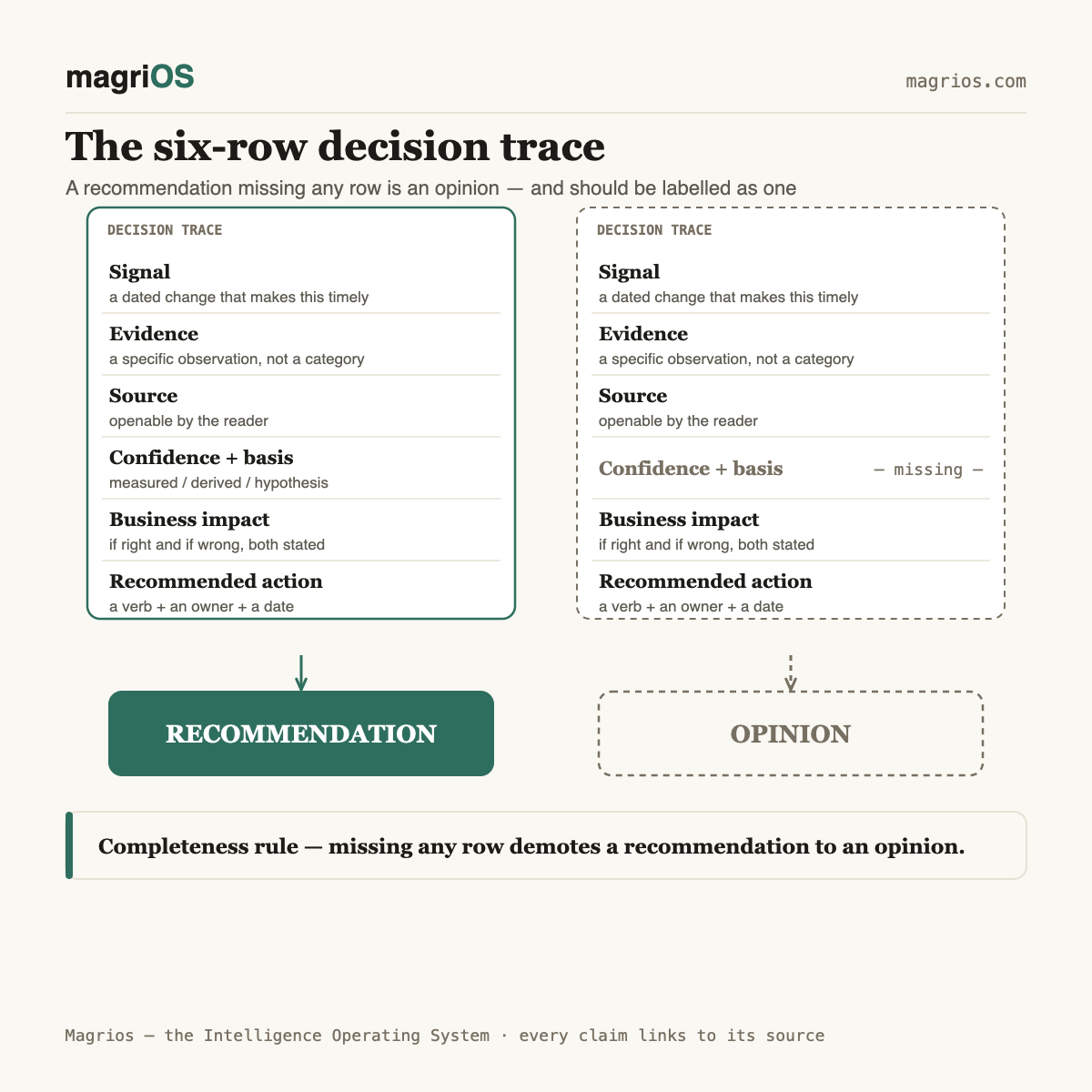
A six-row decision trace documents the reasoning behind a strategic recommendation in six fixed rows: the signal that triggered it, the evidence supporting it, the source of that evidence, the confidence level with its basis, the business impact at stake, and the recommended action. The completeness rule gives the method its force: a recommendation missing any row is an opinion, and should be labelled as one. Because the rows never change, the method is reproducible — two people tracing the same recommendation should produce structurally identical documents that disagree only on substance.
This is the working companion to What is decision traceability, and why enterprises should demand it, which defines the concept and makes the case for requiring it. This piece assumes the case is made and teaches the practice.
The discipline of each row
Signal
The signal is the change in the world that made this recommendation timely now rather than last quarter. It qualifies if it names an event with a date. It fails if it restates the conclusion — "the market is attractive" is not a signal; it is the recommendation wearing a different sentence.
Evidence
Evidence is the specific observation that supports the recommendation: a filing, a pricing change, a hiring pattern, a customer statement. It fails when it is a category rather than an observation. "Market data suggests" is a gesture at evidence, not evidence.
Source
The source must be openable by the reader — a link, a document reference, a dated interview note. If the reader cannot reach it without asking the author, the row fails. "Internal analysis" and "industry sources" are the two most common ways this row is faked.
Confidence, with basis
Confidence must carry its basis: measured (someone counted), derived (computed from measured inputs), or hypothesis (plausible, adopted for planning purposes, not yet tested). A confidence word without a basis — "high confidence" floating alone — is decoration. The reader audits the basis, not the adjective.
Business impact
State what changes if the recommendation is right and what it costs if it is wrong. The row fails when only the upside appears. A trace that cannot articulate the cost of being wrong has not thought about being wrong.
Recommended action
An action is a verb with an owner and a date. "Explore", "consider", and "monitor" are directions, not actions, and they fail the row. If nobody can be late on it, it is not yet a recommendation.
Writing traces people actually read
Three habits keep traces short enough to survive contact with readers. One sentence per row — a trace is a table, not an essay, and a row that needs a paragraph is thinking that is not finished. Links, not summaries — the source row points at the document; it does not paraphrase it, because paraphrase is where drift enters. And the trace travels with the recommendation — same page, same slide, same message — never in an appendix. An appendix trace is read by nobody and audited by nobody, which makes it ceremony.
Deep dive: trace failure modes from practice
Three failure modes recur, and each defeats a casual reviewer because the trace looks complete.
The plausible-but-empty trace has every row filled with restatements of the other rows. The signal restates the action, the evidence restates the signal, and the impact restates the evidence with the word "significant" added. The test: cover the recommendation row and ask whether the remaining five rows point uniquely to it. In an empty trace they point everywhere, because they carry no independent content.
The orphaned trace was honest on the day it was written, but its evidence links rot. Dashboards get rebuilt, documents move, the interview note lives in a departed employee's folder. The trace passes review at publication and fails silently months later — exactly when a disputed decision sends someone back to check it.
The laundered trace dresses derived confidence as measured. A model output or a colleague's estimate enters the confidence row as though someone had counted something. Nothing in the wording betrays it; only following the source reveals that the basis is a computation resting on assumptions nobody listed.
One audit ritual catches all three. Monthly, pick three traces at random. Click every link — that exposes orphans. Re-derive one conclusion from the evidence alone, without reading the recommendation — that exposes empty traces, because the evidence will not carry you to the conclusion. Check each confidence basis against what the source actually is — that exposes laundering. The ritual costs an hour, and it is the difference between a tracing culture and tracing theatre.
Traces in the AI era
A trace is what lets a human audit an AI recommendation without reading its mind. Chain-of-thought is narrative a system produces about itself, and narrative can be fluent without being faithful. A trace makes external commitments — this source, this basis, this impact — that can be checked without any access to the system's internals. That distinction is why traceability, not introspection, is the auditable property to demand from machine-generated recommendations; the trust argument behind it is developed in Enterprise trust in AI systems: refusals and receipts. A live example of machine-produced traces in this format runs at magrios.com/engine.
The honest cost
Tracing slows publishing, and no framing removes that. Six disciplined rows per recommendation is real overhead, and an untraced opinion in a hallway conversation is often exactly the right instrument. The discipline pays only where decisions have owners and budgets — where someone will act, spend, and later be asked why. Trace those, and let everything else stay conversation. The audience that needs traces is the one described in Corporate intelligence for operators, not analysts: people who act on recommendations rather than admire them. Applying the six rows to every passing message does not raise standards — it teaches people that the rows are ceremony, which is the fastest way to lose them where they matter.