Market Intelligence With No Named Owner Never Changes a Decision
Guide · Continuous Intelligence · 5 min read · last verified 2026-08-11
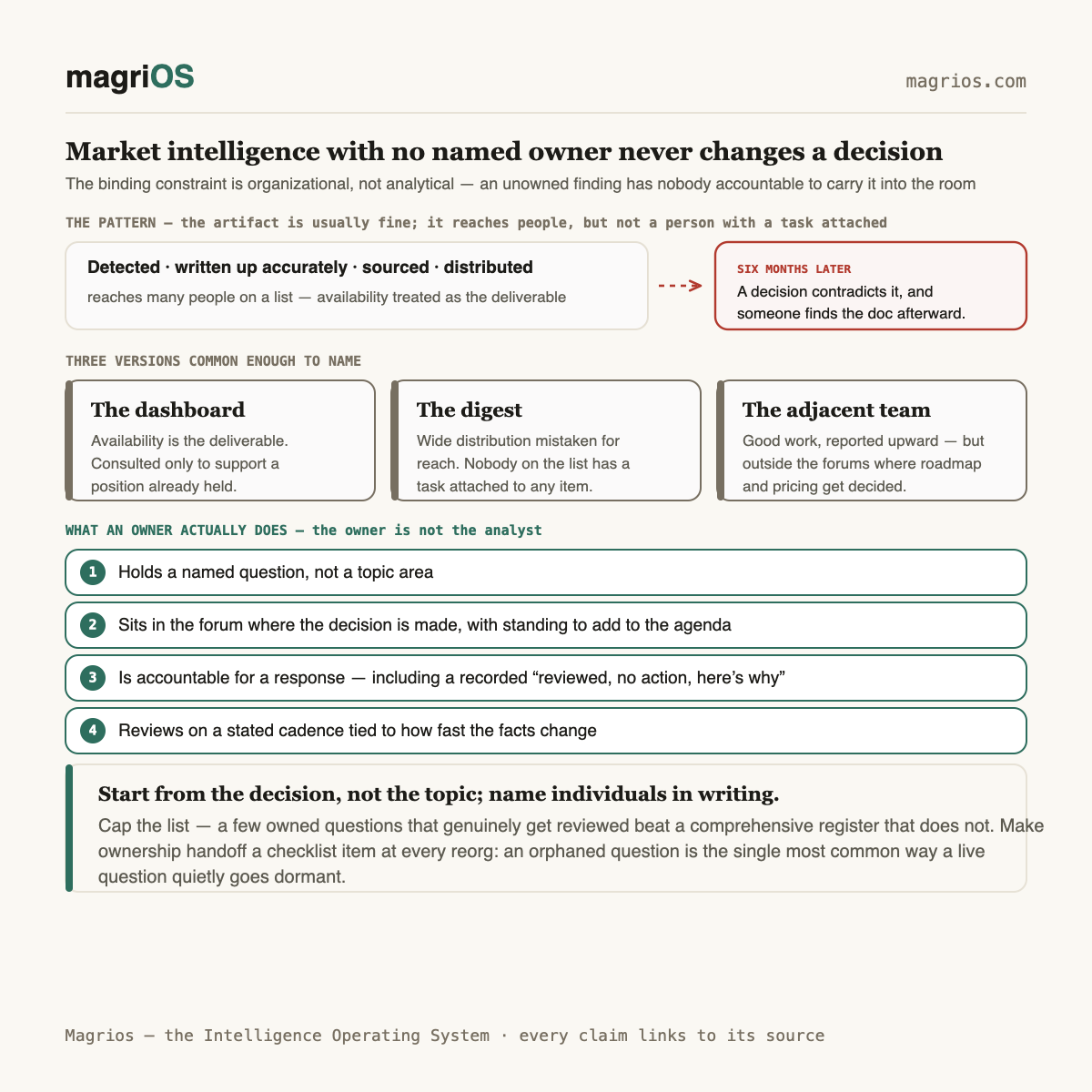
Market intelligence with no named owner does not change decisions, because the binding constraint is organizational rather than analytical — an unowned finding has nobody accountable for carrying it into the room where the decision is actually made.
The pattern
The artifacts are usually fine. A competitor's move is detected, written up accurately, sourced properly, and distributed. Six months later the company makes a decision that contradicts it, and someone discovers the document afterward. The reaction is to question the analysis or the distribution: the report should have been shorter, the dashboard more prominent, the alert more urgent.
None of those was the problem. The finding reached people. It did not reach a person who was accountable for doing something about it.
Three versions of this are common enough to name:
- The dashboard. Competitive data is centralized and made available to everyone. Availability is treated as the deliverable. It is consulted when someone is already looking for support for a position.
- The digest. A recurring roundup goes to a wide list. Wide distribution is mistaken for reach. Nobody on the list has a task attached to any item in it.
- The adjacent team. A competitive or research function produces good work and reports it upward, but sits outside the forums where roadmap, pricing, and go-to-market decisions are made. Their findings enter those rooms only when someone else chooses to carry them.
Why ownership, not quality, is the binding constraint
Decisions are made by people with a stake in a specific outcome, under time pressure, using whatever inputs are in front of them. An input with no advocate competes badly against inputs that arrive with one.
- Accuracy does not travel on its own. A correct finding and an incorrect one both need someone to raise them. The correct one has no structural advantage.
- Attention is allocated by accountability. People read closely when they will be asked about it. Nobody is asked about a digest.
- Shared responsibility resolves to none. When a topic belongs to a function rather than a person, every individual can reasonably assume someone else has it.
- Decision forums have fixed agendas. Getting an item onto one requires standing, and standing belongs to individuals, not to documents.
This is why raising analytical quality often fails to change the outcome. A more rigorous evidence trail makes a finding more defensible once it is being argued. It does not get it argued.
What an owner actually does
The owner is not the analyst. The analyst produces the finding; the owner is accountable for what the organization does about it. Frequently the same person cannot do both well, because the skills and the standing differ.
An owner:
- Holds a named question, not a topic area. "Whether the low-end entrant is changing our win rate in mid-market" is ownable. "Competitive landscape" is not.
- Sits in a forum where the corresponding decision gets made, with the standing to add an item to the agenda.
- Is accountable for a response, including an explicit decision not to respond. Recording "reviewed, no action, here is why" is a legitimate and underused output.
- Reviews on a stated cadence tied to how fast the underlying facts change, rather than reacting to whatever arrived that week.
Where ownership breaks down
- Reorganization orphans the question. Ownership was attached to a role that no longer exists, and no handoff occurred. This is the single most common cause of a live question quietly going dormant.
- The question spans two functions. Pricing sits between product and sales; a competitor's channel move sits between partnerships and marketing. Split ownership behaves like no ownership.
- The owner lacks authority to act. Someone accountable for a finding but unable to fund or sequence a response will stop raising it after the second time nothing happens.
- Findings arrive off-cycle. A signal that surfaces two weeks after the planning meeting has no forum until the next one, and owners without a mechanism for off-cycle escalation absorb it silently.
Assigning ownership without building a bureaucracy
- Start from the decision, not the topic. List the decisions the organization expects to make in the next few quarters, then attach a question to each. Questions with no corresponding decision should not be owned; they should be dropped.
- Name individuals in writing. A person, not a team. If nobody accepts the name, that is the finding.
- Cap the list. A small number of owned questions that genuinely get reviewed beats a comprehensive register that does not.
- Standardize what gets asked each cycle so that reviews compare like with like — the function of a benchmark question set.
- Make the handoff explicit at reorganization. Ownership transfer should be a checklist item when roles change, in the same way system access is.
- Record decisions, not just findings. The record of what was decided and why is what makes the next review fast, and it is what prevents the same question being reopened from zero.
The limits of this fix
Ownership is necessary and not sufficient, and overstating it produces its own failures.
An owner cannot overcome a decision already made for other reasons — strategic commitments, investor expectations, and executive conviction routinely outweigh a well-owned finding, and sometimes correctly. Some findings should be ignored: not every competitor move warrants a response, and an owner incentivized to demonstrate impact will manufacture responses to justify the role. Ownership also does not improve the underlying evidence; a confidently owned wrong answer travels further than an unowned right one, which is an argument for keeping analytical rigor and ownership as separate requirements rather than trading one for the other.
And more monitoring does not help here at all. An organization that cannot act on the signals it already has does not benefit from receiving more of them — the additional volume makes the ownership gap harder to see, not easier. The question of whether to invest in broader coverage, discussed in continuous market intelligence, only becomes worth asking after the ownership question has been answered.