Market Share Moves a Full Buying Cycle After Awareness Does
Guide · Market Growth · 4 min read · last verified 2026-08-11
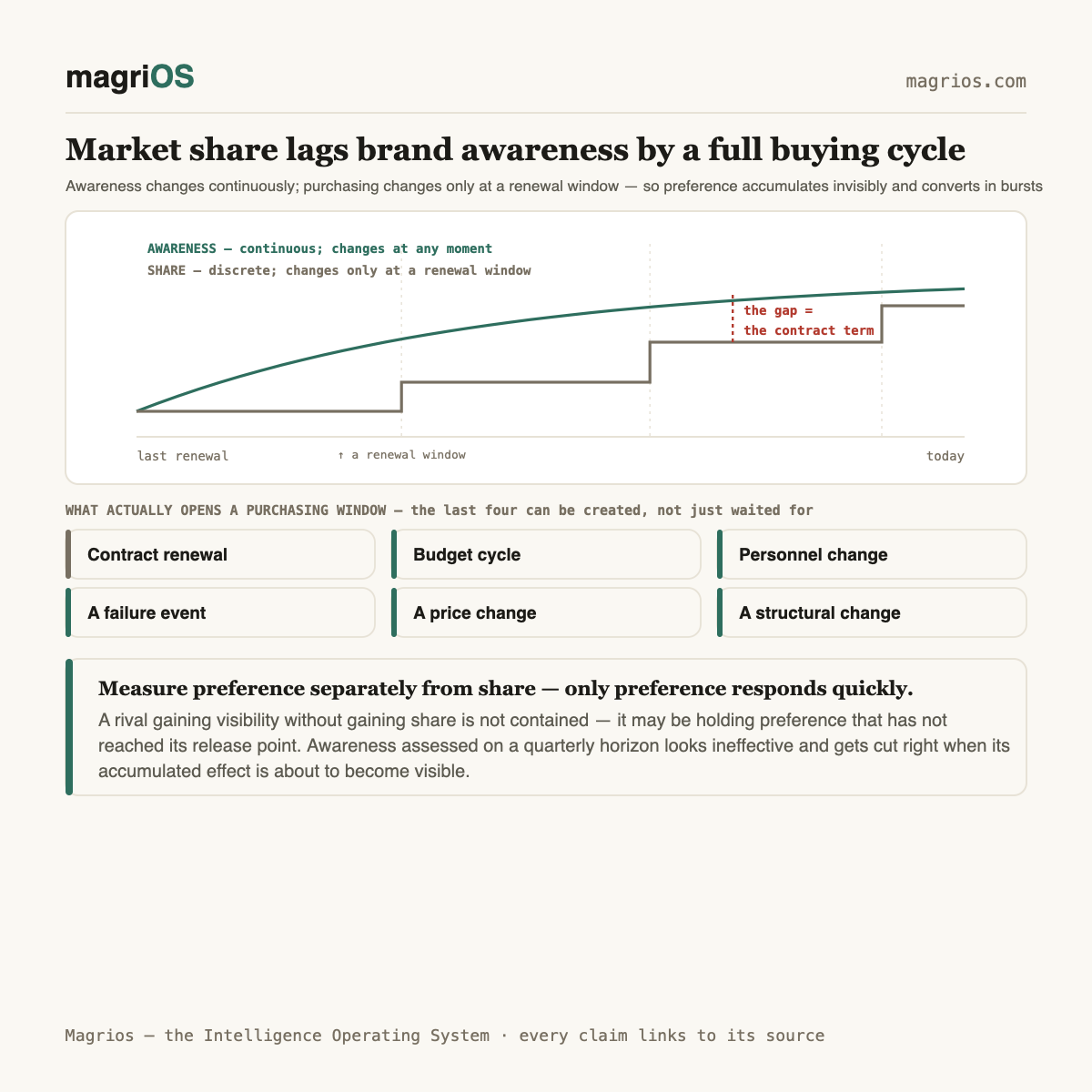
Market share lags brand awareness because awareness can change at any moment while purchasing can only change during a renewal window, and in contractual business software those windows open once a year at most. A company can become well known across a category and still hold the same share for several quarters, not because the awareness failed to convert but because there was no moment at which conversion was possible.
The mechanism
Consumer intuition assumes awareness and purchase sit close together: someone learns about a product and can act immediately. Contracted software breaks that link. Between learning about an alternative and being able to buy it sits a contract with a remaining term, a budget cycle that allocated funds elsewhere, and a switching cost that has to be scheduled rather than simply paid.
The result is that demand accumulates invisibly and releases in bursts:
- Awareness is continuous. It changes whenever content is published, a peer mentions something, or a launch gets attention.
- Purchasing is discrete. It changes only when a contract comes up, a budget opens, or a triggering event forces the question early.
- The gap between them is the contract term. With annual terms, a buyer persuaded shortly after renewal waits nearly a year before acting. With multi-year terms, the wait can be considerably longer, and the persuasion may have to survive a change of personnel before it can be acted on.
- None of the delay is visible. A buyer who has decided to switch but cannot yet act looks identical to a satisfied one, because both renew on schedule and neither produces a signal until the window opens.
Averaged across a customer base with staggered renewal dates, only a fraction of accounts are in a position to move in any given quarter. Even perfect persuasion of every account converts slowly, because most accounts are structurally unable to respond.
Why this misleads teams
The lag creates two symmetrical errors, and organizations tend to commit both in sequence.
- Abandoning campaigns before they can pay off. Awareness work assessed on a quarterly horizon looks ineffective, because most of the population it reached could not act inside that horizon. The work gets cut roughly when its accumulated effect is about to become visible.
- Attributing the eventual wins elsewhere. When conversion arrives, it arrives near a renewal, so it is naturally credited to whatever touched the deal last. The awareness that created the preference months earlier is invisible in the attribution.
- Misreading a competitor's position. A rival that has become highly visible but has not moved share yet looks contained. It may simply be holding preference that has not reached its release point.
- Assuming a decline is over. Awareness lost earlier continues converting into share loss for as long as the contract cycle takes to work through, so a stabilized brand can precede continued share erosion.
What actually opens a window
Renewal dates are the largest source of purchasing windows, but they are not the only one, and the others matter because they can be created rather than waited for.
- Contract renewal. The scheduled, predictable window.
- Budget cycle. New funds allocated at the start of a fiscal period, which sometimes precedes renewal.
- Personnel change. A new owner of a function reviews inherited tools, and inherited decisions carry no personal commitment.
- A failure event. An outage, a security incident, a support escalation, or a billing dispute converts a background preference into an active evaluation.
- A price change. An increase at renewal reopens a question that would otherwise have been answered by default.
- A structural change. A merger, reorganization, or system migration forces re-evaluation of the whole stack.
The last four are why share sometimes moves faster than the contract cycle implies. Accumulated preference sits waiting, and any of these events releases it early.
What follows from this
Treating awareness and share as the same measurement on different scales guarantees misreading both. They are better handled as separate quantities linked by a delay.
- Measure preference separately from share. Whether buyers would choose you if they could is a different question from whether they have, and only the first responds quickly to anything.
- Track renewal timing where it is knowable. Public-sector contracts, disclosed agreements, and buyer-reported terms indicate when segments of a market become addressable.
- Judge awareness work on a horizon at least as long as the category's contract term. Assessing annual-cycle demand on a quarterly basis measures noise.
- Build for the window rather than for the moment. Material that a buyer can act on later matters more than material that requires acting now, because most of the audience cannot act now.
- Watch for accumulation in competitors. A rival gaining visibility without gaining share is not necessarily failing. The relevant question is what happens when its audience's contracts come up.
The uncomfortable implication is that the feedback loop on positioning work is longer than most planning cycles. A repositioning judged after two quarters is being judged before the market has had an opportunity to respond. That is not an argument for patience with work that is not landing — preference can be measured directly, and if preference has not moved, nothing is accumulating. It is an argument for measuring the thing that can move now, rather than the thing that can only move later.