In mature markets, integration depth beats feature count
Guide · Market Growth · 4 min read · last verified 2026-08-11
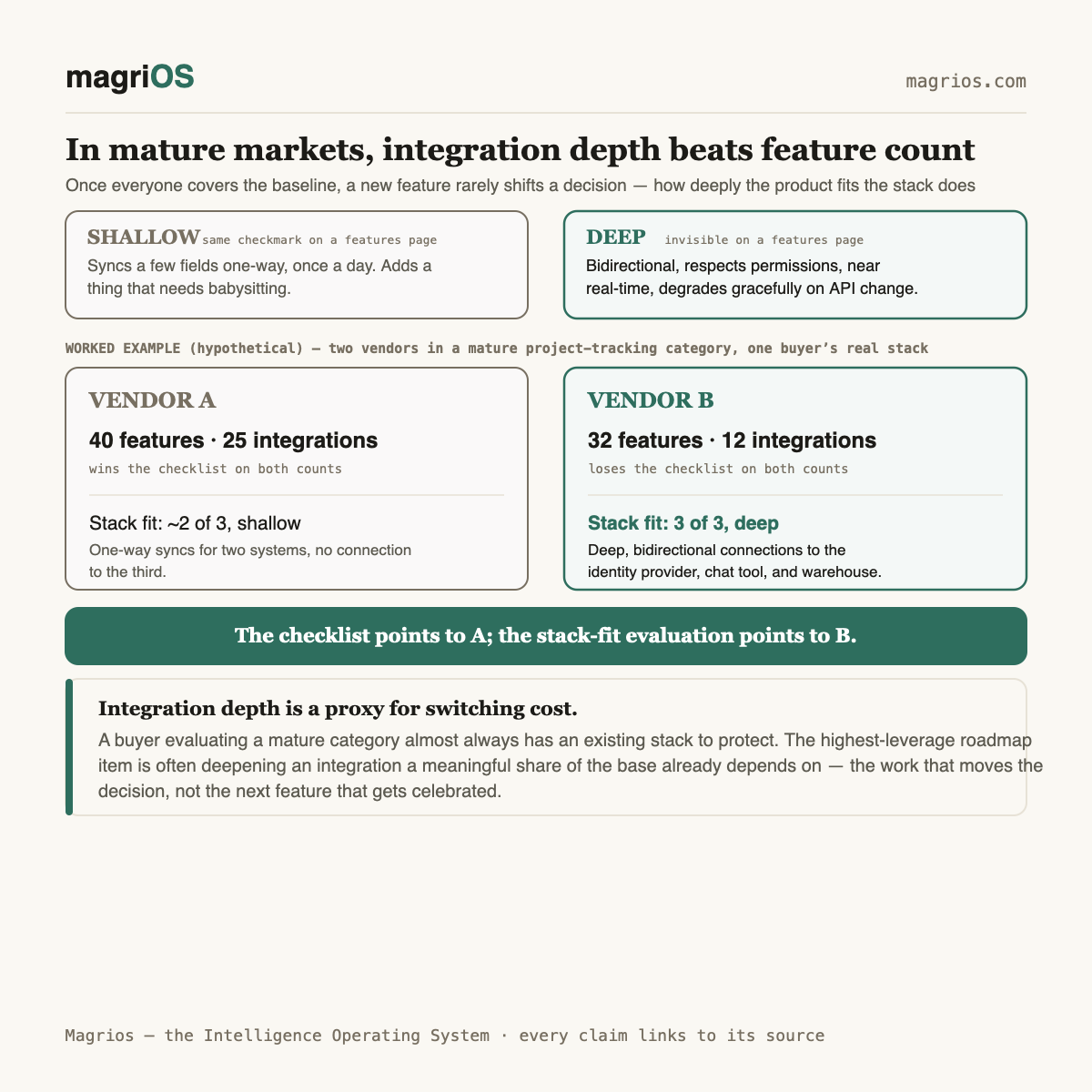
In mature markets, most competitors already cover the baseline feature set, so a new feature rarely shifts a buyer's decision. What does shift it is how deeply a product fits into the buyer's existing stack — fewer workarounds, fewer manual steps, less operational risk from swapping tools.
Why feature parity becomes the norm in mature markets
Early in a category's life, features are genuinely differentiating — being the first tool to solve a problem at all is a real advantage. But features are also the easiest thing for competitors to copy. Within a few product cycles, most serious players in a mature category have converged on roughly the same core capability set, because the market itself has told everyone what "table stakes" looks like. At that point, a comparison built purely on feature checklists starts to look nearly identical across five or six vendors, which is exactly the pattern that shows up when you look at how a mature category gets described: the differentiators buyers actually cite tend to sit outside the checklist.
This convergence isn't a sign that products have stopped improving — it's a sign that improvement has moved somewhere the checklist doesn't capture well. A feature comparison table is a snapshot of capability; it says nothing about how much friction it takes to get that capability actually working inside a specific buyer's environment.
What "integration depth" actually means
Integration depth isn't just "do you have an integration with tool X." A shallow integration might sync a few fields one-way, once a day. A deep integration handles bidirectional sync, respects the other system's permission model, updates in near real time, and degrades gracefully when the other system changes its API. The difference between those two is invisible on a features page — both would get the same checkmark — but it's the entire difference in whether the integration actually reduces a buyer's operational burden or just adds a new thing that needs babysitting.
Depth also extends to how many systems a product connects to well, versus how many it merely claims to connect to. A long list of "supported integrations" that are each shallow is often worse for a buyer than a short list of integrations that are genuinely deep, because the shallow ones create the appearance of fit without delivering it — and the gap only becomes visible after the buyer has already switched.
Why buyers weight integration higher as markets mature
A buyer evaluating a category for the first time has no existing stack to protect — they're building from scratch, so features matter more than fit. A buyer evaluating a mature category almost always has an existing stack, built up over years, and switching costs are a real part of their decision even when they don't say so explicitly. Integration depth is effectively a proxy for switching cost: the deeper a new tool integrates with what's already there, the less the buyer has to rebuild, retrain, or risk breaking.
This is part of why discounting doesn't reliably move buyers in mature categories the way it can in early ones — a lower price doesn't offset a shallow integration, because the cost the buyer is actually worried about isn't the subscription fee, it's the operational risk of the switch. That dynamic is covered from the pricing side in how discounting affects category perception, and from the switching-cost side in why free migrations cost more than discounts.
Hypothetical example: comparing two vendors on features vs. integration
Take a hypothetical comparison between two vendors in a mature project-tracking category. Vendor A lists 40 features and 25 integrations; Vendor B lists 32 features and 12 integrations. On a checklist basis, Vendor A wins on both counts. But in this hypothetical, when a buyer maps their actual stack — an identity provider, a chat tool, and a data warehouse — Vendor B's smaller integration list happens to include deep, bidirectional connections to all three, while Vendor A's longer list includes only shallow, one-way syncs for two of the three and no connection at all to the third.
For this specific buyer, the checklist comparison (40 features and 25 integrations versus 32 and 12) would point to Vendor A, but the fit comparison — 3 of 3 stack systems deeply covered versus roughly 2 of 3 covered shallowly — points to Vendor B. The features page never surfaces that difference; only a stack-specific evaluation does, which is exactly the evaluation most buyers in mature markets are quietly running even when the vendor comparison page doesn't show it.
How this shows up in AI-generated comparisons
When a buyer asks an AI assistant to compare tools in a mature category, the model is drawing on whatever comparison content exists — and most published comparison content is still feature-checklist-shaped, because that's the easiest thing to produce and the easiest thing for a model to summarize. This creates a gap: the content driving AI-generated comparisons often under-represents integration depth, the exact dimension mature-market buyers weight most.
Closing that gap means publishing content that documents integration depth specifically — not just a list of supported tools, but what "deep" looks like for each one — so that a model has something more substantive than a checkmark to draw from when a buyer's question implies a stack-fit concern rather than a pure feature question.
What to build instead of the next feature
In a mature category, the highest-leverage roadmap item is often not a new feature at all — it's deepening an existing integration that a meaningful share of the buyer base already depends on. That work rarely shows up on a features page and rarely gets celebrated the way a new feature launch does, but it's the work that actually moves a mature-market buyer's decision, because it directly reduces the switching cost that's quietly sitting underneath every "which tool should we pick" conversation.