Why probability-weighted pipeline systematically overstates the quarter
Guide · Sales · 5 min read · last verified 2026-08-11
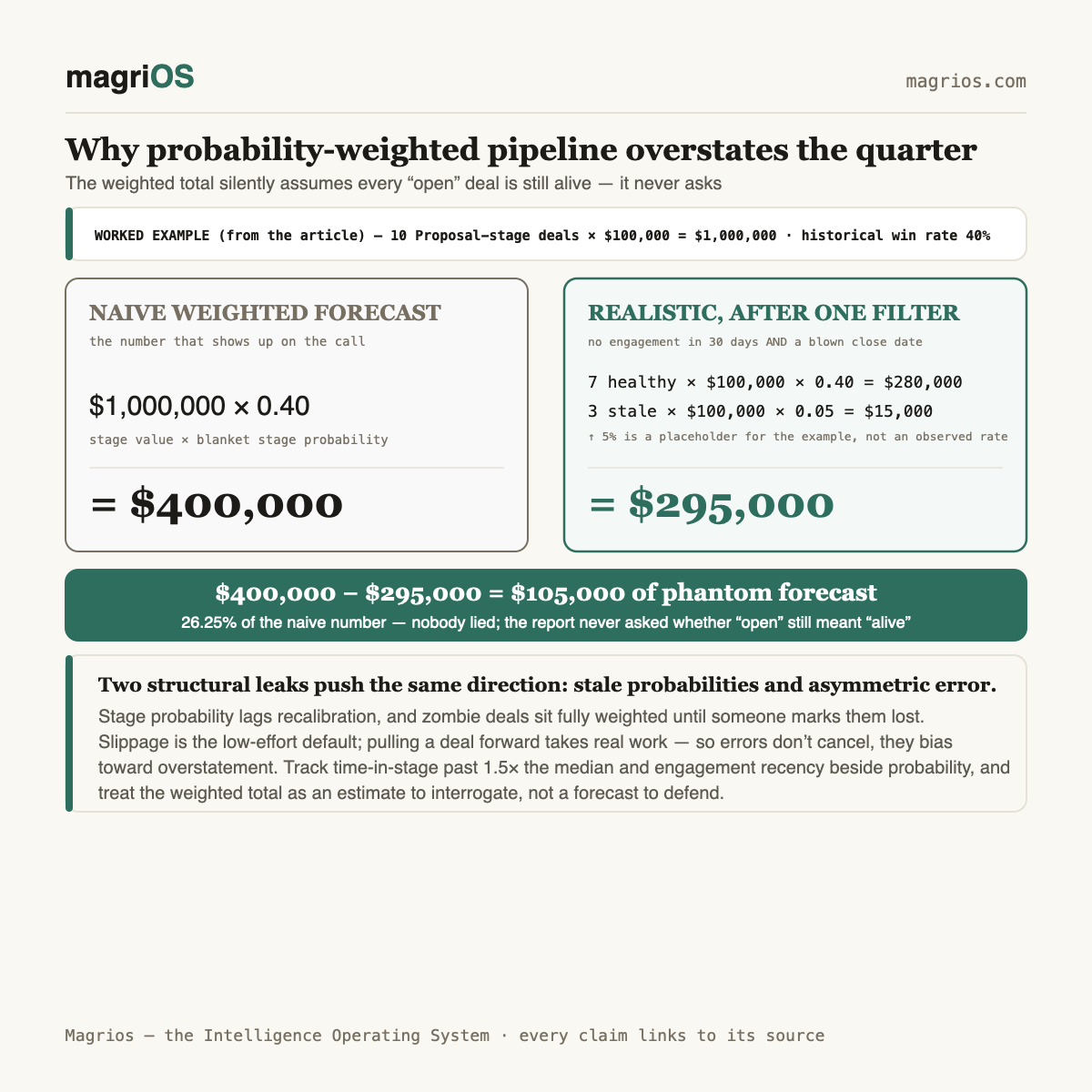
The arithmetic every forecast call depends on: a worked example
Probability-weighted pipeline is a simple multiplication repeated across every open deal: take each opportunity's value, multiply by the probability assigned to its current stage, and sum the results. A $500,000 deal sitting in a stage with a 40% historical close rate contributes $200,000 to the forecast. Do that across 200 open deals and you get the number that shows up on the forecast call.
The formula is trustworthy only if two things hold: the probability assigned to each stage is an accurate estimate of that specific deal's chance of closing, and the errors across all those deals are random and cancel out. Neither holds as consistently as the spreadsheet implies.
Where stage probability actually comes from
The standard CRM implementation doesn't hand-tune probability per deal; it sets a fixed probability per stage — Discovery 10%, Demo 25%, Proposal 40%, Negotiation 65%, Verbal 85% — derived from the historical win rate of deals that previously reached that stage. That's a reasonable starting point. It's also a backward-looking average applied to a forward-looking, individually variable set of deals.
Two specific failures follow from that setup:
Calibration lag. The historical win rate baked into "Proposal = 40%" was calculated from deals that closed (or died) over some prior window — often the last two to four quarters. If competitive pressure increases, if a budget freeze hits the buyer's industry, or if the product's proposal-to-close conversion simply degrades, the stage probability doesn't move until someone recalculates it. Every deal in that stage keeps carrying the old, higher number until the recalibration happens.
Zombie deals. A deal doesn't have to be marked "Closed Lost" to be dead. It just has to go quiet — no replies, no meetings booked, the champion who was driving it changes jobs — and it can sit open at its stage indefinitely, still fully weighted at that stage's probability, because nobody has done the (unpleasant, low-priority) work of marking it lost.
Worked example: a $1,000,000 stage with $105,000 of phantom forecast
Here's the arithmetic, worked in full so you can rerun it against your own pipeline.
A team has 10 open opportunities sitting in the Proposal stage, each worth $100,000, for $1,000,000 in stage value. The team's historical Proposal-stage win rate is 40%.
Naive weighted forecast: $1,000,000 × 0.40 = $400,000.
Now apply one filter: flag any opportunity with no logged buyer engagement (reply, call, meeting) in the last 30 days AND a blown close date. In this worked example, 3 of the 10 deals meet both conditions — 7 are healthy.
For illustration only, assume the 3 stale deals have a realistic close probability closer to 5% rather than the stage's blanket 40% (this is a placeholder assumption for the example, not an observed rate — the point is the mechanism, not the specific number):
- 7 healthy deals: 7 × $100,000 × 0.40 = $280,000
- 3 stale deals: 3 × $100,000 × 0.05 = $15,000
- Realistic weighted forecast: $280,000 + $15,000 = $295,000
Gap between naive and realistic: $400,000 − $295,000 = $105,000, or 26.25% of the naive number. Nobody lied. Nobody manipulated anything. The pipeline report simply never asked whether "open" still meant "alive."
The asymmetry problem: slippage and pull-forward aren't mirror images
Even with clean data, weighted pipeline assumes forecasting errors are symmetric — some deals close early, some close late, and on average it nets out. That assumption doesn't match how B2B deals actually move.
Slipping a deal to next quarter is the default, low-friction outcome. Procurement adds a review cycle. Legal sends back a second round of redlines. The signer is traveling. None of that requires a decision — the deal just doesn't close on schedule and rolls forward on its own.
Pulling a deal forward — closing it earlier than modeled — requires something unusual to happen: a use-it-or-lose-it budget deadline, a competitor outage that creates urgency, an internal champion spending political capital to accelerate approval. It takes active effort against organizational inertia.
Because the low-effort outcome (slip) and the high-effort outcome (pull forward) are not equally likely, the two shouldn't be expected to cancel out. A model that treats them as symmetric noise is structurally biased toward the direction that requires no one to do anything — which is toward overstatement.
Why probability rarely gets downgraded on time
There's a behavioral layer on top of the mechanical one. Downgrading a deal's stage or probability is an uncomfortable conversation — it invites questions about what changed, whether the rep missed something, whether the forecast call needs to be revised upward in scrutiny. Upgrading a deal, or simply leaving it where it is, invites none of that. The path of least resistance is to leave probability where it sits until the deal is unambiguously dead or won. That lag means the recorded probability of an in-flight deal tends to run ahead of its true probability for most of its life in the pipeline, not just at the margins.
What to track instead of the single weighted number
- Stage-to-stage conversion by cohort, not a single blended win rate — a deal that entered Proposal this month should be compared against deals that entered Proposal in prior months, not against every deal that ever reached that stage.
- Time-in-stage versus the historical median for that stage. Flag anything past 1.5x the median — that's a better staleness signal than a probability field nobody updates.
- Engagement recency as a mandatory field, sitting next to probability, not buried in activity logs.
- Pipeline coverage as a cross-check against the weighted number, not a replacement for it — see what is pipeline coverage.
- A deal desk gate before anything counts as Commit — a second set of eyes catches zombie deals that a rep's own probability field won't flag. See what is a deal desk.
The takeaway
Probability-weighted pipeline isn't wrong as a concept — it's wrong as a single trusted number, because it silently assumes stable, well-calibrated probabilities and symmetric error. Neither assumption survives contact with a real pipeline that contains stale deals, lagging recalibration, and a structural bias toward optimism. Treat the weighted total as a starting estimate to interrogate, not a forecast to defend.