The Second Mover Wins More B2B Categories Than the First
Guide · Market Growth · 4 min read · last verified 2026-08-11
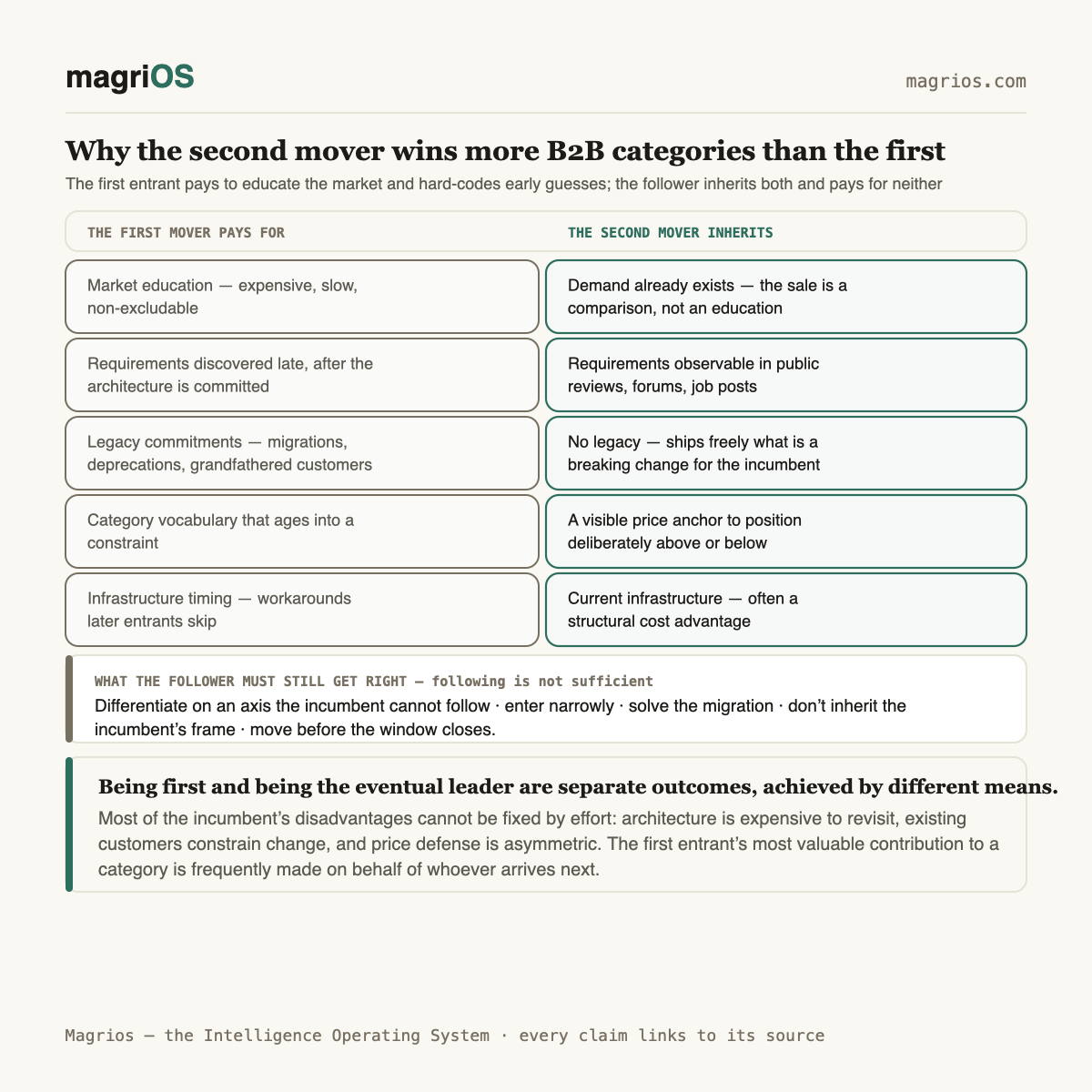
Second movers often win business software categories because the first entrant absorbs the cost of teaching buyers that the category exists, and then finds its product hard-coded around the assumptions it made before anyone knew what the requirements were. The follower inherits an educated market and a documented list of mistakes, and pays for neither.
What the first mover actually pays for
The advantages attributed to going first — brand recognition, early share, accumulated learning — are real but partial, and research on market pioneers has long questioned how durable they turn out to be. The costs are more consistent and less discussed.
- Market education. Someone has to convince buyers a problem is worth solving with purchased software, establish vocabulary, and create the budget line. That work is expensive, slow, and non-excludable: every subsequent entrant sells into the understanding it created.
- Requirements discovered late. The first entrant designs before real usage exists. The things it gets wrong are found after the architecture has been committed.
- Early customers with disproportionate influence. The first cohort funds the company and shapes the roadmap, and their needs are not necessarily representative of the market that arrives later.
- Category vocabulary that ages. Terms chosen at the start get adopted industry-wide, then become constraining when the problem is better understood.
- Infrastructure timing. Products built before an enabling technology matures carry workarounds that later entrants simply do not need.
Why the second mover's position is structurally better
The follower's advantages are not about being smarter. They come from arriving at a different moment.
- Demand already exists. The buyer knows the category, has a budget line, and can describe requirements. The sale is a comparison rather than an education.
- Requirements are observable. Public review sites, forums, support communities, and job postings document what the first product does badly. The follower designs against known needs instead of guesses.
- No legacy commitments. Every migration path, deprecated capability, and grandfathered customer the incumbent maintains is a constraint the follower does not carry.
- Current infrastructure. Building later means building on whatever matured in the interval, which is often a structural cost advantage rather than a preference.
- A visible price anchor. The incumbent has established what the category costs, so the follower can position deliberately above or below a known reference instead of guessing.
- Concentrated targeting. The incumbent's dissatisfied customers are identifiable and already convinced the problem is worth paying to solve.
Why the incumbent struggles to respond
The frustrating part for a first mover is that most of these disadvantages cannot be fixed by effort.
- Architecture is expensive to revisit. Decisions embedded early propagate through everything built on top of them.
- Existing customers constrain change. The improvements a follower ships freely are breaking changes for an incumbent with a deployed base.
- Price defense is asymmetric. Cutting price to match a follower devalues the entire installed base at once, while the follower prices a book of business that does not yet exist.
- Organizational commitment. Teams, targets, and internal narratives are built around the original framing of the problem, and reframing is a political act as much as a strategic one.
What the second mover still has to get right
Following is not sufficient, and the failure mode is well defined: arriving later with a marginally better version of the same product and no reason for anyone to move.
- Differentiate on the axis the incumbent cannot follow. Something structural — architecture, business model, distribution — rather than a feature that can be copied in a quarter.
- Enter narrowly. Attacking the whole category at once means meeting the incumbent where its advantages are strongest. A concentrated segment where the incumbent's design choices hurt most is a better opening.
- Solve the migration. Switching costs are the incumbent's real defense, and a follower that leaves migration as the buyer's problem loses to inertia.
- Avoid inheriting the incumbent's frame. Positioning as a better version of the leader concedes that the leader defines the category and reduces the contest to features.
- Move before the window closes. Second-mover advantage decays. Once an incumbent's switching costs compound and integrations accumulate, the opening narrows.
How to read this from outside
The pattern is observable in the timing of entrants relative to category maturity. An entrant arriving while buyers still need convincing is taking on education cost. One arriving after the vocabulary has stabilized and comparison content is abundant is harvesting it.
Signals worth tracking include when comparison and alternatives content starts appearing in volume, whether new entrants position against a named leader or against a problem, whether the incumbent's public materials have begun defending rather than explaining, and whether migration tooling is being built by entrants — which indicates a market where accounts are considered winnable rather than merely available.
The lesson is not that going first is a mistake. It is that being first and being the eventual leader are separate outcomes, achieved by different means, and the first entrant's most valuable contribution to a category is frequently made on behalf of whoever arrives next.