Alert thresholds vs scheduled reviews: how to catch market shifts
Comparison · Continuous Intelligence · 5 min read · last verified 2026-08-11
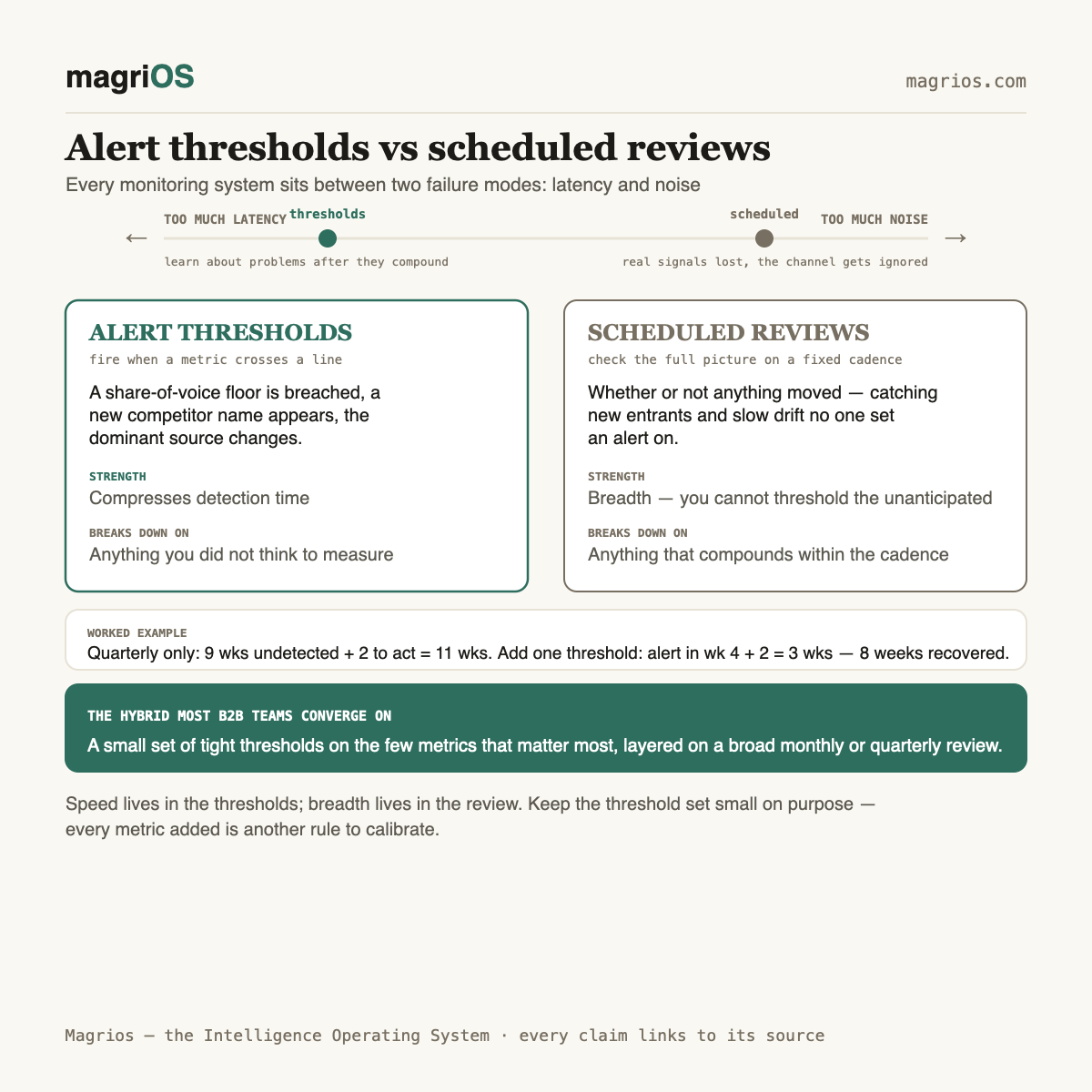
Alert thresholds trigger a review the moment a tracked metric crosses a defined line — a share-of-voice drop, a new competitor citation. Scheduled reviews check everything on a fixed calendar regardless of movement. Fast-moving categories need thresholds; stable ones are served fine by quarterly reviews.
What alert thresholds actually monitor
An alert threshold is a rule: "if metric X moves past value Y, notify someone." In an AI visibility context, that might mean an alert fires when your share of voice for a core query drops below a set floor, when a new competitor name starts appearing in answers where it didn't before, or when the dominant source behind your citations changes. The value of a threshold isn't the notification itself — it's the compression of detection time. Instead of waiting for the next scheduled check to notice a shift, you find out close to when it happens.
Thresholds only work as well as the metric and the line you draw. Set the threshold too sensitive and you get noise — alerts for normal week-to-week variance that don't represent a real shift. Set it too loose and you inherit the same blind spot as a scheduled review, just with extra infrastructure. The design work in a threshold system is almost entirely in calibrating what counts as signal, a distinction covered in more depth in what is a market signal.
What scheduled reviews actually catch
A scheduled review looks at the full picture on a fixed cadence — monthly, quarterly — regardless of whether anything moved. Its strength is breadth: a good scheduled review checks dimensions nobody thought to set an alert on, because you can't threshold what you haven't anticipated. New entrants, slow narrative drift, changes in how a model frames your entire category rather than a single metric — these show up in a broad review even when no single number crossed a line.
Its weakness is timing. If your category can shift materially within a quarter — and most competitive B2B categories can — a scheduled review finds out about a change well after it happened, sometimes well after a competitor has already captured the visibility you lost. This is the core argument laid out in why quarterly market reviews miss shifts: the review isn't wrong, it's just late relative to how fast the underlying thing it's measuring can move.
The core tradeoff: latency vs. noise
Every monitoring system sits somewhere on a line between two failure modes. Too much latency, and you learn about problems after they've compounded — a competitor citation that appeared eight weeks ago and has since become the model's default answer. Too much noise, and real signals get lost in a stream of alerts nobody has time to act on, which trains the team to ignore the channel altogether.
Thresholds push toward low latency but risk noise if calibrated poorly. Scheduled reviews push toward low noise (you only look when you've set aside time to look) but accept latency by design. Neither approach eliminates the tradeoff — they just choose which side of it to accept as the default, and layer the other on top for the cases that matter most.
Hypothetical example: comparing detection speed
Consider a hypothetical team running a quarterly review cycle, with the next check twelve weeks out. In week three, their share of voice for a flagship query drops from a dominant position to third place because a competitor changed a category-defining page. Under the pure quarterly model, that shift sits undetected for the remaining nine weeks. If it takes the team roughly two weeks to respond once they notice a shift, the total time-to-response in this hypothetical is eleven weeks (nine weeks undetected plus two weeks to act) — nearly a full quarter of ceded visibility on a query that matters.
Now run the same hypothetical with one threshold in place: an alert set to fire if share of voice for that flagship query drops by more than a defined margin week over week. If the alert fires in week four (one week after the shift, accounting for the model's own re-indexing lag) and the team still takes two weeks to respond, total time-to-response drops to three weeks. That's eight weeks recovered, in this hypothetical, purely from compressing detection time — the response time itself didn't change.
Where each approach breaks down
Thresholds break down on anything you didn't think to measure. A new competitor entering the category from an adjacent market, a shift in how models frame the entire buying category rather than one query — these have no threshold because nobody wrote a rule for them in advance. This is exactly the gap a broader periodic review is built to catch, and it's also why an AI share of voice metric on its own, however well-thresholded, doesn't substitute for a wider look at adjacent categories, a topic covered in what is a market adjacency map.
Scheduled reviews break down on anything that compounds quickly. A pricing page change that gets picked up by models within days, a competitor's aggressive content push into your core queries — a quarterly cadence finds these long after the window to respond cheaply has closed.
A hybrid model that works for most B2B teams
Neither approach used alone tends to hold up. The practical pattern most teams converge on is a small set of tight thresholds on the handful of metrics that matter most — flagship query share of voice, dominant source stability, appearance of new competitor names — layered on top of a broader scheduled review that runs monthly or quarterly to catch everything the thresholds weren't built to see.
The threshold set should stay small on purpose. Every metric you add is another rule to calibrate and another potential source of alert fatigue. The scheduled review is where breadth belongs; the thresholds are where speed belongs. Trying to make either one do both jobs is usually where monitoring systems quietly stop getting used.