When one source carries your citations, your visibility is fragile
Guide · Continuous Intelligence · 5 min read · last verified 2026-08-11
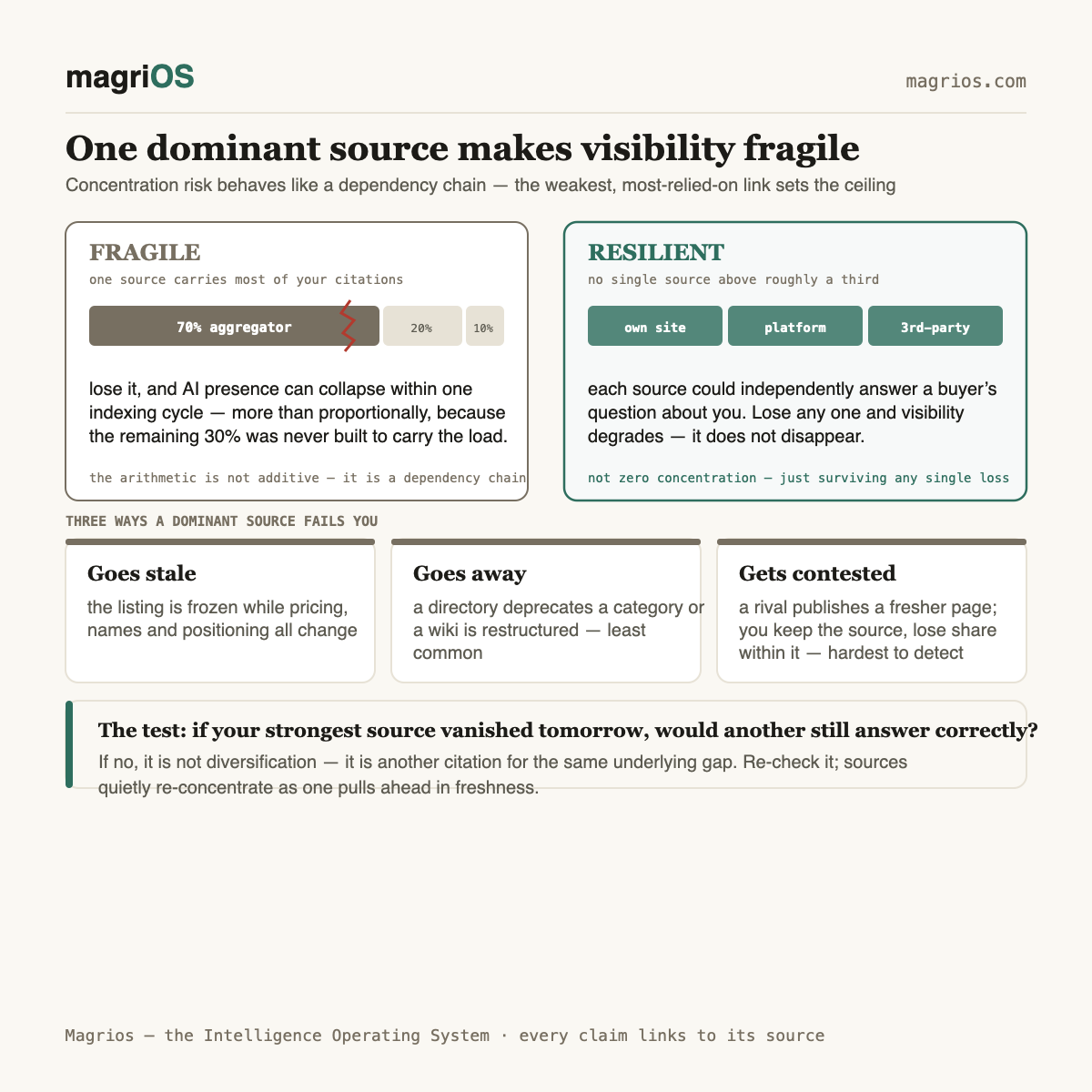
When most of your AI-generated citations trace back to a single source — one directory, one review aggregator, one wiki — your visibility depends on that source's continued existence, accuracy, and goodwill. Lose it, and your AI presence can collapse within one indexing cycle.
What counts as a "dominant source" for AI visibility
A dominant source is whichever platform, page, or dataset supplies the majority of the facts an AI model uses when it answers a question about your company. It might be a review aggregator like G2 or Capterra, a comparison wiki, a single high-authority blog post that every other site cites, or even your own outdated pricing page if it happens to be the only structured data point a model can find. The common thread isn't the type of source — it's the ratio. If one source accounts for most of what a language model says about you, whether that's 90% or 60%, you have concentration risk, and concentration risk behaves differently from the diversification risk marketers are used to managing in paid channels.
Concentration is easy to miss because it doesn't look like a problem while things are going well. A single strong listing can produce excellent AI Overviews snippets, consistent mentions in ChatGPT and Perplexity answers, and a steady trickle of qualified traffic. The fragility only becomes visible at the moment the source changes — and by then, the fix is reactive instead of planned.
How language models pick citations — and why concentration happens naturally
Retrieval-augmented generation systems don't sample the web evenly. They favor pages that are well-structured, frequently crawled, and already cited elsewhere, which creates a feedback loop: the source that's easiest to retrieve gets retrieved more, which makes it look more authoritative, which makes models lean on it further. For a young or mid-market B2B company, this often means one directory listing or one comparison page becomes the de facto source of truth simply because it was the first structured, crawlable summary of your product that existed.
This isn't a flaw you can out-optimize with more content alone. Publishing ten new pages doesn't reduce concentration if none of them reach the crawl frequency, structural clarity, or existing citation graph of the dominant source. Diversification has to be deliberate — you're competing against your own strongest asset for a model's attention, which is a strange position to be in, but it's the reality of how retrieval currently works.
The three failure modes of single-source dependence
There are three distinct ways a dominant source can fail you, and they call for different responses.
The source goes stale. Your listing is accurate the day it's created and then nobody touches it again. Pricing changes, product names change, positioning changes — the AI answer doesn't, because the source it's drawing from is frozen.
The source goes away. A directory deprecates a category, a wiki gets acquired and restructured, a comparison site changes its ranking algorithm and drops you from the page models were citing. This is the scenario most people picture, but it's the least common of the three in practice.
The source gets contested. A competitor buys placement, disputes a claim, or simply publishes a more current version of the same comparison, and models start preferring the newer page. You don't lose the source outright — you lose the citation share within it, which is harder to detect because your listing still exists and still looks fine when you check it manually.
Hypothetical example: modeling source concentration
Say a company's AI citations currently break down as 70% from one review aggregator, 20% from its own site, and 10% from scattered mentions elsewhere. In this hypothetical, if that aggregator's crawl coverage drops and its citation share falls from 70% to 20% (a 50-point drop), the company doesn't lose 50% of total visibility proportionally — because the other two sources were never built to carry that load, total citation volume can fall by far more than the aggregator's share alone, since the remaining 30% (20% own site + 10% elsewhere) wasn't structured to absorb the overflow. The arithmetic of concentration risk isn't additive; it's closer to a dependency chain, where the weakest, most-relied-upon link sets the ceiling for what survives its failure.
The practical takeaway from this hypothetical isn't a target percentage — it's the shape of the risk. A portfolio where no single source exceeds roughly a third of total citation share can absorb the loss of any one source without a proportional collapse, because the remaining sources were already carrying meaningful weight before the failure happened.
How to diversify without diluting authority
Diversifying doesn't mean spreading your message thin across dozens of low-quality listings. It means deliberately building two or three additional structured, crawlable, frequently updated sources that could each independently support an AI answer about your product — your own site's comparison and pricing pages, a well-maintained presence on one or two category-relevant platforms, and consistent third-party coverage that gets refreshed rather than published once and abandoned.
The test for whether a new source counts as real diversification is simple: if the dominant source disappeared tomorrow, would this other source still be enough to correctly answer a buyer's question about you? If the answer is no, it's not diversification — it's just another citation for the same underlying gap. Related to this is the concept covered in what is a market signal, since a source's freshness and update cadence function as a signal in their own right, independent of what it actually says.
A practical audit: mapping your current source concentration
Before deciding how to diversify, map where you currently stand. Run a representative set of buyer questions through the major AI assistants and record which source each answer traces back to. Group the results by domain, not by individual page — five citations from five different pages on the same directory still count as one source. This exercise connects directly to tracking AI share of voice, since concentration is really a distribution question sitting underneath the aggregate visibility number.
Once you have the breakdown, decide whether to check it on a fixed schedule or set up alerts for meaningful shifts — the tradeoffs between those two approaches are covered in alert thresholds vs. scheduled reviews. Either way, treat the concentration map as a living document. Sources that look diversified today can quietly re-concentrate as one listing pulls ahead in freshness or authority, and the only way to catch that drift is to keep measuring it, not to assume the first audit holds.
Fragility from a dominant source isn't a one-time risk to fix and forget. It's a structural property of how AI systems retrieve information, and it re-forms every time your content ecosystem changes. The goal isn't zero concentration — some asymmetry between sources is normal and even efficient. The goal is making sure that if your strongest source failed tomorrow, your visibility would degrade, not disappear.