Geographic expansion vs vertical expansion: which one to do first
Comparison · Market Growth · 18 min read · last verified 2026-08-11
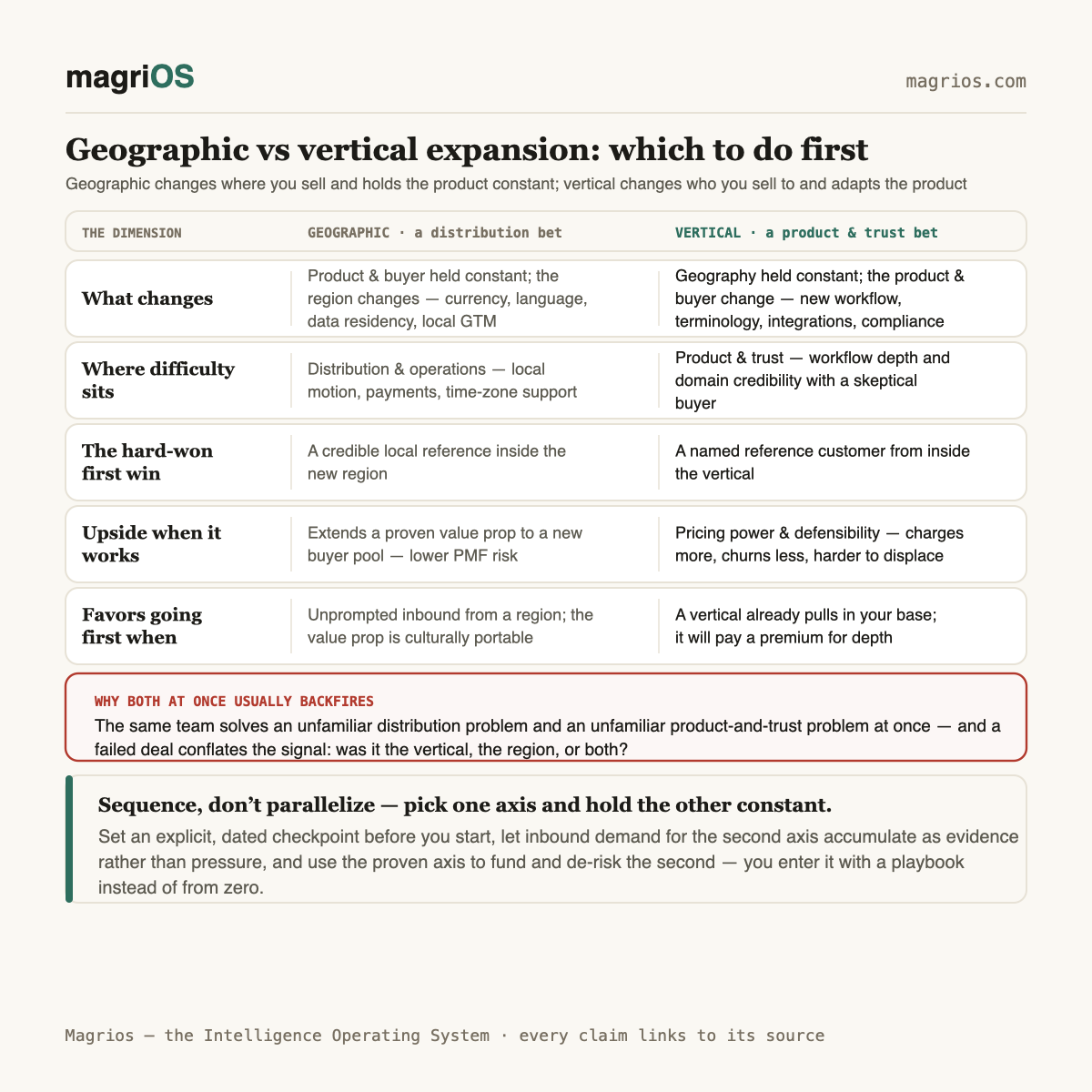
Geographic expansion grows revenue by selling an existing product into new regions; vertical expansion grows revenue by adapting the product for a new industry within a region you already serve. Most early-stage SaaS companies do better picking one axis at a time — splitting focus slows both.
Founders rarely frame the decision this cleanly in the moment. It shows up instead as a scattered set of individual choices — whether to respond to inbound interest from a prospect in a new country, whether to build the feature a healthcare prospect is asking for, whether the next hire should be a bilingual salesperson or an industry specialist — each of which feels like an isolated tactical call. Laid end to end, though, those choices add up to a strategic direction, and companies that never step back to name which direction they're actually pursuing tend to end up half-committed to both, which is close to the worst outcome available.
This piece lays out what each path actually requires, why trying to run both simultaneously tends to backfire for companies without the resources to support it, how to read your own situation for which one to prioritize first, and how to test a bet cheaply before committing a full quarter of engineering and sales capacity to it.
Why this decision gets confused with "just growth"
Both paths get talked about, casually, as "expansion" — as if they were interchangeable instances of the same underlying activity: find more customers who look different from the ones you already have. That framing hides a real difference in what each path costs and what capabilities it requires.
Geographic expansion holds the product and the target buyer roughly constant and changes where you're selling. The core value proposition doesn't change — you're still solving the same problem for the same kind of team — but nearly everything around the product might: currency, language, data residency requirements, local competitors, payment methods, sometimes labor law if you're hiring locally, and often the informal go-to-market conventions of doing business in a new region, which can differ from what worked in your home market in ways that aren't obvious until you're already there.
Vertical expansion holds the geography roughly constant and changes who you're selling to and, usually, changes the product to fit. Moving from selling generic project management software to marketing teams toward selling a healthcare-specific or financial-services-specific version of the same underlying tool means new terminology, new workflows, often new integrations with industry-specific systems, sometimes new compliance requirements, and a materially different sales motion — different buyer titles, different objections, different proof points a prospect needs before they'll trust you with the specific risks their industry carries.
Both are legitimate growth paths. Both are also expensive, multi-quarter commitments that draw on the same limited pool of engineering time, sales capacity, and executive attention. Treating them as the same kind of decision — "more growth is more growth" — is what leads companies to greenlight both at once without noticing they've just doubled the number of unfamiliar problems the team has to solve simultaneously.
What geographic expansion actually requires
Geographic expansion is, at its best, a distribution problem more than a product problem — which is exactly why it's tempting to underestimate how much work it actually takes.
Localization, at minimum, usually means currency and often language, even for a technical B2B product sold to English-fluent buyers — invoicing in the local currency, and often at least translated marketing and support materials, is frequently table stakes for being taken seriously as a real local option rather than a foreign vendor doing business opportunistically.
Legal and regulatory groundwork varies enormously by target region — data residency requirements, sometimes a local legal entity requirement before you can sign certain categories of customer, employment law if you're hiring locally rather than selling remotely, and payment processing rules that differ by country. Some of this overlaps with the pattern covered in how regulation creates software categories: a regulatory requirement in a new region can itself force product changes, not just paperwork.
Local go-to-market motion is the piece founders most often underestimate. Even in a market that speaks the same language and shares a lot of business culture, the channels that work, the sales cycle length, the procurement norms, and the level of local social proof a buyer expects to see before they'll take a meeting can all differ meaningfully from your home market. A reference customer or case study from your home region often carries much less weight with a buyer in a new region than a local equivalent would — which is one of the reasons landing an early, credible customer inside a new geography is disproportionately valuable, in the same way described in what is a lighthouse customer: the first strong reference inside a new market does work that no amount of marketing spend from outside that market can replace.
Support coverage across time zones, and sometimes languages, is a real operational cost that scales with how far the new geography is from your existing team, and it's easy to underbudget because it doesn't show up until customers are already live and expecting a response inside their own business hours.
The upside, when it works, is that you're not reinventing the product — you're extending a proven value proposition to a new buyer pool, which is a fundamentally lower-risk bet on product-market fit than vertical expansion is, because you already know the product works for this kind of buyer somewhere.
What vertical expansion actually requires
Vertical expansion is, at its best, a product and trust problem more than a distribution problem, and the work is concentrated in different places.
Workflow and feature adaptation is usually the biggest lift. A project management tool built for marketing teams and a project management tool credible to a construction company or a hospital department are not the same product wearing different marketing copy — the underlying entities, the workflow steps, the fields that matter, and the integrations required to fit into how that industry actually operates are frequently different enough to require real engineering investment, not just a repositioned landing page.
Domain credibility is a real and often underestimated barrier. Buyers in a specialized vertical are often skeptical of a horizontal tool trying to become "vertical enough" for their world, and that skepticism has to be overcome with specific proof — terminology used correctly, workflows that clearly reflect an understanding of how the industry actually works, and ideally a named reference customer from inside the vertical, again tying back to how disproportionately valuable a strong early lighthouse customer is in a new vertical specifically, because it's often the single fastest way to close the credibility gap a horizontal product starts with.
Compliance and integration requirements are frequently steeper in a new vertical than in a new geography, especially in regulated industries — healthcare, financial services, government — where the vertical itself carries specific legal obligations layered on top of whatever applies to your business generally. This is where vertical expansion and the regulatory pattern described in how regulation creates software categories intersect directly: entering a regulated vertical often means building toward a specific compliance requirement as a precondition for being considered at all, not as an optional differentiator.
Sales motion changes are usually significant too — different buyer titles, different budget owners, different procurement processes, and often a materially longer and more relationship-driven sales cycle than a horizontal product is used to, particularly in verticals like healthcare, government, or financial services where trust and referenceability matter more than feature comparison.
The upside, when it works, is pricing power and defensibility that horizontal products rarely get: a genuinely vertical-fit product can charge more, churns less, and is much harder for a horizontal competitor to displace once it's built real domain-specific trust and workflow depth — but that upside is earned through a longer, more expensive path to the first credible win than geographic expansion usually requires.
The core tradeoff: why doing both at once usually backfires
The reason this choice matters as a genuine either-or, at least for companies without abundant resources, comes down to where the hard work actually concentrates in each path.
Geographic expansion concentrates difficulty in distribution and operations — building local go-to-market motion, navigating new regulatory and payment environments, and covering new time zones — while the product itself stays mostly stable. Vertical expansion concentrates difficulty in product and trust — adapting the product to a new workflow and earning credibility with a skeptical, specialized buyer — while distribution stays mostly familiar.
Running both simultaneously means asking the same team to solve an unfamiliar distribution problem and an unfamiliar product-and-credibility problem at the same time, with no path yet proven for either. Engineering has to build vertical-specific features and localize the product for a new region in parallel. Sales has to learn a new buyer profile and a new regional motion at once, with no playbook for either to lean on. Support has to handle both a new domain's terminology and a new region's time zone coverage simultaneously.
Compare that to companies that pick one axis and hold the other constant — the axis they're not actively expanding on keeps working the way it always has, generating cash flow and stability, while the team's attention and hiring goes toward proving out the one new dimension. That's not just a resourcing argument, either. It's a learning-speed argument: doing one thing at a time means each cycle of trying, failing, and adjusting teaches you something about a single new variable. Doing both at once conflates the signal — if a new-vertical, new-geography deal falls through, you often can't tell whether it failed because the vertical fit was wrong, the regional motion was wrong, or both, which makes it much harder to course-correct quickly.
None of this means simultaneous expansion is never right — companies with enough capital, an unusually repeatable playbook, or an acquisition that hands them both at once can sometimes make it work. But for most companies operating with normal resource constraints, sequencing beats parallelizing, and the rest of this piece is about how to pick which one goes first.
Signals that point toward geography first
A few situational signals tend to favor prioritizing geographic expansion before vertical expansion.
Inbound demand is already showing up from a new region, unprompted, for the product exactly as it exists today. That's a strong, low-cost signal that the product-market fit you already have travels, and it's usually cheaper to formalize a motion around demand that already exists than to manufacture demand in a new vertical from scratch. This is a clean example of the kind of market signal worth acting on rather than a hypothesis you have to test cold.
Your home market is genuinely saturated or is a small fraction of the realistic global opportunity for the exact product you have today. If a large majority of the realistic buyers for your current product, in your current form, exist outside the geography you currently serve, geographic expansion is closer to "selling the same thing to more of the market that already wants it" than a speculative bet.
Your product's value proposition is culturally and operationally portable. Products solving universal operational problems — accounting, scheduling, general project management — tend to travel better across geographies than products deeply embedded in one region's specific regulatory or business norms.
You have, or can reasonably get, a credible local presence or partner to anchor the new market — an early local hire, a founder with existing relationships in the target region, or a partnership that gives you real local credibility from day one rather than starting from zero.
Signals that point toward vertical first
A different set of signals tends to favor vertical expansion before geographic expansion.
A specific vertical is already showing disproportionate pull within your existing customer base, even without you targeting it deliberately — a cluster of customers from one industry, higher engagement or lower churn from that segment, or inbound requests for industry-specific features you haven't built yet. That's evidence of latent product-market fit worth deliberately pursuing rather than starting a vertical bet cold.
Your product's core workflow is close to vertical-specific already, just not positioned or built out that way — meaning the incremental product work to become genuinely vertical-fit is smaller than it would be for a fully horizontal product, lowering the cost of testing the bet.
Horizontal competition in your current market is intense and pricing-driven, while a specific vertical shows willingness to pay a premium for depth and trust — a common pattern in categories where a horizontal tool becomes commoditized and the more durable, defensible position turns out to be narrower and deeper rather than broader.
Your home geography is large enough that a vertical bet doesn't also require a geography bet — meaning you can test vertical fit inside a market you already understand operationally, without also having to solve for a new region's regulatory and go-to-market differences at the same time. Testing one genuinely new variable, rather than two at once, is the whole point of sequencing.
Worked example: a hypothetical company weighing the two paths
Consider a hypothetical company, "Fictional Ops," selling operations software to mid-market logistics companies in the United States. None of the figures below describe a real company — they're illustrative arithmetic meant to show how you'd actually structure the comparison, not a claim about any real market.
Suppose Fictional Ops has 40 active customers. Of those, 6 customers (15% of the base) are in the healthcare logistics niche specifically, and those 6 accounts have a renewal rate the team has noticed is qualitatively stickier than the rest of the base, plus 3 unprompted inbound requests in the last quarter specifically asking for healthcare-compliance-related features. Separately, the team has fielded 2 inbound inquiries in the same quarter from logistics companies in Canada, asking whether the product is available there.
Sizing the two opportunities with simple arithmetic: the healthcare cluster is 6 of 40 existing customers (6/40 = 15%) of current revenue-generating relationships, already validated as a real segment with product usage data behind it, against 3 inbound signals in one quarter. The Canada interest is 2 inbound inquiries in one quarter, with zero existing customer base to validate demand — it's a colder signal, even though the total addressable population in Canada might well be sizable.
On pure signal strength, the healthcare vertical looks like the stronger near-term bet: it's supported by existing paying relationships and repeat inbound interest, not just speculative inquiries. The Canada opportunity isn't invalid, but it's earlier-stage evidence — it would need more inbound signal, or a deliberate low-cost test, before justifying the same level of investment. A reasonable next step for Fictional Ops would be building out one or two of the specific compliance features the healthcare inbound requests are asking for, watching whether that increases both the healthcare segment's growth rate and its share of new inbound, and deliberately deferring a real geographic push into Canada until the vertical bet is proven out or clearly stalls.
Sequencing: how to actually do one, then the other
Picking an axis isn't a one-time decision so much as a sequencing discipline that has to hold up over several quarters of pressure to do the other thing too.
Set an explicit, dated checkpoint for the first axis before you start — a review point where you'll honestly assess whether the vertical or geographic bet is working, based on criteria you defined in advance, not criteria that shift to match whatever the current metrics happen to look like.
Let inbound demand for the second axis accumulate as evidence, not as pressure to act immediately. It's normal for inbound interest in the "not now" axis to keep showing up while you're focused on the first — log it, the same way described for reading market signals in what is a market signal, but resist treating every individual inquiry as a reason to split focus.
Protect the team from silently pursuing both anyway. The most common failure mode isn't a deliberate decision to run both expansions at once — it's death by a thousand small yeses: one engineer quietly builds a feature for the region you said you weren't prioritizing, one salesperson chases a deal in the vertical you said was "later." Each yes feels reasonable in isolation and collectively reproduces the exact split-focus problem the sequencing decision was meant to avoid.
Use the proven axis to fund and de-risk the second one. Once the first expansion axis is validated and generating stable revenue, it typically funds the second expansion with much better information than you had at the start — you now know more about your own playbook for entering something new, which makes the second axis meaningfully cheaper to pursue than if you'd started both from zero simultaneously.
This overall approach — commit to a path, hold the line against distraction, revisit deliberately rather than reactively — is really a specific application of the more general discipline covered in strategy vs. planning: the sequencing decision is the strategy, and the quarter-by-quarter execution against it is the planning, and conflating the two is how companies end up reactively chasing whatever inbound signal is loudest in a given week instead of following a chosen path.
Running a lightweight test before fully committing
Before either path gets a full quarter of dedicated engineering and sales resourcing, it's usually worth running a smaller, cheaper test that produces real evidence rather than committing based on the signals alone.
For a geographic test, that often looks like taking on a small number of customers in the target region using your existing product, with minimal localization — perhaps just currency handling and translated core materials — and a founder or an existing salesperson handling the motion manually rather than hiring a dedicated regional team upfront. The goal isn't to prove the full motion scales; it's to find out whether the product and pitch actually land with buyers in that region once they're in front of it, and to surface which localization gaps turn out to matter in practice versus which ones you assumed would matter but don't.
For a vertical test, that often looks like taking the inbound interest you're already seeing from a specific industry and manually building or configuring the one or two most-requested adaptations for a small number of design-partner customers, rather than committing to a full vertical product rebuild upfront. The goal is the same — find out whether deeper investment is justified — before committing the engineering roadmap for multiple quarters to a full vertical build-out.
In both cases, the test should be cheap enough that a negative result doesn't set the company back meaningfully, and structured enough that a positive result gives you a real basis for the bigger commitment — not just anecdotal enthusiasm from a founder who wanted the answer to be yes. Write down, before you run the test, what result would actually justify the larger investment. It's easy to unconsciously lower the bar after the fact if the early results are merely okay rather than clearly strong.
How the calculus shifts at different company stages
The tradeoff described throughout this piece holds at every stage, but which axis tends to make sense first often shifts as a company matures.
Very early-stage companies, still establishing product-market fit in any market, are usually better served by neither expansion path yet — the priority is proving the core product works for a well-defined initial customer type in a single market, closer to the discipline described in what is a beachhead market. Pursuing geographic or vertical expansion before that initial fit is solid tends to just multiply the number of unknowns the team is trying to resolve at once, without yet having a proven playbook for either.
Companies with initial product-market fit and a repeatable, if not yet fully scaled, sales motion are usually in the strongest position to make a deliberate first bet on one expansion axis, using the signals described above. This is the stage where the sequencing discipline in this piece matters most, because the company has enough traction that both paths look tempting, and enough at stake that guessing wrong is costly.
More mature companies with an established core market often have the resources to run both paths in parallel, but even then, the strongest operators tend to stagger the two rather than launching them simultaneously — proving a repeatable playbook on one axis, codifying what was learned, and using that playbook to make the second axis meaningfully faster and lower-risk than starting from zero. The resourcing constraint loosens at scale, but the learning-speed argument for sequencing doesn't disappear entirely, it just becomes less binding.
Presenting the decision to a board or investors
However the choice gets made internally, it's worth presenting it to a board or investors as a deliberate sequencing decision backed by specific evidence, rather than as a permanent either-or commitment carved in stone. Naming the actual signals that drove the choice — the volume and source of inbound demand, the usage patterns already visible in the current customer base, and the specific checkpoint date at which the team will formally reassess — gives a board something concrete to evaluate and push back on if they disagree, rather than a vague strategic preference that's hard to interrogate.
This framing also pays off later. If the evidence at the checkpoint suggests switching axes, or adding the second one sooner than originally planned, a board that understood the original decision as evidence-based and provisional is far more likely to see the change as disciplined execution of a stated plan than as an unplanned reversal driven by whatever happened to be loudest that quarter. The distinction matters for the kind of trust that makes future strategic conversations easier rather than harder — a board that has watched a team make one evidence-based sequencing call well is generally more willing to grant latitude on the next one.
Common mistakes
Choosing based on excitement rather than evidence. A large new geography or a glamorous vertical can be exciting to talk about in a board meeting, but excitement isn't evidence of fit. The signals worth weighing are the ones described above — actual inbound demand, actual usage patterns in your existing base, actual willingness to pay — not the size of the opportunity in the abstract.
Treating the "TAM math" as the whole decision. A frequently invoked argument for either path is that it dramatically expands total addressable market. That's often true of both paths and therefore doesn't actually help you choose between them — the deciding factor is which path you can execute with the evidence and resources you actually have, not which one has a bigger number on a slide.
Under-resourcing the chosen path because it "should" be simpler. Founders sometimes pick geographic expansion assuming it's the lower-effort option because the product doesn't need to change, then underbudget the local go-to-market and operational work, which is often where the real cost lives. The reverse mistake happens with vertical expansion, where founders underbudget the sales cycle length and credibility-building time even after correctly anticipating the product work.
Never revisiting the decision. Sequencing doesn't mean permanently ruling out the other axis — it means deliberately deferring it until there's real evidence about whether the first bet worked. Companies that treat the initial choice as permanent, rather than as the current priority given current evidence, often miss a genuinely strong opportunity on the deferred axis long after it would have made sense to pick it up.