The Ansoff Matrix: choosing a growth direction you can defend
Guide · Frameworks · 4 min read · last verified 2026-08-11
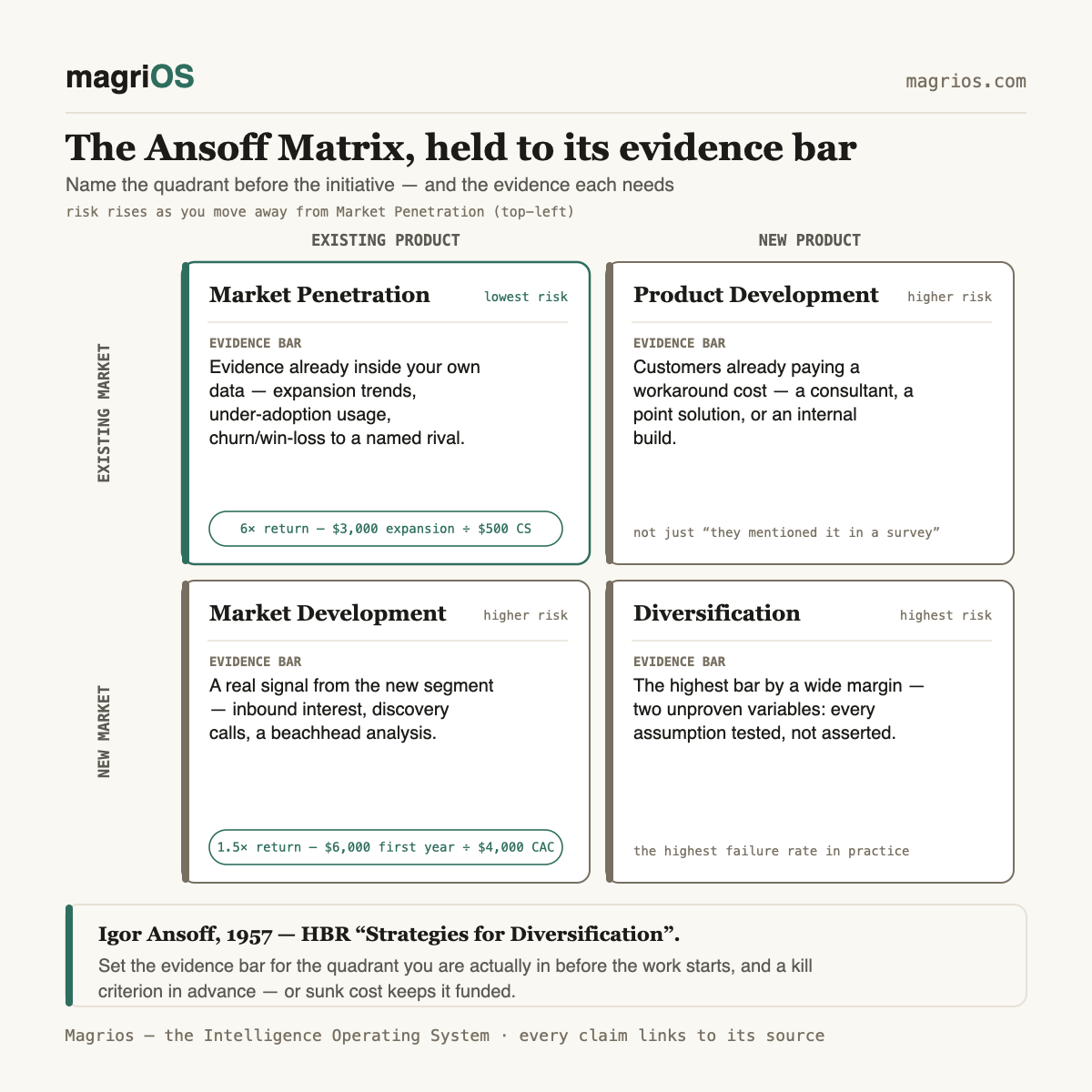
A matrix built to sort risk, not to justify a roadmap
Igor Ansoff introduced the product-market growth matrix in a 1957 Harvard Business Review article, "Strategies for Diversification." The matrix crosses two variables — product (existing or new) and market (existing or new) — into four quadrants: Market Penetration (existing product, existing market), Market Development (existing product, new market), Product Development (new product, existing market), and Diversification (new product, new market). Risk rises as you move away from the top-left quadrant, because each step away from what you already know how to sell, and to whom, adds a variable you have less evidence about.
That's the whole framework. It's a two-by-two, deliberately simple, meant to force an explicit choice about which direction growth comes from and an honest reckoning with how much of that direction is unproven.
Where it degenerates into a rationalization tool
The failure mode in SaaS strategy decks is almost always the same: the matrix gets filled in after the growth decision has already been made, not before. Someone wants to build a new product line, or enter a new geography, or launch an adjacent SKU — and the Ansoff quadrant gets drawn up to make that decision look like the output of a structured framework rather than what it actually was, which is a preference that needed a slide.
The second, quieter failure is treating Market Penetration as the boring quadrant — the one you list first and move past quickly on the way to the "exciting" ones. In practice, penetration (selling more of what you have to the market you already understand — expansion, upsell, cross-sell, deeper account penetration) is very often the highest-return, lowest-risk lever available to a SaaS company, precisely because you already have the product-market fit evidence, the support infrastructure, and the customer relationships. Treating it as beneath a growth conversation is usually a resourcing mistake dressed up as ambition.
The third failure is blending quadrants without naming it. A "new product for a new market" is Diversification — the highest-risk cell, because you're carrying two unproven variables (whether the product works and whether the market wants it) at once. Teams routinely describe this kind of move using the language of "expansion," which understates the risk and skips the evidence bar that a genuinely diversifying move should have to clear.
Applying it honestly: what evidence each quadrant actually needs
Market Penetration needs evidence that there's more room in your existing base and existing market segment: expansion revenue trends, usage data showing under-adoption, a churn or win/loss pattern showing where you're losing share to a specific competitor. This is the lowest-risk quadrant precisely because the evidence already exists inside your own data — there's rarely an excuse for this one to be under-resourced relative to its evidence quality.
Market Development (existing product, new market — a new segment, vertical, or geography) needs evidence that the new market actually has the same problem your product solves, not just enthusiasm that it might. That means some real signal from the new segment — inbound interest, discovery conversations, a beachhead-market analysis — rather than an assumption that "if it works for mid-market, it'll work for enterprise" or vice versa.
Product Development (new product, existing market) needs evidence that your current customers would actually pay for the adjacent capability, not just that they mentioned wanting it in a roadmap survey. The strongest version of this evidence is customers already paying a workaround cost — hiring a consultant, buying a point solution, building something internally — to solve the adjacent problem today.
Diversification carries both unproven variables at once and deserves the highest evidence bar of the four, by a wide margin. It's the quadrant most associated with high failure rates in practice, precisely because it's the one where founders are most tempted to substitute conviction for evidence — there's no existing customer base and no existing product to validate against, so every assumption underneath the bet needs to be tested rather than asserted.
Worked example: why penetration usually wins the resourcing argument
Here's a hypothetical comparison a founder could run before allocating next quarter's growth budget. Say your existing base is 200 accounts. An expansion motion — upsell to that base — costs roughly $500 per account in customer-success time to execute, against an average expansion contract value of $3,000. That's a return of $3,000 / $500 = 6x on the resources spent.
Compare that to a new-market logo motion: acquiring a customer in a market you haven't sold into before, at a fully-loaded CAC of $4,000, against a first-year contract value of $6,000. That's $6,000 / $4,000 = 1.5x.
Six times the return versus one-and-a-half times the return is not a subtle difference, and it's the arithmetic that should be sitting underneath any decision to deprioritize penetration in favor of a flashier new-market push. None of this means new-market expansion is wrong — a lower near-term return can still be the right call if the new market is larger, growing faster, or closing a window of opportunity. But that has to be argued explicitly, with its own evidence, rather than assumed by default because penetration sounds unambitious.
Setting the discipline before you start
Two habits keep Ansoff from becoming a rationalization exercise. First, decide which quadrant you're in and name the evidence bar for it before the initiative starts, not after — if you're honest that a move is Diversification, treat it with Diversification-level scrutiny rather than describing it with Market Development's lower evidence bar. Second, set kill criteria in advance: a specific piece of evidence that, if it doesn't show up within a defined window, ends the initiative. Without a pre-committed kill criterion, sunk cost alone will keep any quadrant funded long after the evidence has turned against it.