How AI assistants choose their sources
Guide · AI Visibility · 5 min read · last verified 2026-08-11
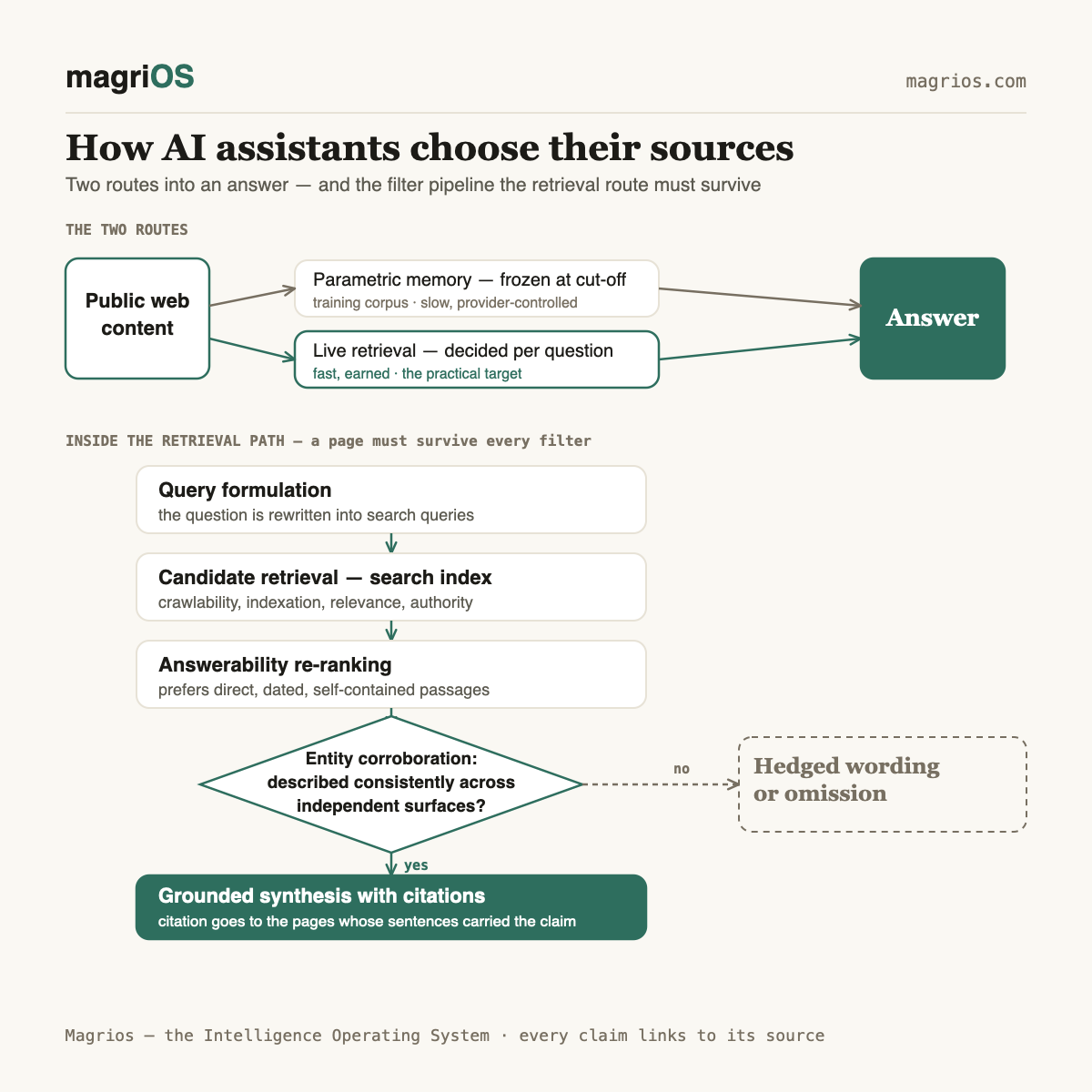
AI assistants choose their sources through two mechanisms: the training corpus the model was built from, and the retrieval layer that fetches live pages at the moment a question is asked. The training route is slow and lags the real web; the retrieval route is decided fresh for every question, largely from the same public pages that search engines already rank. For anyone trying to influence how assistants describe their company, the retrieval layer is the practical target: it is the only route that moves on a timescale you control.
The two routes into an answer
Route one is parametric. Whatever the model read during training — pages, forums, documentation, press — is compressed into its weights, so a company consistently described on the public web at corpus time can be discussed without any lookup. The route is durable, but you cannot edit it and it is frozen at the cut-off: a company that repositioned, renamed a product, or did not yet exist is wrong or missing in the weights until the next refresh.
Route two is retrieval. When a question needs current or specific information, the assistant searches the live web, selects candidate documents, and grounds its answer in what it finds — often with citations. This route is earned page by page and moves at publishing speed rather than retraining speed.
To be fair, the parametric route works even when retrieval never triggers, and it sets the model's prior — the framing it reaches for before any source is fetched. Today's corroborated record is also a candidate for tomorrow's corpus, so the routes converge over time.
How the retrieval path chooses
Retrieval is a pipeline of filters, and a page must survive all of them. First, query formulation: the user's question is rewritten into search queries, often quite different from the user's wording. Second, candidate retrieval: the queries run against a search index, where classic ranking mechanics apply — crawlability, indexation, relevance, authority. A page that cannot rank for the reformulated query is never seen by the model at all. Third, answerability re-ranking: the system prefers passages that answer directly — clear claims, visible dates, self-contained paragraphs a model can quote without reconstruction. Finally, grounded synthesis: citation goes to the pages whose sentences actually carried the claims.
The consequence: presence is won question by question, not domain by domain. An assistant does not "cover" your site; each answer is assembled from whichever pages survived the filters.
Which source classes answers favor, and why
Three properties recur in cited pages, each with a mechanical explanation. Third-party status: a vendor's claim about itself is a single-source statement from an interested party, while a review platform or community thread making the same statement is independent evidence — the safer sentence to cite. That is why category questions so often resolve to review platforms, comparison pages, and communities rather than vendor homepages. Verifiability: concrete, checkable statements — what the product does, who it is for, when something shipped — give the model quotable material, while vague positioning language leaves nothing to ground a claim on. Freshness: where answers can change, dated recent pages beat undated ones — the system cannot tell an undated current page from an obsolete one.
Deep dive: entity corroboration
A failure mode puzzles many founders: their pages rank, retrieval fetches them, and the assistant still answers in hedged language — "appears to offer", "according to the company's own website" — or drops the company from a list it plausibly belongs on. The mechanism is entity corroboration. Grounding appears to involve more than document retrieval: the hedging behaviour observable in live answers is consistent with systems checking that an entity exists and is described consistently across independent surfaces — a working hypothesis inferred from behaviour, not a documented internal step. If the only place the web says "Acme is a market intelligence platform" is Acme's own domain, the model is being asked to assert a self-interested, single-source claim — and its trained behavior is to hedge or omit.
Corroboration fails in predictable ways. Inconsistent naming splits the entity: one name on the site, another in directories, a third on profiles, and no single entity accumulates the mentions. Rebrands orphan it: the old name keeps the third-party record while the new one starts from nothing. Category drift reads as uncertainty, and uncertainty produces hedged prose.
The practical checklist follows from the mechanism:
- One canonical name, category phrase, and one-line description, used identically everywhere you control.
- Several independent surfaces — review platforms, directories, community answers, press or partner pages — that describe the company in the same category language, in their own words.
- An about page and structured data carrying stable facts that third parties can copy accurately.
- Dated evidence of ongoing activity — releases, changelogs, coverage — so the entity reads as current rather than dormant.
None of this persuades a model; it gives whatever verification the system performs multiple agreeing witnesses.
What this means for your visibility work
The controllable input is question-level presence in the source layer. For each question your buyers ask, there either is or is not a page — yours or a third party's — that ranks, answers directly, and names your entity in corroborated terms. Enumerating those questions, checking which sources assistants cite for each one, and closing the gaps is the working loop — the discipline that What is answer engine optimization (AEO)? formalizes. Measuring the citation side is its own tooling question — see Which tools track how ChatGPT and Perplexity describe my company — and the full programme is laid out in AI visibility: the complete guide.
What you cannot control
Parts of this system are simply out of reach. Model refresh cycles are the provider's schedule: nothing you publish today changes parametric memory until the next training refresh. Per-user context shapes answers invisibly — conversation history, location, saved instructions — so identical questions from different people can receive different sources, and no outside party can steer that. Retrieval has variance: assistants sample, and answers differ from run to run, so a single spot-check proves little.
The honest timeline follows from the mechanics. Retrieval-layer presence can begin once a page is crawled, indexed, and ranking — realistically weeks for an established domain, longer for a new one. Corroboration accrues over months, because it depends on third parties publishing. Training-layer presence lags a full refresh cycle behind everything else. Any promise of immediate placement in AI answers is a promise the mechanics cannot keep.