The entity corroboration playbook: making AI systems believe you exist
Guide · SEO / AEO / GEO · 3 min read · last verified 2026-08-11
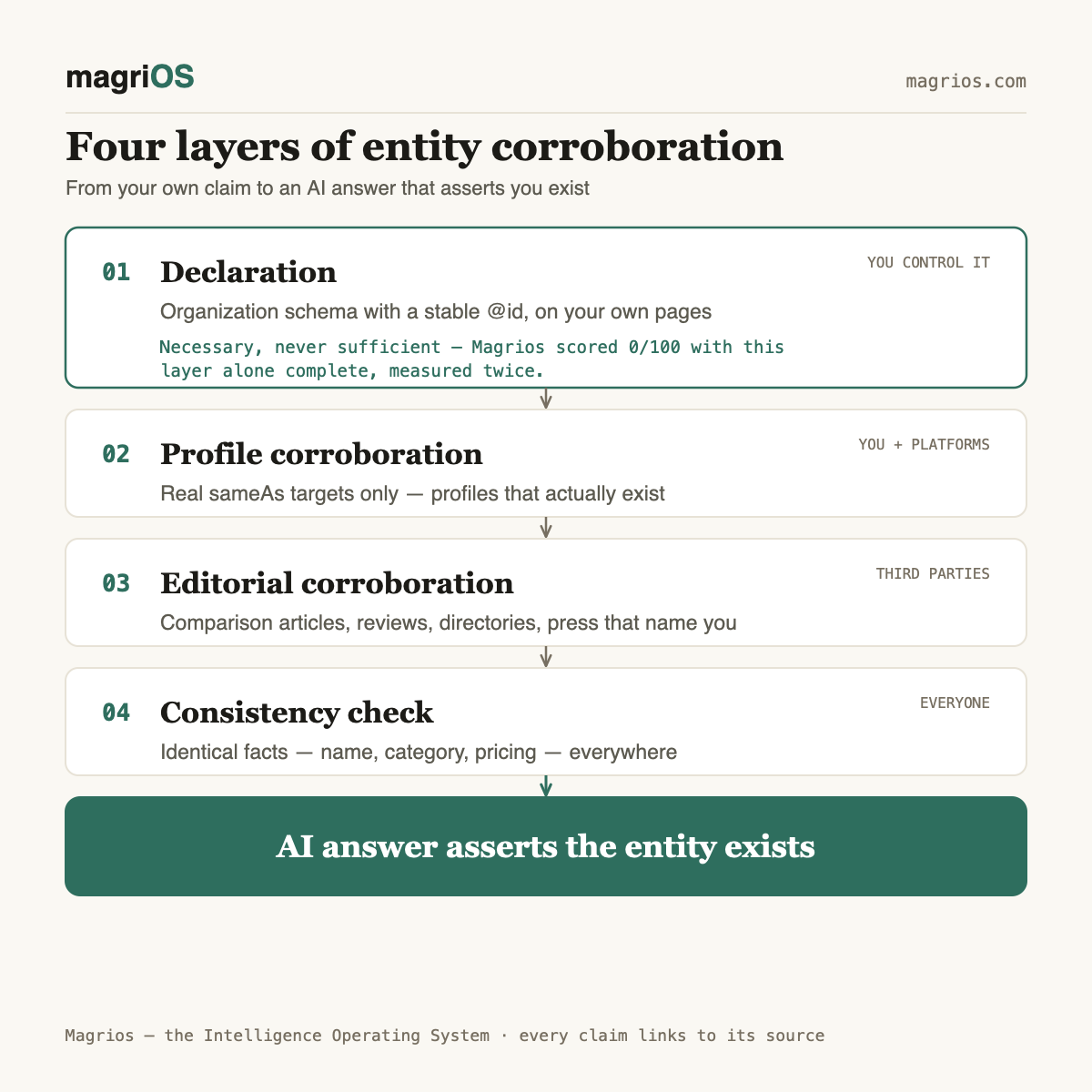
AI systems do not believe your website; they believe agreement between sources they treat as independent. To make an assistant assert that your company exists, the same facts must appear in your own machine-readable markup and on pages you do not control — profiles, directories, editorial coverage that answers buyer questions. Until that agreement exists, your brand is a string, not an entity. We write this from direct experience: on 2026-07-22, Google AI Mode told our founder that Magrios does not exist.
Why would an AI system deny that a real company exists?
Because "exists" means something stricter to an answer engine than it does to a company registrar. Magrios is a live product with production infrastructure behind it, a public trust page, and a complete JSON-LD entity graph on every page. None of that stopped Google AI Mode from denying the company on 2026-07-22 — the founder kept the screenshot. The denial also agrees with our own instrument: the locked-benchmark AI-visibility audit we run on ourselves has scored 0/100 twice; we recorded both runs and publish the method rather than waiting for a flattering number.
The mechanism deserves an honest confidence label. It is a hypothesis — grounded in observable behavior, not in any vendor's internal documentation — that answer engines require corroboration across independent sources before asserting an entity exists. What is directly observable: companies described only by their own domain draw hedges and denials, while companies named across many unaffiliated pages draw confident summaries. How AI assistants choose their sources examines that observable pattern in detail.
What counts as corroboration?
Four layers, in the order you can build them:
| Layer | What it is | Who controls it | What it establishes |
|---|---|---|---|
| Declaration | Organization schema with a stable `@id`, consistent naming, on your own pages | You | What you claim to be |
| Profile corroboration | `sameAs` targets — LinkedIn, Crunchbase, GitHub — that actually exist | You create them; platforms host them | Your claim appears off-domain |
| Editorial corroboration | Comparison articles, review platforms, directories, press that name you | Third parties | Someone with no stake repeats the claim |
| Consistency | Identical facts — name, category, pricing — across all of the above | Everyone | The claims agree |
Declaration is necessary: it is the reference every other layer gets checked against. It is also the one layer every company fully controls, which is exactly why it cannot be sufficient. A claim you can only make about yourself is testimony without witnesses.
What is the playbook, step by step?
1. Declare one entity, once, on every page. A single Organization node with a stable `@id` anchor, referenced by every other schema node your site emits. Fifty pages should describe one organization, not fifty near-duplicates an engine has to guess about.
2. Populate `sameAs` with real profiles only. Our own schema ships `sameAs` empty until a real profile URL exists to put in it. An invented-but-plausible profile link corroborates nothing, points at a 404 or at someone else, and teaches engines that your self-description cannot be trusted.
3. Earn presence on the pages that answer buyer questions. Assistants assemble comparative answers largely from third-party comparison and review pages — why vendor sites rarely win citations covers the pattern. This is the slowest layer and the one that appears to move recognition.
4. Keep the facts identical everywhere. Name, category, pricing, one canonical description. Disagreement between sources is precisely what corroboration checking exists to catch, and a brand that contradicts itself reads as two weak entities instead of one solid one.
5. Measure on a locked benchmark and treat denial as a baseline. Ask the same unbranded buyer questions on a schedule and record what the systems say — the locked benchmark methodology explains why the questions must not change. A mention and a citation are different achievements; track them separately (brand mentions vs citations).
How long does corroboration take to register?
We do not know, and we will not invent a timeline. Our baseline is 0/100; it stands until re-measurement moves it, and the next runs will be recorded against the same method whatever they say. What a team can commit to is the loop: declare, corroborate, keep the facts consistent, re-ask the same questions. When the number finally moves, you will know which work moved it — because the questions never changed.