How to run a SWOT analysis that tells the truth
Guide · Frameworks · 6 min read · last verified 2026-08-11
Why most SWOT analyses are worthless before the meeting even starts
SWOT gets treated as a warm-up exercise — something you do on a whiteboard before the "real" strategy work begins. That's exactly backwards, and it's why most SWOT grids end up as four lists of adjectives that nobody can act on six months later.
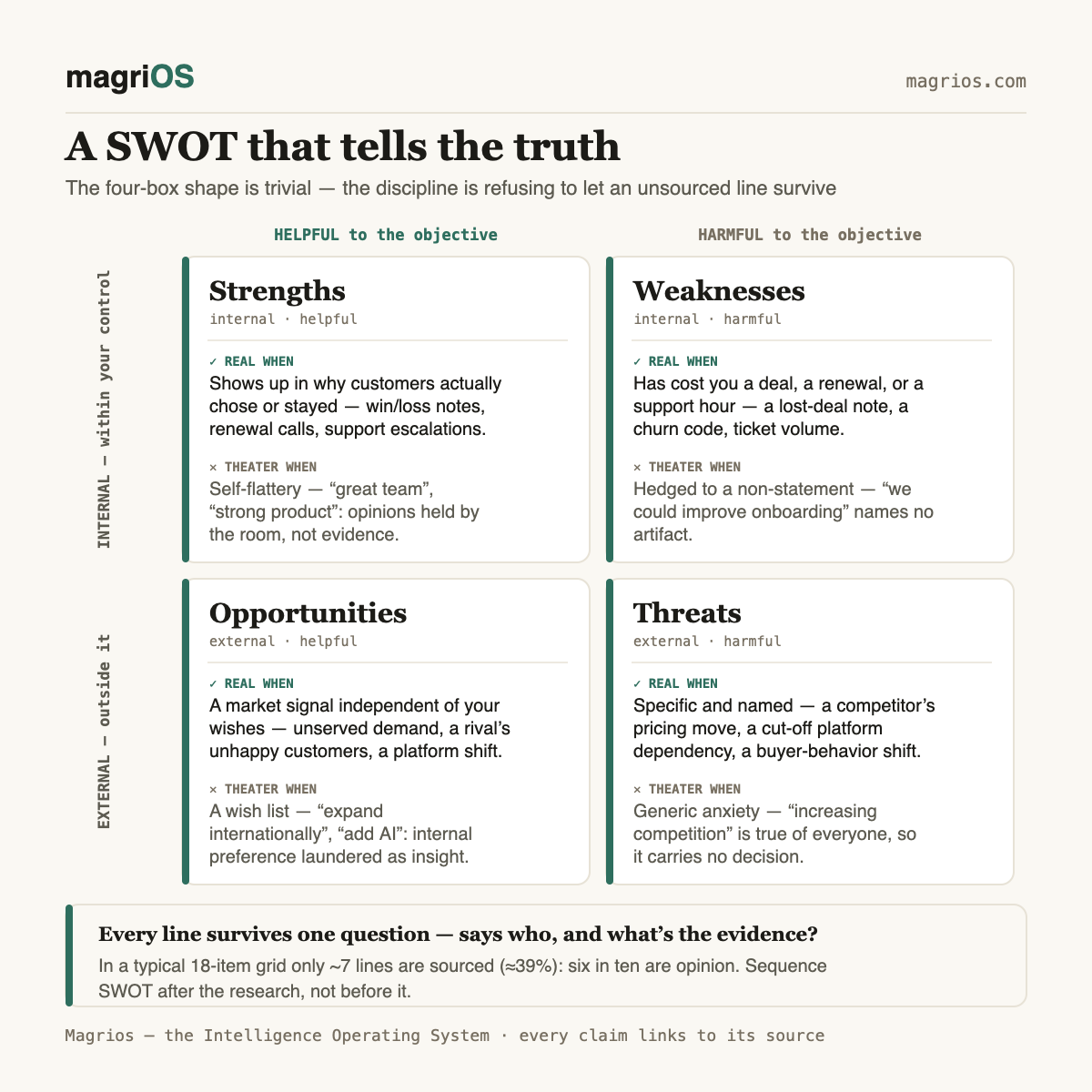
Here's the tell: read a SWOT grid out loud to someone who wasn't in the room. If every line sounds like it could belong to any company in your category — "strong team," "great culture," "increasing competition," "market is growing" — you haven't done a SWOT analysis. You've done a mood board. A real SWOT item survives one question: says who, and what's the evidence? If a bullet can't answer that, it doesn't belong on the grid.
The framework itself is simple and genuinely useful: Strengths and Weaknesses are internal and (mostly) within your control. Opportunities and Threats are external and largely outside it. The internal/external split is the whole point — it forces you to separate "things we can fix ourselves" from "things happening in the market that we need to respond to." Collapse that distinction and you get a list of complaints and hopes instead of a decision tool.
On origin: SWOT's authorship is genuinely disputed. It's commonly associated with work done at the Stanford Research Institute in the 1960s and 70s, with Albert Humphrey's name frequently attached to it, but the historical record on who actually invented the exact four-box format is not clean, and multiple business schools and consultants have claimed credit or independently converged on similar tools. Treat any confident single-inventor story you read elsewhere with some skepticism — we're not going to manufacture false certainty here.
Where SWOT degenerates into checkbox theater
Four failure modes show up over and over in SaaS strategy offsites:
Strengths become self-flattery. "Great team," "strong product," "excellent culture" — these are opinions held by the people in the room, not evidence a buyer, investor, or competitor would recognize. A strength is only real if it shows up in why customers actually chose you or stayed — pulled from win/loss notes, renewal conversations, or support escalation patterns, not from how the team feels about itself.
Weaknesses get hedged into meaninglessness. "We could improve onboarding" is not a weakness, it's a non-statement. A real weakness is something that has cost you a deal, a renewal, or a support hour — traceable to an actual lost opportunity, a churn reason code, or a competitive loss. If nobody can point to the artifact (the lost-deal note, the churn interview, the support ticket volume) behind a weakness, it's an opinion wearing a weakness costume.
Opportunities become wish lists. "Expand internationally," "move upmarket," "add an AI feature" — these are things the team wants to do, laundered through the Opportunities box so they look like market-driven insight instead of internal preference. A real opportunity is backed by a signal that exists independent of your team's desires: a segment showing inbound demand you're not serving, a competitor's customers expressing dissatisfaction in public forums, a regulatory or platform shift that changes buyer behavior.
Threats become generic anxiety. "Increasing competition" and "economic downturn" are true of almost every company at almost every time, which means they carry no decision-making information. A real threat is specific: a named competitor's pricing move, a platform dependency that could be cut off, a buyer behavior shift you can point to.
How to run it so it survives contact with a skeptical board member
- Sequence it after research, not before. SWOT is a synthesis tool, not a discovery tool. If you haven't already gathered win/loss data, churn reasons, and some read on the competitive and buyer landscape, running SWOT first just means you're synthesizing guesses. Do the fact-finding — internal (win/loss, churn, support, sales notes) and external (buyer conversations, market signals, competitive moves) — and then use SWOT to organize what you found.
- Require a source for every line. Next to each bullet, name the artifact: "Q2 win/loss interviews (4 of 6 mentioned X)," "churn survey, category: missing integration," "three inbound leads from [segment] in the last quarter." If you can't name a source, the item goes into a separate "hypotheses to test" list — not the SWOT grid itself.
- Separate internal opinion from external evidence explicitly. The external quadrants — Opportunities and Threats — are the ones most often filled with internal opinion masquerading as market insight. This is exactly where grounding in real buyer-side and competitive research pays off, rather than relying on what the product or sales team assumes the market wants; a market-intelligence pass through actual buyer conversations and competitor evidence will surface opportunities and threats a brainstorm never will.
- Assign an owner and a decision to each quadrant, not just a list. A SWOT with no next action attached is a museum piece. Each strength should map to something you double down on or defend; each weakness to something you fix or explicitly decide not to fix; each opportunity to a bet you place or defer with a stated reason; each threat to a mitigation or an accepted risk.
- Put a date on it and revisit. Markets move. A SWOT done at a January offsite and never looked at again is a snapshot mistaken for a strategy. Set a recurring review — quarterly is reasonable for most SaaS companies — where you check which items are still true.
Worked example: scoring your own SWOT for evidence, not vibes
Here's a hypothetical gut-check you can run on any SWOT grid before it goes in front of a board.
Say a 12-person SaaS team runs a SWOT session and produces 6 strengths, 5 weaknesses, 4 opportunities, and 3 threats — 18 items total. Go through each one and mark it "sourced" only if someone can point to a specific artifact behind it (a win/loss note, a churn reason, a support ticket pattern, an actual buyer conversation, a documented competitor move). In this hypothetical, only 7 of the 18 items pass that test.
7 divided by 18 is about 39%. That means roughly six out of ten lines on the grid are opinion, not evidence. A board member who asks "says who?" on a random line has better than even odds of hitting an unsourced claim. That's not a strategy document, it's a discussion starter — which might be fine for an internal working session, but it shouldn't be presented as a finished strategic input until the sourced fraction is meaningfully higher, ideally above half.
The exercise isn't about hitting a magic percentage. It's that forcing yourself to count exposes how much of a typical SWOT is unsupported assertion, and gives you a concrete task — go get evidence for the other 11 items, or cut them — instead of a vague feeling that the exercise wasn't very useful.
What honest SWOT actually changes
Done this way, SWOT stops being an offsite ritual and becomes a forcing function: it makes the gap between what your team believes and what you can actually show visible, in one document, before you commit resources based on it. That's the entire value of the framework — not the four-box shape, which anyone can draw, but the discipline of refusing to let an unsourced claim survive into a strategic decision.
If your organization already treats strategy and planning as separate disciplines — deciding what to do versus scheduling how to do it — SWOT belongs firmly on the strategy side, feeding the decisions that planning then executes against. Used as a planning input without the evidence discipline above, it just formalizes whatever the room already believed walking in.