How to tell a model update from real market movement
Guide · Continuous Intelligence · 5 min read · last verified 2026-08-11
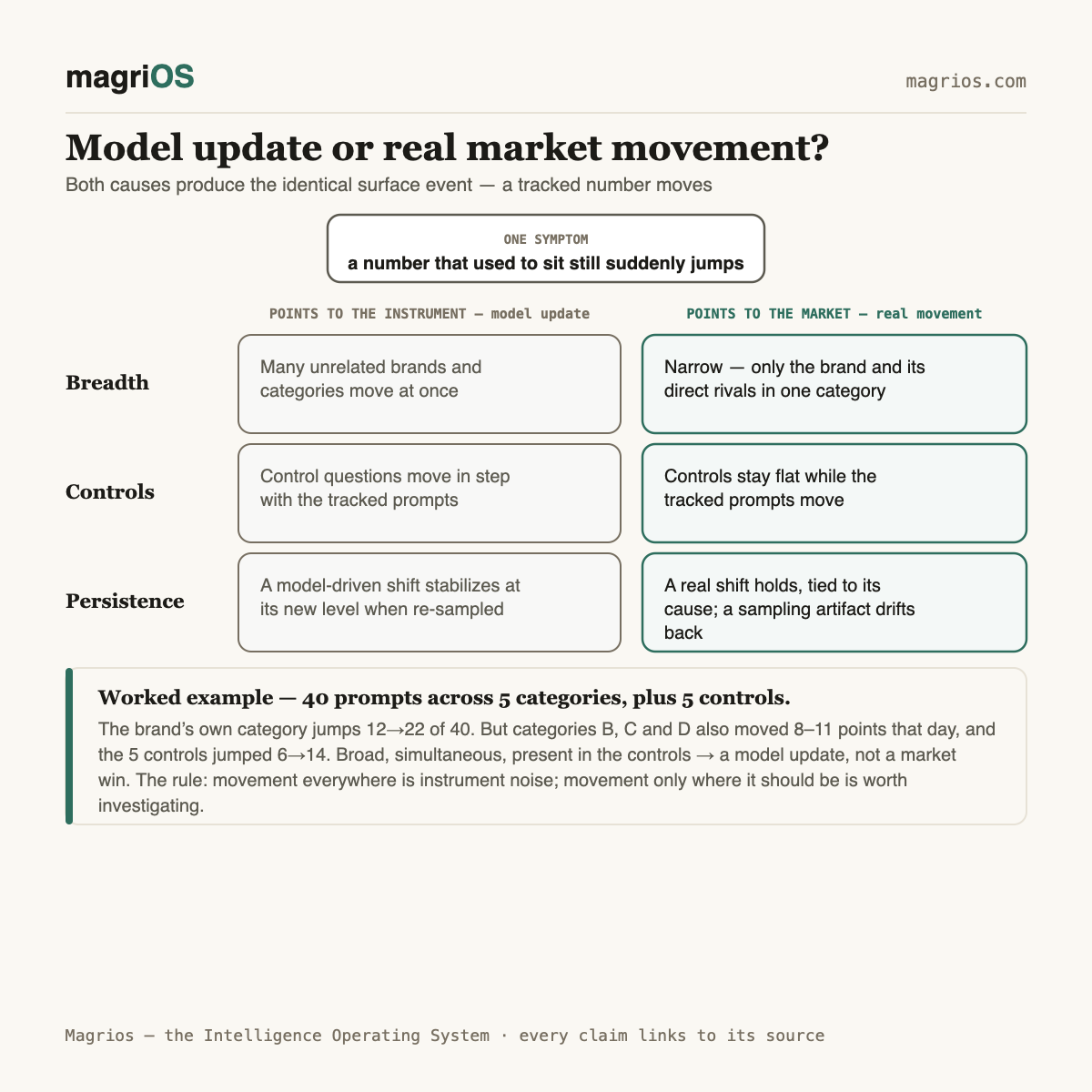
A visibility score change signals a model update, not market movement, when it shifts uniformly across unrelated brands and topics on the same day. Real market movement shows up selectively, tied to specific products or events, and holds after a fresh sampling pass confirms it.
Why this distinction matters
Every AI visibility measurement program eventually hits the same moment: a number that used to sit still suddenly jumps. The instinct is to explain it — a competitor launched something, a press cycle landed, the product finally clicked. That instinct treats the number as a market signal by default, and most of the time that assumption is wrong before it's checked.
Large language models are not static instruments. Providers update base models, swap retrieval indexes, adjust grounding sources, and change system prompts on schedules nobody publishes in advance. Any of those changes can alter how often any brand gets mentioned, cited, or recommended — independent of anything happening in the market itself. Treating an instrument change as a market event means the team ends up debugging the wrong problem: rewriting positioning in response to a shift the underlying model manufactured on its own.
The cost compounds. A team that credits a model update for a real competitive loss stops looking for the actual cause. A team that panics over a model update chases noise, reallocates budget, and burns credibility the next time a real signal shows up and gets waved off as "probably just another model thing."
Different causes, same symptom
Both causes produce the identical surface event: a tracked number moves. That's what makes them hard to separate by eyeballing a dashboard.
A model update changes the measurement instrument. The prompts are the same, the brand is the same, the market hasn't moved — but the system generating answers now behaves differently. This can shift mention rates, citation patterns, or ranking order for reasons that have nothing to do with any single company's performance.
Real market movement changes the underlying reality the instrument is measuring. A competitor ships a feature that gets written about. A company's own content gets indexed and picked up. Pricing changes. A category leader stumbles publicly. These events change what's true about the market, and a well-built measurement system should reflect that change — eventually.
The pattern that tells them apart
Several properties separate the causes reliably, and none of them require guessing:
Breadth. A model update tends to move many unrelated brands and categories at once, because it's a change to the tool doing the measuring, not to any one thing being measured. Real market movement is narrow — it affects the brand and its direct competitors in one category, and leaves unrelated categories untouched.
Controls. A well-designed tracking set includes control questions — prompts about topics with no connection to the brand being watched, included specifically so they should never move. If the controls move in step with the tracked prompts, the shift lives in the instrument. If controls stay flat while the tracked prompts move, the shift more likely lives in the market.
Persistence. A single sampling pass can't distinguish a real shift from ordinary noise — see what sampling error means in this context for why. Re-running the same prompts a few days later separates the two: a model-driven shift usually stabilizes at its new level, while a sampling artifact tends to drift back toward where it started.
Worked example: separating the two signals
Take a hypothetical team tracking 40 prompts spread across five unrelated categories, plus five control questions with no connection to the brand at all.
On Monday, the team's own category shows a jump: brand mentions go from 12 of 40 responses to 22 of 40, a 10-point increase in raw count. Before treating that as a market win, they check the other four categories. Categories B, C, and D — completely unrelated to the brand's market — also moved that day, each up somewhere between 8 and 11 percentage points. The five control questions moved too, shifting from a combined 6 mentions to 14 mentions across categories nobody would expect the brand to appear in at all.
That pattern — broad, simultaneous, and present even in the controls — points to a model update, not a market event. If instead only the brand's own category had moved, and the four unrelated categories plus the five controls had stayed within their normal range, the shift would look like a real market change specific to that one category.
The arithmetic itself doesn't prove causation. What it does is give the team a rule to apply instead of a guess: movement that shows up everywhere is instrument noise; movement that shows up only where it should is worth investigating as real.
Building a habit of checking before reacting
The practical version of this is a short checklist, run before any score change gets written up in a report.
Check whether unrelated categories moved on the same date. Check whether the control questions moved. Re-sample the same prompts after a few days rather than reacting to a single pull. Note the date against any known provider release or update — public changelogs are irregular but worth a quick look. And separate whether the score moved because of aggregate changes or the underlying rank against competitors moved, since those tell different stories.
Programs that run on a slow cadence — for instance the kind covered in why quarterly market reviews miss shifts — are especially exposed here, because by the time a quarterly snapshot gets reviewed, there's no way to tell whether a change from months ago was a one-day model blip or a sustained market shift. The fix isn't a smarter dashboard. It's a habit: hold a set of controls, re-sample before reacting, and only call something a market signal once the pattern rules out the instrument as the cause. From there, comparing overall share of voice trends becomes a much more trustworthy exercise, because the noise has already been filtered out before the number reaches a report.