Adding prompts changes your score without changing your position
Guide · Continuous Intelligence · 4 min read · last verified 2026-08-11
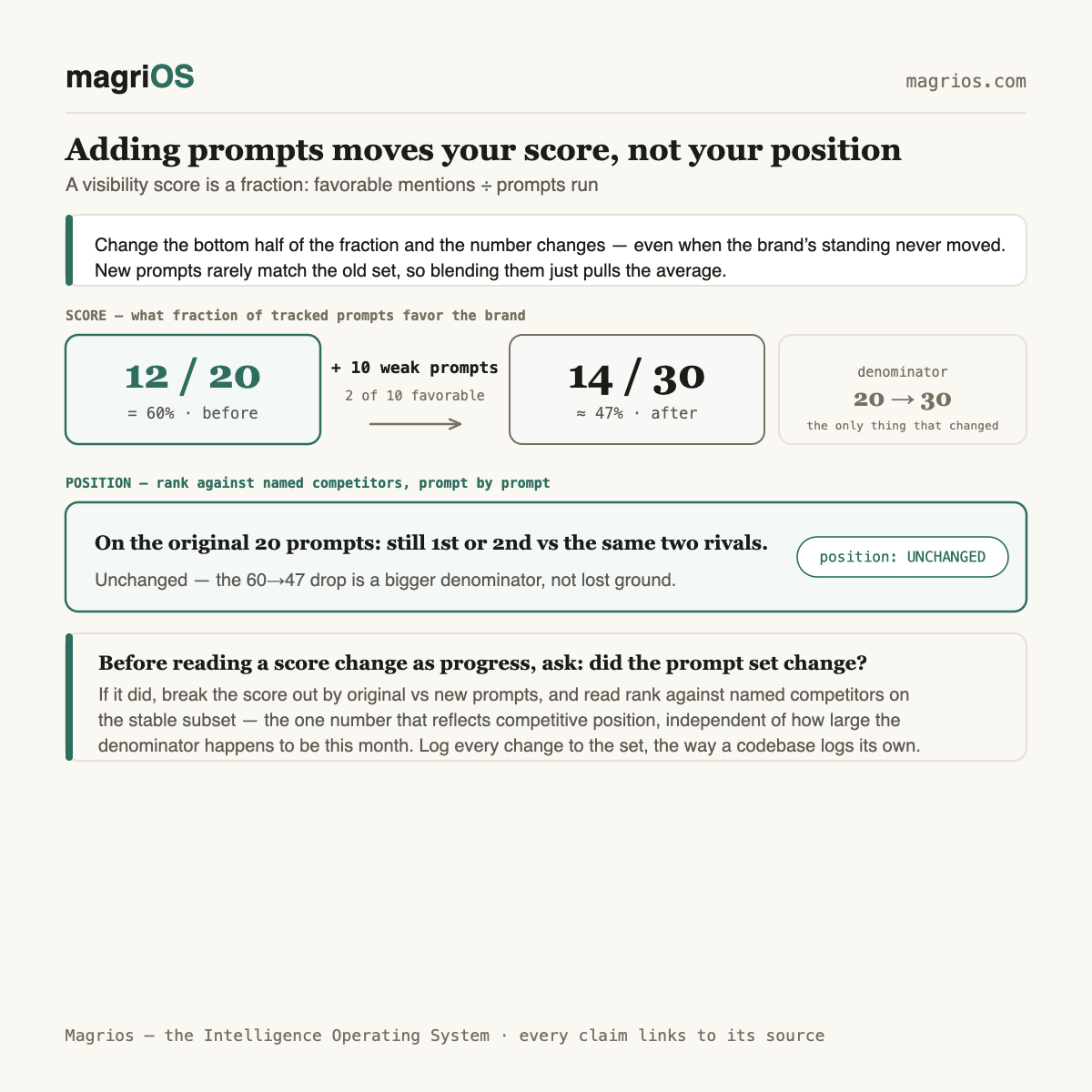
Adding prompts to a tracking set changes the score because it changes the denominator, not because your competitive standing shifted. Your rank against competitors on the prompts you already had stays the same; only the aggregate number moves when new prompts enter the mix.
Score is a fraction; the denominator matters
An AI visibility score, however it's presented, is built from a fraction: some count of favorable mentions or citations, divided by the number of prompts run to produce them. Anything that changes the bottom half of that fraction changes the resulting number, even if nothing about the brand's actual standing moved at all.
This sounds obvious stated plainly, but it's easy to lose track of in practice. A team adds new prompts to a tracking set — a new persona, a new sub-topic, a competitor comparison someone thought of — and the aggregate score shifts. The instinct is to read that shift as progress or regression. Often it's neither. It's arithmetic: a different denominator producing a different result from a mix of old and new data.
The confusion is understandable because the dashboard usually shows one continuous line. Nothing on that line visually marks the point where the underlying prompt set changed shape, so a viewer has no way to know, just by looking at the trend, whether a dip or a rise reflects the market or reflects the measurement getting bigger. Only the underlying prompt log — what was added, when, and how it performed on its own — can answer that.
Why a bigger prompt set almost always moves the number
New prompts rarely perform identically to the existing set. A newly added persona or sub-topic might be one where the brand is unusually strong, or unusually weak, relative to its average across the original prompts. Either way, blending that new performance into the aggregate pulls the overall score toward the new prompts' result, purely as a function of averaging — not because the brand got better or worse at anything it was already being measured on.
This is closely related to why branded queries are the wrong benchmark: swapping the composition of a prompt set — whether by adding prompts, removing them, or shifting the mix of branded to unbranded — changes what the score is actually measuring, even when the label on the dashboard stays the same.
Score versus position: not the same question
Score answers "what fraction of tracked prompts favor this brand." Position answers "how does this brand rank against its specific competitors, prompt by prompt." These are related but not identical, and expanding the denominator affects them differently.
Adding prompts changes the score because it changes what's being averaged. It does not, on its own, change the brand's rank on any of the prompts that were already being tracked — the brand's standing against a given competitor on the original prompt set is exactly what it was before, prompt by prompt. What looks like a meaningful score movement can be entirely explained by a bigger denominator, while the underlying competitive position — the part that actually reflects whether the brand is winning or losing ground — hasn't moved at all.
Worked example: same rank, different score, just from adding prompts
Take a hypothetical brand tracked on 20 prompts, appearing favorably in 12 of them — a 60 percent score. On every one of those 20 prompts, the brand ranks either first or second against its two closest competitors, and that ranking hasn't changed in this example.
The team then adds 10 new prompts covering a sub-topic where the brand performs weakly, appearing favorably in only 2 of the 10. The new combined score across all 30 prompts is 14 of 30, or roughly 47 percent — a meaningful-looking drop from 60 percent. But the brand's rank on the original 20 prompts is unchanged: still first or second against the same two competitors, on every one of them.
Reported as a single trend line, the drop from 60 percent to 47 percent looks like the brand lost ground. Broken out by prompt set, nothing changed on the prompts that were already being tracked — the score moved because the denominator did.
What to check before reading a score change as progress
Before treating a score change as a sign of real movement, check whether the prompt set itself changed — new prompts added, old ones dropped, a persona reweighted. If the set is stable, a score change is more likely to reflect an actual shift, subject to the usual checks for model updates and sampling error. If the set changed, break the score out by the original prompts versus the new ones, and look at rank against named competitors on the stable subset — that's the number that actually reflects competitive position, independent of how large the denominator happens to be this month.
This distinction matters even more for programs that only check in on a slow cadence — see why quarterly market reviews miss shifts — where a denominator change and a real competitive shift are even easier to conflate months apart. Tracking both figures side by side, rather than one blended score, is what keeps a growing prompt set from being mistaken for a shrinking competitive position, or the reverse.
It's also worth logging every change to the prompt set the same way a codebase logs changes to itself — what was added or removed, and when — so that months later, anyone looking at the trend line can tell instantly whether a bend in it lines up with a denominator change rather than having to reconstruct the history from memory. A visibility program that can't answer "did the prompt set change here" isn't equipped to tell score movement from position movement at all.