Leading vs Lagging Indicators: Why Most Market Dashboards Only Report the Past
Comparison · Continuous Intelligence · 4 min read · last verified 2026-08-11
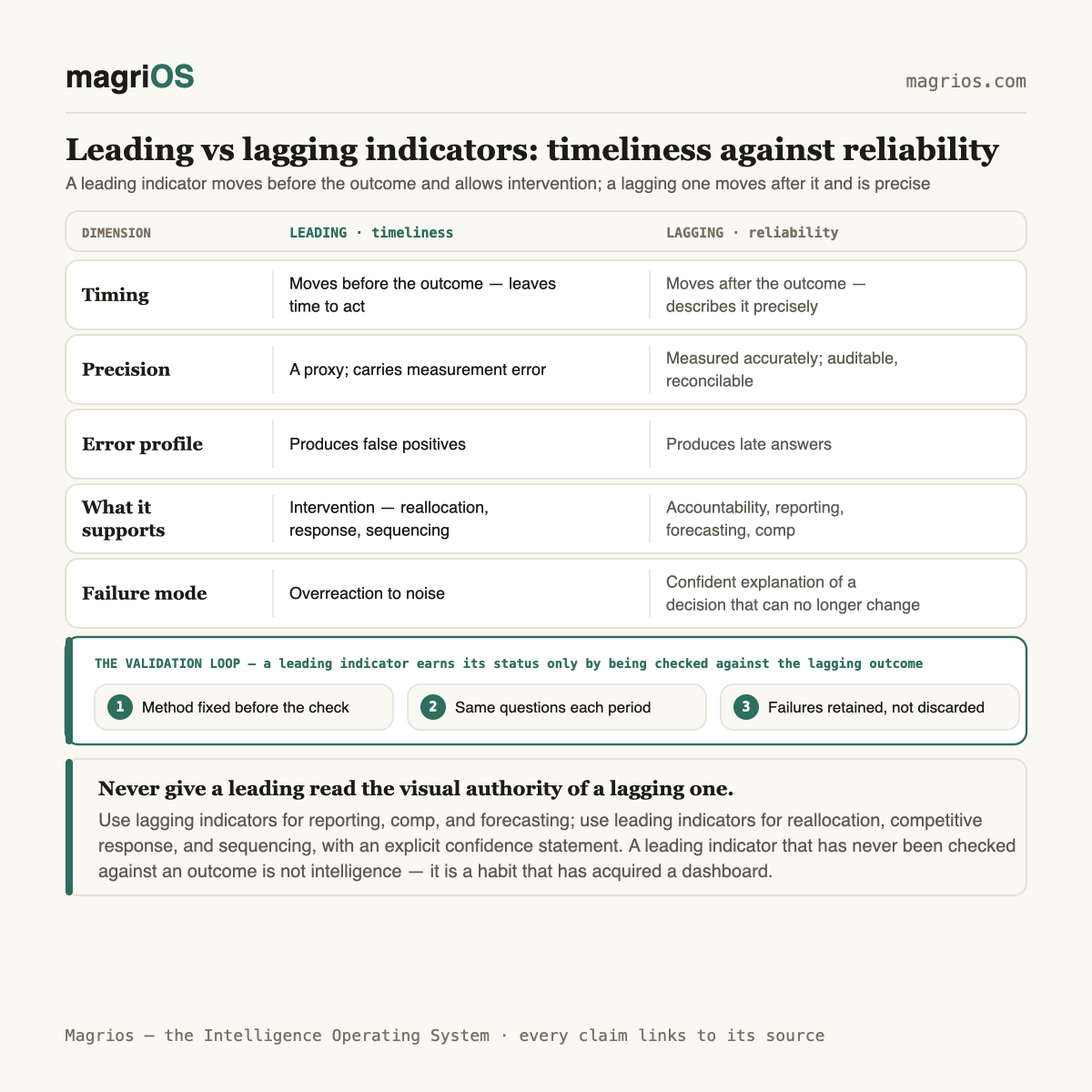
A leading market indicator moves before the outcome it predicts and leaves time to act on it; a lagging market indicator moves after that outcome has already occurred and describes it precisely.
Leading vs lagging market indicators at a glance
- Timing. Leading indicators change before the result. Lagging indicators change after it.
- Precision. Lagging indicators are measured accurately and can be audited. Leading indicators are proxies and carry measurement error.
- Error profile. Leading indicators produce false positives. Lagging indicators produce late answers.
- What they support. Leading indicators support intervention. Lagging indicators support accountability and reporting.
- How they are trusted. Lagging indicators come from internal systems of record. Leading indicators earn trust only by being checked against a lagging outcome afterward.
- Failure mode. Leading indicators invite overreaction to noise. Lagging indicators invite confident explanation of decisions that can no longer be changed.
What leading indicators are
A leading indicator is an observable change that tends to precede a market outcome you care about. In business-to-business markets these are typically inferred from behavior rather than measured directly:
- Hiring activity and the shape of open roles, which reveal where a company is committing capacity.
- Changes to public positioning, packaging, or pricing pages, which reveal a shift in intended buyer.
- New integrations, partnerships, or marketplace listings, which reveal a distribution bet.
- The composition of requirements appearing in requests for proposal, which reveals what buyers have started to expect.
- The mix of reasons recorded in early-stage deal notes, which often moves before the win rate does.
- New names appearing in evaluations, which is the earliest form of the question covered in how to detect a new competitor early.
Each of these is a market signal: an observation that suggests a change without confirming it. They are cheap to collect, ambiguous by nature, and only meaningful in aggregate and over time.
The honest description of a leading indicator is that it buys time in exchange for certainty. Acting early means acting on incomplete information, and a portion of those actions will be wrong. That is the deal, and organizations that refuse to accept the false-positive rate end up using leading indicators only to confirm decisions they have already made.
What lagging indicators are
Lagging indicators are the outcomes themselves, measured after the fact: closed-won and closed-lost counts, revenue, renewal and churn rates, realized pricing, share of shortlists, customer counts by segment. They come from systems of record, they can be reconciled, and two people looking at the same query get the same number.
That precision is exactly why they dominate reporting. It is also why they are weak instruments for steering. By the time churn moves, the causes are several quarters old, distributed across product, pricing, support, and competitive changes, and no longer separable. A lagging indicator tells you the score. It does not tell you which play caused it, and it never arrives while the play is still callable.
There is a further trap: lagging indicators are frequently used as explanations rather than measurements. A quarter's win rate falls, an explanation is constructed to fit, and the explanation is treated as a finding. Nothing in the lagging data supports the causal claim.
How they relate
The relationship is a validation loop, and it is the only thing that separates a real leading indicator from a plausible story.
A candidate leading indicator earns its status by being checked against the lagging outcome it claims to predict, using a method that does not change between checks. If competitor hiring in a category is proposed as a predictor of that competitor appearing in your deals, that proposition can be tested against the deals that actually occurred. Most candidates fail this test, and the failures are the useful part.
Three conditions make the loop trustworthy:
- The method is fixed before the check. Redefining what counts as a signal after seeing the result produces indicators that only ever worked in hindsight. This is the same discipline described in why trend lines need fixed methodology.
- The same questions are asked each period. Comparability across time and across competitors requires a stable instrument — see what is a benchmark question set.
- Failures are retained. An indicator that fired three times and preceded the outcome once is a weak indicator, and that record has to survive for anyone to know it.
Coincident indicators sit between the two: they move with the outcome rather than before or after it. Pipeline composition and inbound demand often behave this way, and they are frequently misfiled as leading.
Which to use when
Use lagging indicators for board and executive reporting, compensation, forecasting, and any context where the number will be challenged and must be reconcilable. Do not use them to justify an intervention, because the window they describe has closed.
Use leading indicators for resource reallocation, competitive response, roadmap sequencing, and territory or segment focus — decisions where being roughly right early beats being exactly right late. Attach an explicit confidence statement and name what would falsify the read.
Use both, labeled, when presenting to a decision forum. The common failure is presenting a leading indicator with the visual authority of a lagging one — a clean chart implying a precision the underlying observation does not have.
A note on the limits. Leading indicators do not make an organization faster; they only make earlier action possible for organizations already able to act. Where decisions require a planning cycle regardless, earlier detection produces anxiety rather than advantage. And a leading indicator that has never been checked against an outcome is not intelligence — it is a habit that has acquired a dashboard.