Substitutes vs Direct Competitors: Your Real Threat Is Not on Your Comparison Grid
Comparison · Market Growth · 4 min read · last verified 2026-08-11
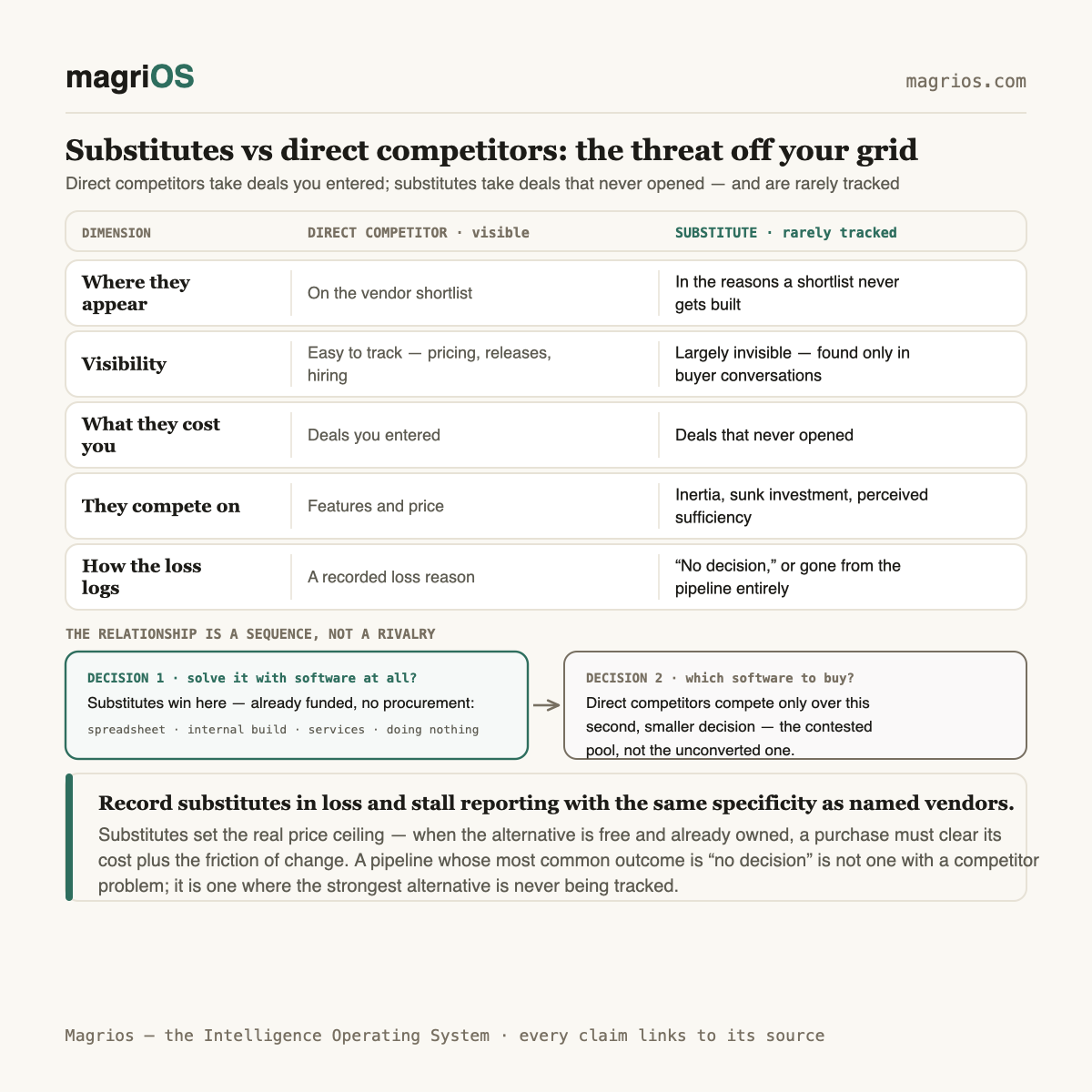
A direct competitor sells a product recognizably like yours to the same buyer; a substitute meets the same underlying need by entirely different means, including a spreadsheet, an internal build, an outsourced service, or the decision to do nothing. Substitutes routinely absorb more of a category's potential revenue than named rivals do, and they are absent from most competitive analysis because they have no marketing to monitor.
Substitutes vs direct competitors at a glance
- Direct competitors appear on vendor shortlists. Substitutes appear in the reasons a shortlist never gets built.
- Direct competitors are easy to track: pricing pages, releases, hiring, announcements. Substitutes are largely invisible and must be discovered through buyer conversations.
- Direct competitors cost you deals you entered. Substitutes cost you deals that never opened.
- Direct competitors compete on features and price. Substitutes compete on inertia, sunk investment, and perceived sufficiency.
- Losing to a direct competitor produces a recorded loss reason. Losing to a substitute usually gets logged as "no decision" or disappears from the pipeline entirely.
- Direct competitors validate that a category exists. Substitutes indicate how much of the category remains unconverted.
What substitutes are
The concept is standard in competitive strategy, where the threat of substitutes sits as one of the forces shaping how much value an industry can capture. In practice, substitutes in business software cluster into a few recurring forms:
- Spreadsheets. Universally available, already paid for, infinitely flexible, and understood by everyone who would use the alternative.
- Internal builds. Engineering time spent replicating enough of the product to remove the urgency, often with a maintenance cost nobody has priced.
- Manual process. People doing the work by hand, absorbed into existing headcount and therefore invisible as a line item.
- Services. An agency, consultancy, or contractor delivering the outcome rather than the tool.
- Adjacent tools stretched. A product bought for something else, used past its intended purpose because it is already deployed and approved.
- Doing nothing. Tolerating the problem, which is the strongest substitute in any category where the pain is chronic rather than acute.
The reason these dominate is structural. Each one is already funded, already approved, and requires no procurement cycle. They compete not on being better but on being present.
What direct competitors are
Direct competitors sell into the same buying process, get compared against you on similar criteria, and are named by buyers when asked who else is being evaluated. They are the visible surface of a category and they are genuinely important — they set price expectations, define feature baselines, and shape how buyers describe the problem.
They are also over-weighted in most analysis, for reasons that have nothing to do with importance:
- They are observable, so tracking them feels like progress.
- They are specific, so losing to one produces a clear internal narrative.
- They are responsive, so competing against them yields visible cause and effect.
- They appear in deals, so the sales organization surfaces them continuously while never encountering the deals that did not open.
How they relate
The relationship is a sequence, not a rivalry. In most categories, a buyer decides whether to solve the problem with purchased software before deciding which software to purchase. Substitutes win the first decision. Direct competitors compete over the second.
That ordering has consequences:
- The larger pool almost always sits before the shortlist, not on it. A category where most potential buyers are still using spreadsheets has more unconverted demand than contested demand.
- Competitive feature work aimed at rivals does nothing for buyers who never entered the comparison. Beating a competitor on a capability does not persuade someone who has not accepted that the problem warrants a purchase.
- Substitutes set the real price ceiling. When the alternative is free and already owned, the purchase must clear the cost of the substitute plus the friction of change.
- Market sizing that counts only vendor revenue systematically undercounts the opportunity, because the substitute population is not spending anything to measure.
Which lens to use when
Use the direct competitor lens when the question concerns a live comparison:
- What does a buyer see when they build a shortlist?
- Where do published prices and packaging sit relative to each other?
- Which capability gaps come up repeatedly in competitive deals?
- How does a rival's positioning change after a product launch?
Use the substitute lens when the question concerns the size or growth of the opportunity:
- Why do qualified opportunities stall without a named alternative?
- What is the actual incumbent in accounts that have never bought anything in this category?
- What would have to change for a manual process to become intolerable?
- How much of the addressable market has not yet accepted that the category exists?
Use both when forecasting. Growth comes from two distinct sources — share taken from rivals and conversion from substitutes — and they respond to entirely different actions. Share is won with differentiation. Conversion is won by making the cost of the status quo legible.
The practical discipline is to record substitutes in loss and stall reporting with the same specificity applied to named vendors. A pipeline where the most common outcome is "no decision" is not a pipeline with a competitor problem. It is one where the strongest alternative is never being tracked.