Porter's Five Forces, applied to a SaaS market
Guide · Frameworks · 5 min read · last verified 2026-08-11
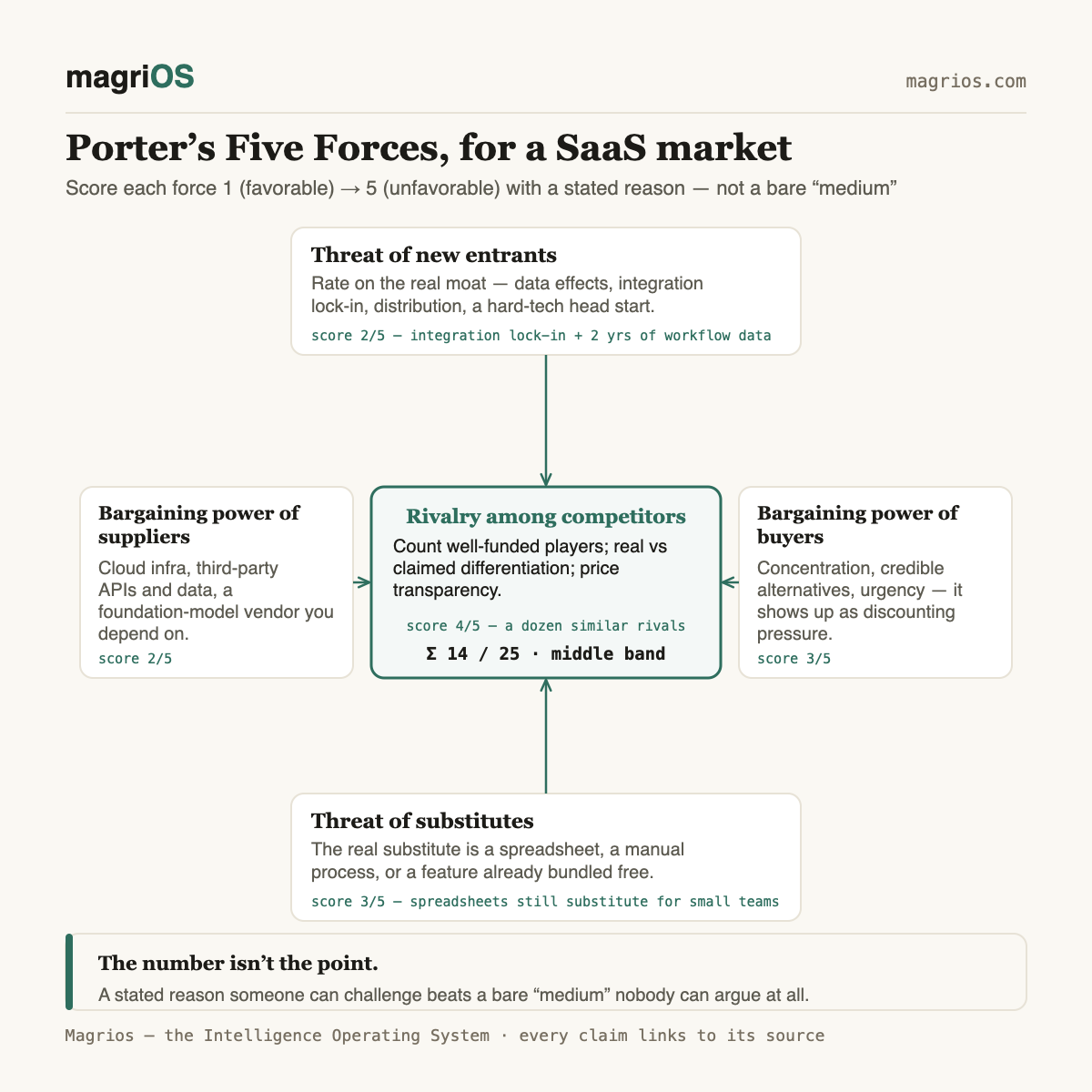
The altitude problem: Five Forces was built for industries, not products
Michael Porter introduced the five forces framework in a 1979 Harvard Business Review article, "How Competitive Forces Shape Strategy," as a way to assess the structural attractiveness of an entire industry — steel, airlines, retail. That origin matters, because most SaaS teams apply it at the wrong altitude: they run Five Forces on their own product category instead of the market they're competing in, fill in a table with "high / medium / low" next to each force, and stop. Nothing changes. No pricing decision, no packaging decision, no roadmap decision comes out the other end. That's the checkbox-theater version of this framework, and it's the default outcome unless you deliberately fight it.
The five forces are: threat of new entrants, bargaining power of buyers, bargaining power of suppliers, threat of substitute products, and rivalry among existing competitors. Porter's insight was that industry profitability is a function of the interaction of all five, not any single one — a market can look uncompetitive on rivalry and still be unattractive because buyer power is crushing margins, for instance.
Where it degenerates into theater for SaaS founders
Three patterns show up constantly:
The rating with no evidence behind it. A team writes "buyer power: medium" on a slide. Medium relative to what? Based on what observed behavior? Without a stated reason, the rating is a number pulled from the air, and two people in the same room could defensibly write "high" or "low" for the same force with equal (lack of) justification.
Doing it once, at an offsite, and never again. Five Forces describes a snapshot of industry structure. SaaS markets move fast — a new well-funded entrant, a platform vendor bundling a competing feature for free, a shift in how buyers evaluate tools — and a Five Forces analysis from eighteen months ago can be actively misleading today.
No decision attached to the output. The single biggest tell of theater: after the exercise, ask "so what are we going to do differently because of this?" If the honest answer is nothing, the exercise didn't do its job. Five Forces should inform something concrete — where you invest in defensibility, how you price, which segment you prioritize, what you build next.
Running each force honestly in a SaaS context
Threat of new entrants. SaaS has low capital barriers to shipping a first version, which makes founders assume this force is automatically "high." But the real question is defensibility once a challenger exists: do you have data network effects, switching costs from integrations and workflow lock-in, proprietary distribution, or a head start on a hard technical problem? Rate this on the actual moat you can point to, not on how easy it looks to build a competing landing page.
Bargaining power of buyers. This is often the most underrated force in B2B SaaS. Ask concretely: how concentrated is your buyer base (a handful of large accounts, or a long tail)? Do buyers have credible alternatives, including building in-house? Can they wait you out in a sales cycle, or do they have urgency? Enterprise buyers with procurement teams and multiple vendor options exert real, measurable power — you can often see it directly in discounting pressure during negotiations.
Bargaining power of suppliers. For SaaS, "suppliers" usually means cloud infrastructure, key third-party APIs or data providers, and in some categories a foundation-model vendor you depend on. If your product's cost structure or feature set is materially dependent on one vendor's pricing and roadmap decisions, that's real supplier power working against you, not a hypothetical.
Threat of substitutes. The mistake here is scoping substitutes too narrowly to direct competitors. The actual substitute for a lot of B2B software is a spreadsheet, a manual process, an internal script, or a feature bundled free inside a tool the buyer already pays for. Ask what your prospects were doing before they considered buying anything in your category — that's your substitute set.
Rivalry among existing competitors. Count the well-funded players, look at how differentiated the offerings actually are versus how differentiated the marketing claims to be, and look at price transparency. Rivalry intensifies when competitors are similar in size, growth has slowed, and switching costs for the buyer are low.
Worked example: turning five ratings into one attractiveness score
Here's a hypothetical scoring approach that forces the evidence question instead of letting "medium" stand unexamined. Score each force 1 (favorable to you) to 5 (unfavorable to you), based on a stated reason, then sum.
Hypothetical: a project-management SaaS company scores itself as follows. Rivalry: 4 (a dozen well-funded, similarly-positioned competitors — unfavorable). Threat of new entrants: 2 (meaningful integration lock-in and two years of workflow data — favorable). Buyer power: 3 (mid-market buyers with some but not extreme negotiating leverage). Supplier power: 2 (standard cloud infrastructure, no single-vendor dependency). Threat of substitutes: 3 (spreadsheets remain a real substitute for smaller teams).
Sum: 4 + 2 + 3 + 2 + 3 = 14, out of a possible 25. That places this hypothetical market in the moderately-attractive middle band — not a structurally easy market (rivalry is the biggest drag), but not structurally hostile either. The number itself isn't the point; the point is that "rivalry: 4" now has a stated reason (a dozen well-funded competitors) that someone else in the room can challenge with better information, which is exactly what a bare "medium" rating doesn't allow.
Making the output actually change a decision
Once you have honestly-scored forces, tie each one to an action. High rivalry and low switching costs should push you toward investing in retention and differentiation rather than pure acquisition spend. High buyer power should show up in how you structure contracts and multi-year pricing. Real supplier dependency should trigger a concrete mitigation conversation, not just an awareness that it exists. And do this on a cadence — reviewing it whenever you refresh your view of the total addressable market or run a beachhead-market exercise — rather than as a one-time offsite artifact that nobody opens again.