VP of sales vs first account executive: which hire comes first
Comparison · Founder · 5 min read · last verified 2026-08-11
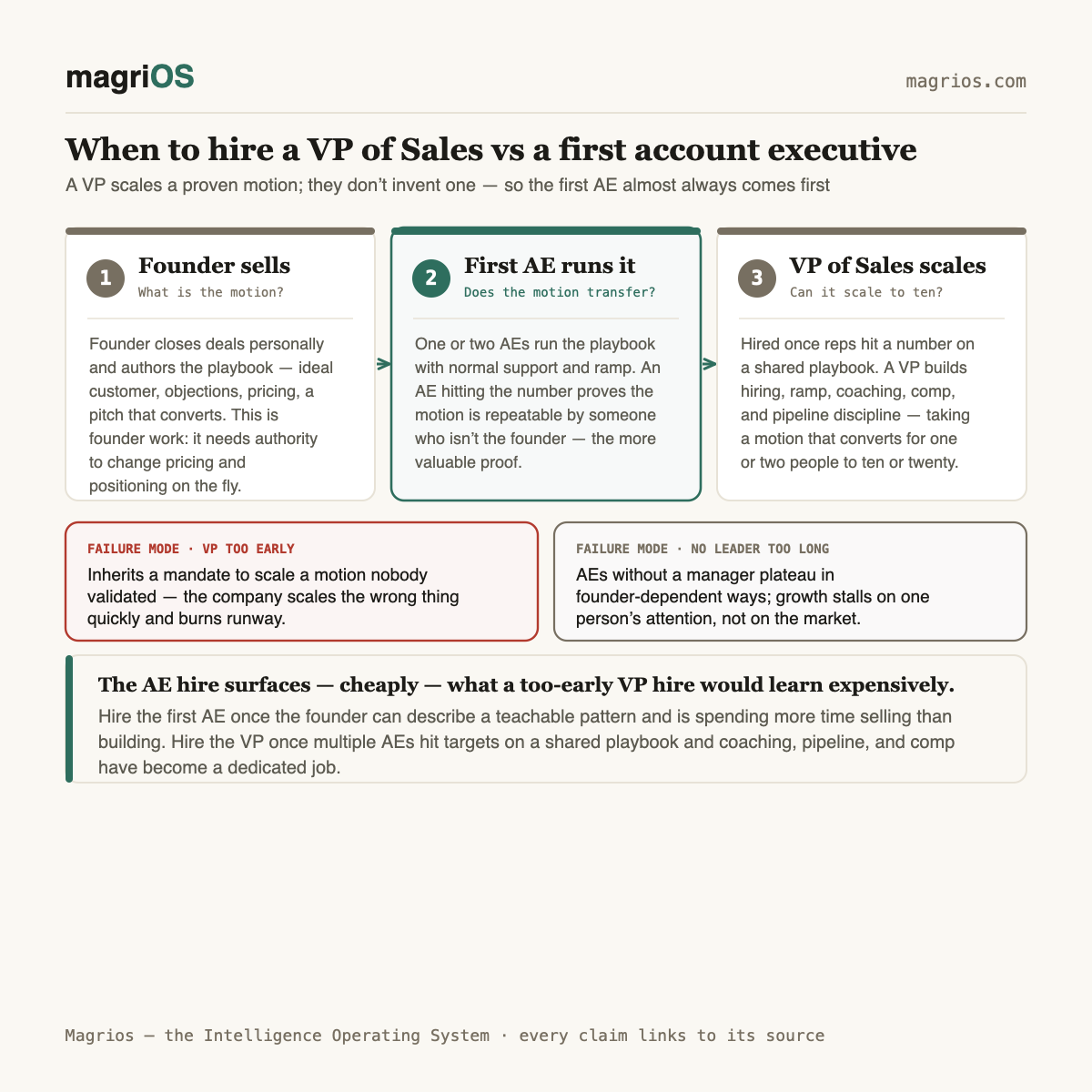
Most companies get this sequence backwards: they hire a VP of Sales before they've hired a single account executive, hoping the VP will build the machine from scratch. In practice a VP of Sales is a force multiplier on a sales motion that already works, not the person who invents one from nothing — so the first account executive almost always comes first, with the founder still closing deals personally until a repeatable pattern exists to hand off.
The core question a VP of Sales can't answer for you
A VP of Sales is hired to scale a motion, not to discover one. If a founder can't yet describe who buys, why they buy, which objections come up in the same order every time, and what a pitch that converts actually sounds like, then no VP hire fixes that gap — they'd be spending their first six months doing exactly what the founder should already be doing through direct selling. That discovery work is inherently founder work, because it requires the authority to change pricing, positioning, and even parts of the product on the fly based on what a prospect just said, and a new hire rarely has that authority or that context in month one.
This is the trap in the hiring sequence: a VP of Sales title implies someone senior enough to run a sales org, and senior sales leaders are, reasonably, hired to manage and optimize, not to originate. Ask a strong VP candidate to spend their first quarter doing the founder-led selling that should have already happened, and either they balk at the mismatch between their level and the task, or they do it and the company has effectively paid VP-level compensation for AE-level discovery work.
What a first account executive hire actually tests
Hiring an AE before a VP is not just cheaper — it answers a different and more urgent question: does this motion transfer? A founder who closes deals is proving the product can be sold by someone with full context, full authority, and total personal investment in the outcome. An AE closing deals with a documented playbook, reasonable ramp time, and normal support is proving something much more valuable — that the motion is repeatable by someone who isn't the founder.
If an AE consistently can't hit reasonable activity or close numbers with the playbook as written, that is information the company needs now, before a VP is hired to scale a process that doesn't yet transfer to anyone else. It might mean the playbook is incomplete, the ideal customer profile is still too broad, or the deal actually still requires founder-level authority to close — all things worth knowing before adding a management layer on top.
What a VP of Sales actually needs to succeed
A VP of Sales needs a system to manage against: a defined target customer profile, a pitch that converts at a known rate, pricing that holds up under real negotiation, and at least a couple of reps, or one AE with a track record, whose performance gives the VP something to diagnose. Without that baseline, a VP has no way to tell whether a new rep is underperforming or whether the underlying motion itself is broken — every hiring and coaching decision becomes a guess layered on top of another guess.
This is also what a VP is actually good at: taking a motion that already converts for one or two people and building the hiring, ramp, coaching, comp design, and pipeline discipline that lets it convert for ten or twenty. That is a genuinely hard, specialized skill set. It is a different skill set from finding product-market fit in the sales motion itself, which is why asking a VP to do both at once usually means one of the two jobs gets done badly.
Failure mode: hiring a VP of Sales too early
When a VP is hired before the motion is proven, they inherit a mandate to scale something that hasn't actually been validated. Because they are senior and expensive, the instinct is to justify the hire by building fast: standing up a team, writing a comp plan, and setting quotas around a playbook the founder never fully authored or de-risked. If the underlying motion is wrong, the company now scales the wrong thing quickly, burning cash on reps chasing a number nobody verified was hittable. The VP is set up to fail through no fault of their own, and the company loses months of runway relearning a lesson the first AE hire would have surfaced far more cheaply.
Failure mode: waiting too long to hire any sales leader
The opposite failure is just as real. If a founder keeps hiring AEs directly without ever adding a dedicated sales leader, the founder remains the only person coaching reps, reviewing pipeline, and refining comp — on top of running product, fundraising, and everything else on their plate. Growth stalls not because the motion doesn't work, but because it has hit the ceiling of one person's attention. A team of AEs without a manager tends to plateau in inconsistent, founder-dependent ways long before the market itself is the constraint.
A simple sequencing model
The practical order is rarely complicated once it's stated plainly. First, the founder sells directly and personally authors the playbook: ideal customer, objections, pricing, and a pitch that reliably converts. Second, one or two AEs run that playbook with reasonable support, and the company watches whether the numbers transfer — not identically, but close enough to prove repeatability. Third, a VP of Sales is hired once there is a real motion with at least a couple of reps hitting a number using the same playbook, because now there is something concrete to manage, coach, and scale, rather than something to invent from a standing start.
Signals it's time to make each hire
The first AE hire makes sense once the founder has closed enough deals to describe a teachable pattern, and once the founder is spending more time selling than building or leading the rest of the company — the opportunity cost of founder-led sales is starting to outweigh the risk of handing it off. The VP of Sales hire makes sense once multiple AEs are hitting targets using a shared playbook, but coaching, pipeline review, hiring, and comp design have grown into a dedicated job that the founder can no longer sustain alongside their other responsibilities. Hiring in that order matters as much as the go-to-market motion itself, which is why it belongs in the same conversation as strategy-vs-planning and meddic-vs-bant — a sales leader hired before the qualification framework is settled is managing against a moving target. It also has direct cost implications worth modeling against what-is-burn-multiple, since a VP hired too early inflates burn against revenue that hasn't yet proven it will show up on schedule. And because the visibility problem this hire creates or solves shows up first at the board level, it's worth reading alongside why-board-decks-and-operating-reviews-should-differ.