Your board deck and your operating review should not be the same document
Guide · Founder · 5 min read · last verified 2026-08-11
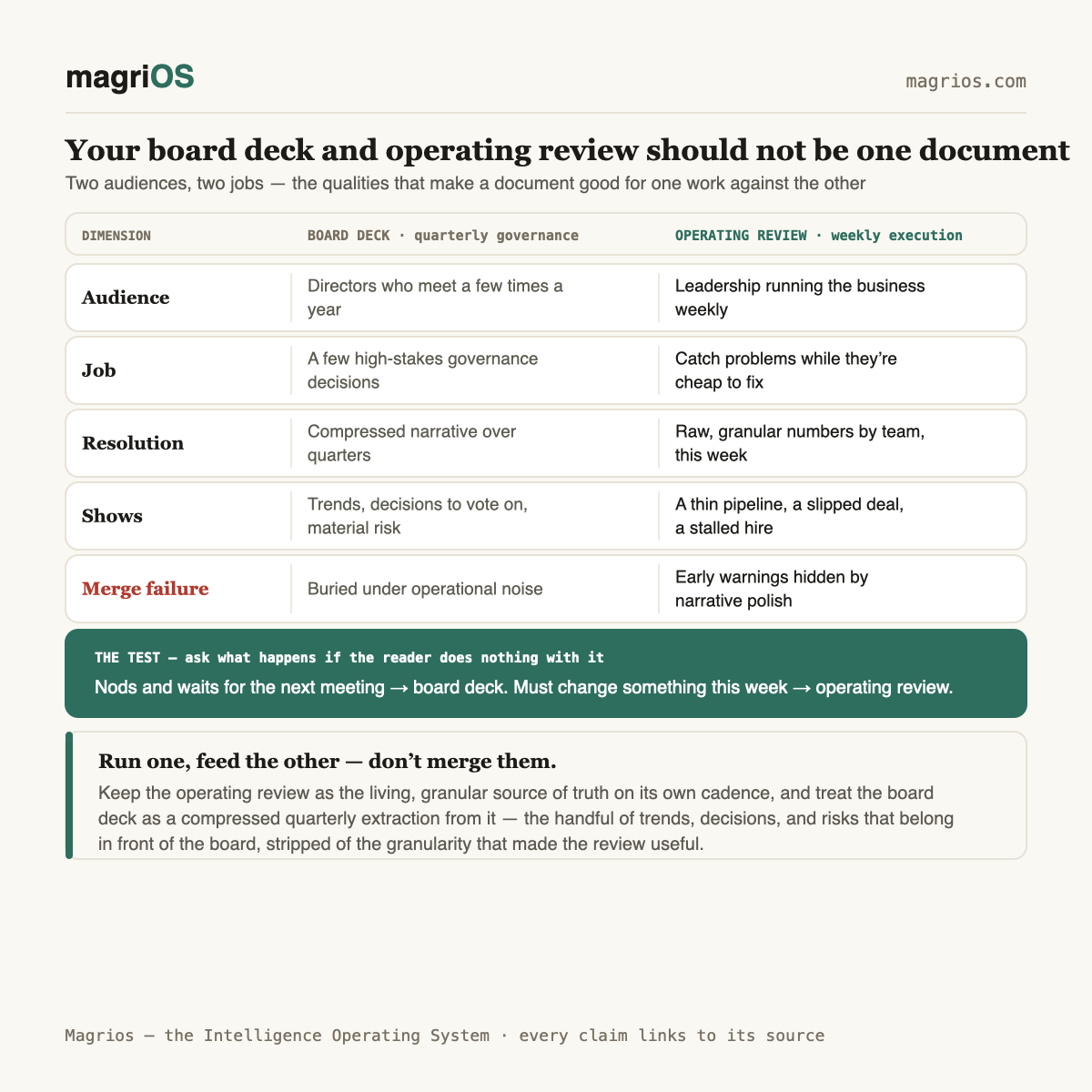
A board deck and an operating review serve two different audiences with two different jobs, and treating them as one document weakens both. The board deck exists to help people who meet quarterly make a small number of high-stakes governance decisions; the operating review exists to help the people running the business every week catch problems while they're still cheap to fix. A document built for one job is, by construction, badly suited to the other.
Two different audiences, two different jobs
A board meets a handful of times a year, sees the business in compressed intervals, and carries fiduciary responsibilities: approving financings, hiring or removing executives, blessing major strategic shifts, and sanity-checking that the company isn't walking into a legal or financial problem. Given that cadence and that mandate, a board deck has to compress months of activity into a narrative a director can absorb in an hour, with enough context to exercise judgment on the handful of decisions actually in front of them that quarter.
An operating review serves the people who are in the business daily or weekly — the founder, the leadership team, sometimes function heads — and its job is completely different: surface the metric that moved the wrong way last week, the deal that slipped, the hire who isn't ramping, before those things compound into something a board would need to hear about three months later. It trades narrative compression for granularity, because the whole point is to catch the small thing before it becomes the big thing.
What a board deck must do
A board deck has to answer a short list of governance-grade questions clearly: is the company on track against the plan the board already approved, what changed since last quarter and why, what decisions need a board vote or input this meeting, and are there risks material enough that a fiduciary needs to know about them now rather than later. Everything else is, from the board's perspective, noise — interesting operational detail that doesn't change what the board needs to decide or approve.
This means a good board deck is deliberately curated. It should highlight trends over quarters, not fluctuations within a week, and it should connect metrics to the handful of decisions the board is actually there to make. A board that receives forty slides of granular weekly detail isn't better informed; it's just more likely to miss the three things that actually needed its attention.
What an operating review must do
An operating review has the opposite job: it has to be granular, current, and unflattering when the truth is unflattering, because its entire value is early detection. It should show the raw weekly or monthly numbers by team or function, flag anything trending the wrong direction before it's a quarter-old story, and give leadership a forum to argue about what to do about it right now, not to seek approval for something already decided.
The operating review can and should include things a board deck never would: a specific rep's pipeline that's thin, a specific feature that's behind schedule, a support queue that's backing up. None of that belongs in front of the board on its own — it's too granular and too early-stage to be governance information — but withholding it from the leadership team that needs to act on it immediately would defeat the entire purpose of running the review at all.
Where the confusion creeps in
The two documents get conflated for an understandable reason: building one polished narrative feels more efficient than building two different documents on two different cadences, and it's tempting to reuse the board deck as the internal operating review, or vice versa, to save the work. The trouble is that the qualities that make a document good for one audience actively work against the other. A board deck's curation and narrative polish, applied to an operating review, hides the early warning signs the review exists to surface. An operating review's granularity and rawness, applied to a board deck, buries the handful of decisions the board actually needs to make under noise it has no way to prioritize.
What happens when you merge them
Merge the two and one of two failure modes shows up. Either the combined document stays polished and curated, in which case the board is getting what it needs but the leadership team has lost its early-warning tool — problems now surface for the first time in board meetings, three months late, dressed up as narrative rather than caught as raw data. Or the combined document stays granular and unfiltered, in which case leadership has its working tool but the board is now wading through operational detail with no clear signal about which parts require its judgment, making it harder, not easier, for directors to do the job they're actually there for.
A simple test to tell them apart
Ask what happens if the reader does nothing with the document. If the honest answer is that a board member reads it, nods, and takes no action until the next scheduled meeting, it's functioning as a board deck. If the honest answer is that someone on the leadership team needs to change something this week because of what's in it, it's functioning as an operating review. A document that tries to trigger both kinds of response at once usually triggers neither reliably.
How to run both without doubling the workload
The operating review can feed the board deck rather than duplicate it. Keep the operating review as the living, granular source of truth updated on its own weekly or monthly cadence, and treat the board deck as a compressed, curated extraction from it every quarter — the handful of trends, decisions, and risks that actually belong in front of the board, stripped of the granularity that made the operating review useful in the first place. Done this way, the board deck and the operating review stop competing to be one document and start being two views of the same underlying data, produced at very different resolutions for very different jobs. This is the same discipline that separates strategy-vs-planning: the operating review is closer to planning, tracking the granular execution against a plan, while the board deck is closer to strategy, focused on the handful of directional decisions that matter this quarter. It also connects directly to what-is-burn-multiple, since burn efficiency usually needs to be tracked weekly in the operating review long before it becomes a single curated line in front of the board. And because the underlying story a company tells about itself can drift out of date in either document, it's worth reading alongside why-fundraising-narratives-age-faster-than-metrics and, on the hiring side, when-to-hire-a-vp-of-sales-vs-a-first-account-executive, since a sales leadership gap is exactly the kind of thing that should surface in the operating review long before it becomes a board-level question.