Auto-renewal clauses hide churn rather than prevent it
Guide · Customer Success · 5 min read · last verified 2026-08-11
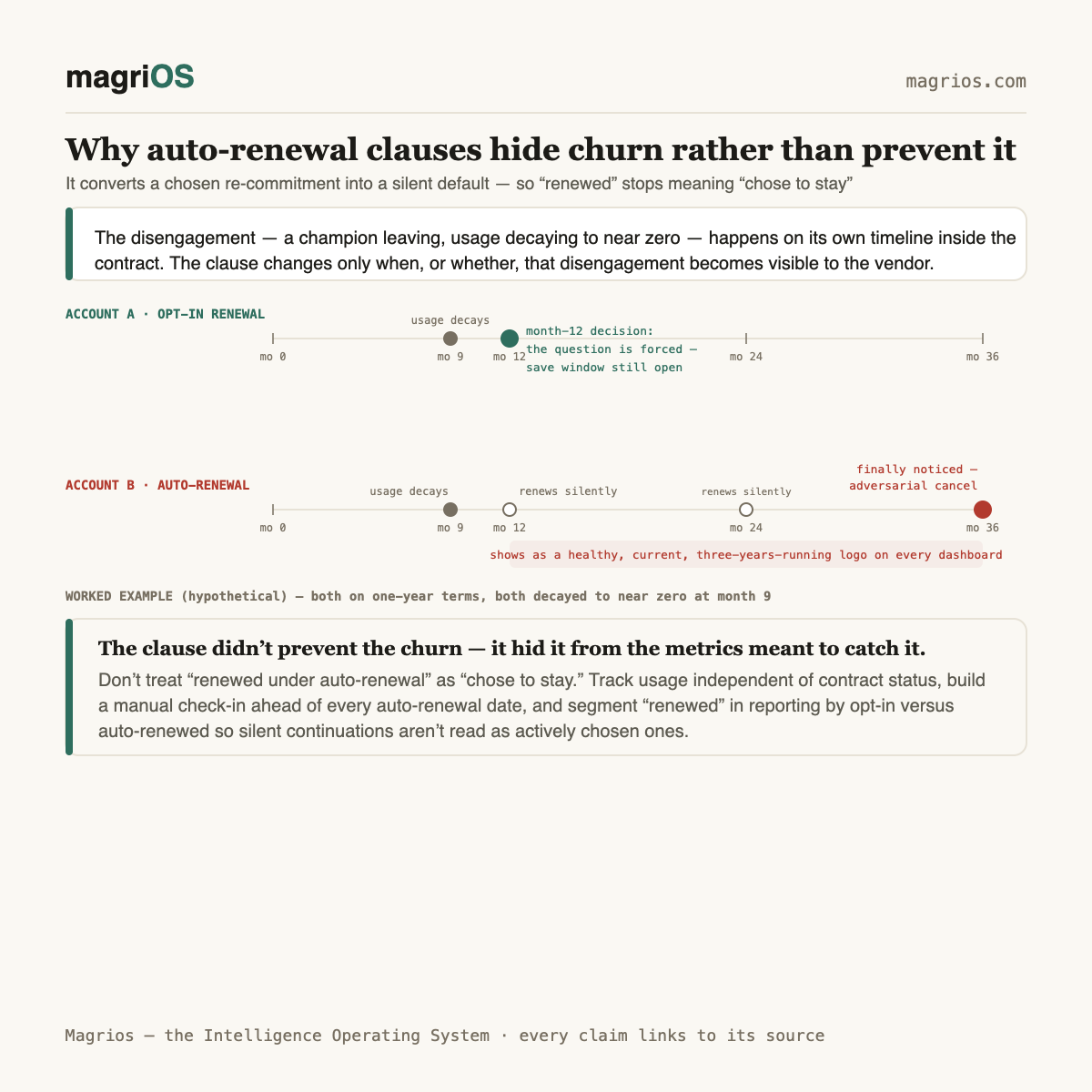
What an auto-renewal clause actually does
An auto-renewal clause converts a contract's expiration date from an event requiring a decision into a default that requires a decision only to avoid. Instead of the customer taking an action to renew, the contract renews unless the customer takes an action to cancel, usually within a defined notice window before the term ends. This is a mechanical change to who has to act, and that mechanical change has a consequence most retention reporting doesn't account for: it changes what "the account renewed" tells you.
Why "renewed" stops meaning "chose to stay"
Under an opt-in renewal, a signed renewal is evidence someone at the customer actively evaluated the relationship and decided it was worth continuing. That's a real, if imperfect, signal — someone looked at the account, compared it to alternatives (including the alternative of doing nothing), and chose to keep paying.
Under an auto-renewal clause, the same outcome — the contract continues — requires no such evaluation. It requires only that nobody with cancellation authority noticed the notice window in time, or noticed and didn't consider the account important enough to act on. A renewal under auto-renewal terms is consistent with genuine satisfaction, and it is equally consistent with an account nobody inside the customer's organization is actively managing anymore. The contract event looks identical in both cases. The underlying reality does not.
This is the same structural problem as the one where silence is not evidence of a healthy account: absence of action is not evidence of satisfaction, it's an absence of information. Auto-renewal takes that problem and builds it directly into the contract mechanics, so it isn't just a monitoring gap — it's a designed default that produces silence exactly where a health signal used to exist.
How this delays the signal, not the disengagement itself
The disengagement — a champion leaving, a workflow migrating elsewhere, usage decaying to near zero — happens on its own timeline, inside the contract period, regardless of the renewal clause. What the auto-renewal clause changes is when, or whether, that disengagement becomes visible to the vendor.
Under opt-in renewal, disengagement tends to surface at the renewal date, because someone has to actively decide to keep paying for a tool they've stopped using, and that decision point forces the question. Under auto-renewal, disengagement can pass through multiple renewal dates completely unremarked, because nobody has to make an active decision for the contract to continue. The account can be functionally churned — zero real usage, no internal champion, no one who could name what the product does — while still showing as a renewed, current, revenue-generating logo on every dashboard that only tracks contract status.
The eventual cancellation, when it comes, then looks sudden: a customer who "had no warning signs" cancels with no notice, because the actual disengagement happened one or two renewal cycles earlier and the contract mechanics simply never surfaced it.
A worked example
Two hypothetical accounts, both on one-year terms, and both with usage that decayed to near zero around month nine — so in both cases the decay is already visible before the first renewal decision arrives. The only thing that differs is the renewal clause:
Account A, opt-in renewal. At the twelve-month mark, someone at the customer has to actively sign a renewal. Usage decayed three months earlier (per the usage decay definition, a sustained drop against baseline), so the renewal conversation surfaces the problem: the account either doesn't renew, prompting an immediate save attempt, or renews reluctantly at reduced scope. Either way, the vendor learns about the disengagement at month twelve, roughly a quarter after it started, and the signal arrives attached to a decision someone has to make.
Account B, auto-renewal. Same one-year term, but with an annual auto-renewal clause. At the twelve-month mark, usage has decayed the same amount, but no one at the customer has to do anything for the contract to continue. It renews silently. At month twenty-four the second cycle auto-renews the same way. The vendor's dashboards show a healthy, current, three-years-running logo through month thirty-six. The actual disengagement is identical to Account A's — it happened at the same point, for the same reasons — but the vendor has no visibility into it until the customer, or a legal or procurement review at the customer, finally notices the auto-renewal and cancels, likely with hard feelings about having "paid for nothing" for two renewal cycles they didn't actively choose — the cycle that began at month twelve and the one that began at month twenty-four.
Same underlying disengagement, first visible at month nine in both accounts. Account A surfaced it at the month-twelve decision; Account B surfaced it two cycles later, if at all. The auto-renewal clause didn't prevent the churn — it hid it from the metrics that were supposed to catch it, and it turned an early, manageable save attempt into a late, adversarial cancellation.
The downstream cost when the signal finally arrives
Two costs compound when auto-renewal delays the signal instead of preventing the disengagement:
- Lost intervention window. Every renewal cycle that passes silently is a cycle the vendor could have used to re-engage a disengaging account but didn't, because nothing in the contract mechanics forced the question.
- A worse cancellation when it happens. A customer who realizes they've been auto-renewed for a product they weren't using tends to be more frustrated at cancellation time than a customer who made an active, informed choice not to renew — the auto-renewal itself becomes a grievance, on top of the underlying dissatisfaction, and can surface as a negative reference or a public complaint rather than a quiet non-renewal.
What to do instead of relying on the clause
Auto-renewal terms aren't inherently bad for a business — they reduce administrative churn from customers who are genuinely satisfied but simply forget to re-sign. The fix isn't removing the clause; it's not treating "renewed under auto-renewal" as equivalent to "chose to stay" in any health or retention reporting.
- Track usage independent of contract status. Usage decay is measurable inside the contract term and doesn't wait for a renewal event to surface, so it shouldn't be the only place disengagement becomes visible.
- Build a manual check-in ahead of every auto-renewal date, not just opt-in renewal dates, specifically to force the evaluation the clause was designed to skip.
- Segment "renewed" in reporting by renewal type — opt-in versus auto-renewed — so a leadership team isn't reading silent, unevaluated continuations as the same signal as actively chosen ones.