Why Silence Is Not Evidence of a Healthy Account
Guide · Customer Success · 5 min read · last verified 2026-08-11
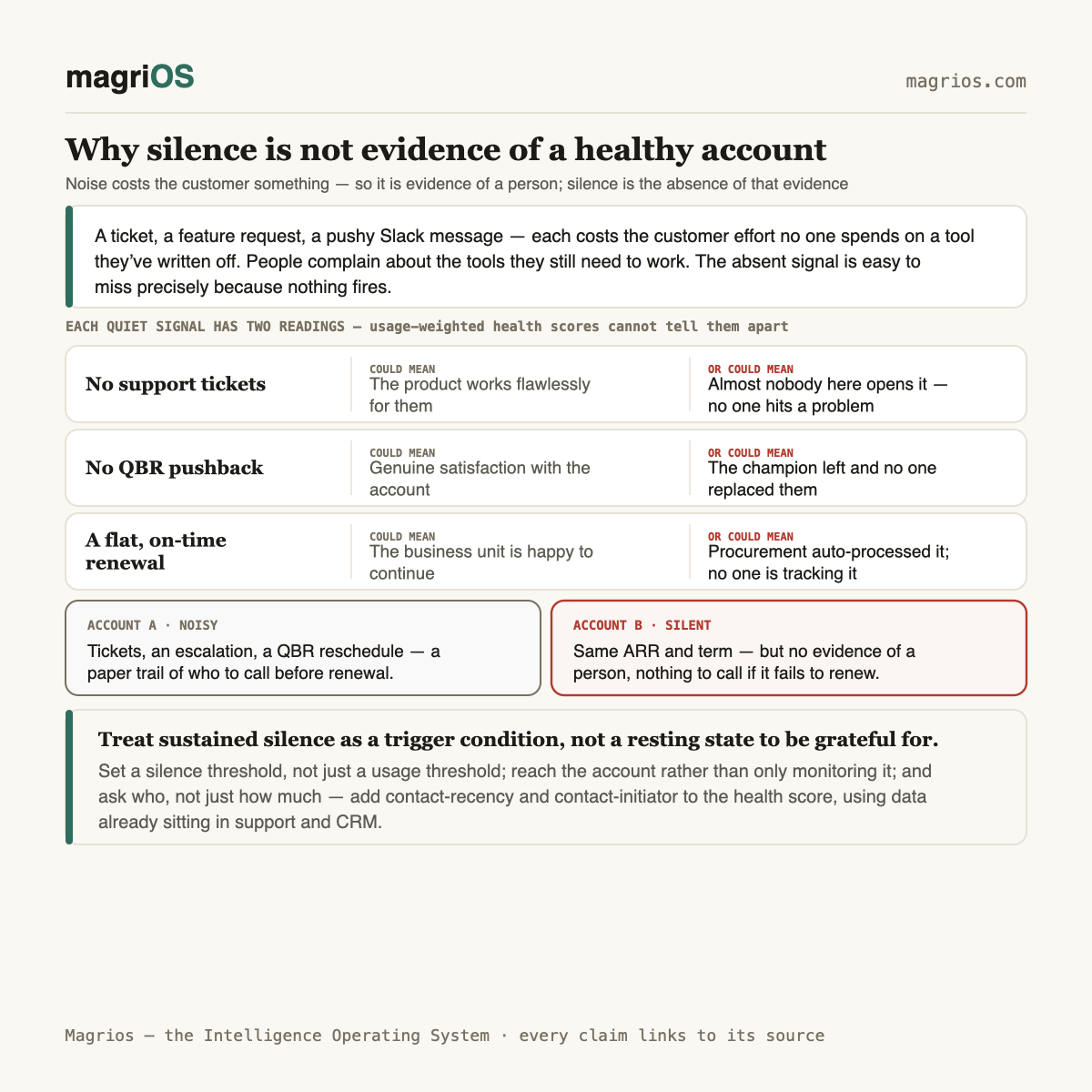
Silence is not the absence of a signal — it is a signal
Customer success teams routinely rank accounts by how much trouble they cause: tickets filed, escalations raised, feature requests submitted. Low-noise accounts get deprioritized because they look easy. That ranking has the mechanism backwards. Noise is evidence someone inside the account is still spending organizational capital on your product. Silence is the absence of that evidence, and it is entirely consistent with no one spending any.
A support ticket, a feature request, a pushy Slack message to your CSM — each of these costs the customer something. Someone had to notice a problem, decide it was worth their time to report, and be willing to be the person inside their company associated with "we need this vendor to fix something." That is an investment. People do not make that investment in a tool they have already mentally written off. They complain about the tools they still need to work.
What creates false confidence in a quiet account
A CSM managing forty accounts naturally triages toward the loudest ones, because loud accounts generate work that has to be done today. This produces a specific blind spot: the quietest accounts in the book are the ones getting the least attention, and they are also the accounts whose disengagement, if it is happening, is least likely to be noticed.
Three mechanisms make silence look like health when it is not:
- No tickets can mean no problems, or it can mean no one is using the product enough to hit a problem. A login-only user who never touches a feature complex enough to break never files a ticket. Ticket volume near zero is consistent with both "this product works flawlessly for them" and "almost nobody here opens it."
- No QBR pushback can mean satisfaction, or it can mean the champion left and no one replaced them. A QBR that gets rescheduled twice and then attended by someone who "will loop in the right people" is not a neutral scheduling issue. It is evidence the internal owner of the relationship is gone or disengaged.
- A flat renewal, paid on time, without questions, can mean the account is happy — or it can mean procurement auto-processed a renewal nobody inside the business unit is tracking anymore. Payment is a fact about the finance department's calendar, not a fact about whether anyone is using the seats.
A worked comparison
Two hypothetical accounts, same ARR, same contract length, to make the mechanism concrete:
Account A, noisy. Three support tickets in the quarter, one feature request escalated by name, one QBR reschedule request because the champion wanted a specific stakeholder present. Every one of these events required a person at the customer to take an action tied to your product. That person is your renewal case, whether or not they know it yet.
Account B, silent. Zero tickets, zero feature requests, QBR calendar invite accepted without comment, no replies in the shared Slack channel in ninety days. Nothing here is a problem on its face — but nothing here is evidence of a person, either. If Account B does not renew, the CSM will not have seen it coming, because there was no channel through which the disengagement could have shown up as noise. The silence was the disengagement, not a gap in reporting it.
Same contract value. Same time horizon. The noisy account gave you a paper trail of who to call before renewal. The silent account gave you nothing to call.
Why this matters more than it looks like it should
The instinct to read silence as low-risk comes from a reasonable place: most operational systems treat "no alerts" as "system healthy," and CSMs import that logic from infrastructure monitoring into account monitoring. The analogy breaks because infrastructure alerts on failure states that are binary and instrumented — a server is up or down. Customer engagement is not instrumented that finely. There is no alert that fires when a champion quietly stops caring; the only signal available is the absence of the noise they used to generate, and absence is much easier to miss than a fired alert.
This is also why noisy accounts that churn are usually less damaging to a book than silent accounts that churn. A noisy account's churn comes with warning — the volume of contact typically drops before the contract ends, giving the CSM a window to intervene. A silent account's churn arrives at the renewal date with no prior drop to notice, because there was no baseline of activity to drop from.
What to do when an account goes quiet
Treat sustained silence as a trigger condition, not a resting state to be grateful for:
- Set a silence threshold, not just a usage threshold. If an account generates zero inbound contact (tickets, replies, meeting requests) for a defined window — say, one full quarter for a mid-market account — that should trigger outreach regardless of what the login-based usage numbers say.
- Reach the account, don't just monitor it. A monitoring dashboard cannot distinguish "quiet because it works" from "quiet because no one's there." Only a human conversation, or a reply to one, can.
- Ask who, not just how much. Usage dashboards tell you seats and sessions. They do not tell you whether the person using those seats has any influence over the renewal decision. A silent account with high usage from a junior individual contributor and zero contact from anyone with budget authority is still a silent account in the sense that matters.
- Weight recency of contact, not just presence of a champion on record. A champion who was active eight months ago and has gone quiet since is functionally the same risk as no champion at all — the org chart says otherwise, the behavior does not.
What this means for health scoring
A health score that weights product usage heavily and engagement lightly — the natural result of usage being easier to instrument — should be reconsidered for accounts where usage is flat or ambiguous — the accounts where engagement signal is doing the most work, because usage alone cannot distinguish "healthy and steady" from "coasting toward non-renewal." A health score that only reads usage will rate a silent account exactly the same whether the silence means comfort or abandonment. Adding a contact-recency and contact-initiator component — did the customer reach out, and was it someone with authority — closes that gap without requiring any data you don't already have sitting in your support and CRM systems.