Your fundraising narrative goes stale faster than your metrics do
Guide · Founder · 5 min read · last verified 2026-08-11
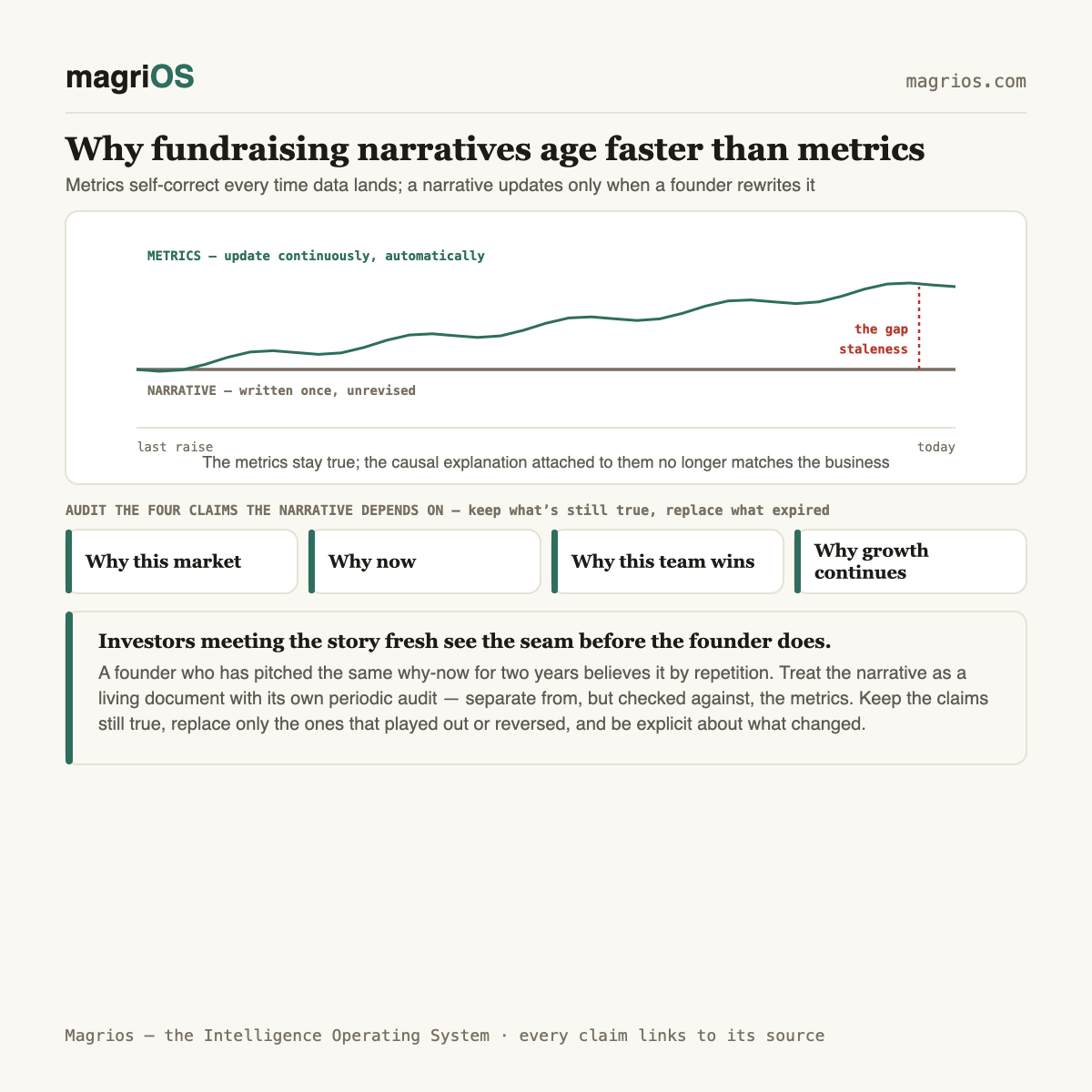
A fundraising narrative is the causal story behind the numbers: why this team, why this market, why now, and why the current trajectory continues. Metrics update automatically every time new data rolls in, but the narrative only updates when a founder deliberately rewrites it — so the story quietly falls out of sync with the business while founders keep pitching the version that worked in the last round.
Why metrics self-correct and narratives don't
A metrics dashboard has no opinion. Revenue, retention, and burn update themselves the moment new data lands, whether or not anyone likes what they show. A narrative has no equivalent mechanism. It was written once, usually under real time pressure during a previous raise, and it sits there, unrevised, until someone consciously decides to rebuild it. That asymmetry is the whole problem: the metrics move continuously while the explanation for the metrics moves only in discrete, effortful jumps that require someone to notice the gap has opened up in the first place.
This is worse than it sounds, because the narrative isn't just decoration around the numbers — it's the causal claim that makes the numbers meaningful to someone deciding whether to invest. Two companies can show identical growth curves and mean entirely different things by them, depending on whether that growth is explained by an expanding market, a temporary tailwind, or a sales motion the company just proved out. When the narrative goes stale, the metrics are still true, but the explanation attached to them may no longer be.
What a stale narrative looks like in a pitch
A stale narrative shows up as a mismatch between the story being told and the business actually being run. A founder might still be pitching a land-and-expand story built around the first several customers, while the current sales motion has quietly shifted to outbound-led deals with a completely different buyer. Or the original why-now argument — a regulatory shift, a technology unlock, a competitor's stumble — was true eighteen months ago and has since either played out fully or been overtaken by a different dynamic nobody's updated the deck to reflect. The metrics in these decks are usually accurate. What's stale is the causal explanation sitting next to them, still describing a version of the business that no longer exists in quite that form.
Where the mismatch shows up first
The gap tends to surface earliest in the rooms where someone is comparing the story to the operational reality in real time, rather than taking the pitch deck at face value. That's exactly the dynamic covered in why-board-decks-and-operating-reviews-should-differ: an operating review, built to surface what actually changed this week or this month, will contradict a narrative long before a board deck does, because the board deck is often assembled by pulling forward language from the last one rather than being rebuilt from what the operating review has been showing all along.
Why investors notice before founders do
Investors meeting a company for the first time have no attachment to the old story — they're hearing it fresh, against a business they're studying from scratch, so a seam between the narrative and the metrics is more visible to them than it is to a founder who has repeated the same story dozens of times and stopped hearing where it strains. A founder who has pitched the same why-now argument for two years believes it by force of repetition, even if the underlying condition it described has since resolved or reversed. An investor doing diligence is comparing the story against the current metrics, the current market, and the current competitive set, and any gap between what's claimed and what's evidenced is precisely what diligence is designed to find.
How to audit your own narrative for staleness
A useful test is to write down the specific claims the original narrative depended on — the market dynamic, the competitive gap, the reason this team specifically wins, the reason growth continues — and check each one against what's true today rather than what was true when it was first written. Claims that were true and are still true can stay. Claims that were true and have since played out, reversed, or been overtaken by a different explanation need to be replaced, not quietly left in the deck because rewriting them feels like admitting the story changed. It's also worth checking the narrative against whatever the company's own operating review has been surfacing recently — a stale narrative often ignores exactly the shifts an operating review would have caught months earlier, which is one more reason those two documents need to stay distinct rather than merged into one polished story.
Rebuilding the narrative without over-correcting
The fix isn't to throw out the old narrative and improvise a new one from whatever's most exciting this quarter — that just produces a different kind of mismatch, a story that's fresh but disconnected from the actual multi-year arc investors expect a company to have. The better approach is to keep the parts of the original story that are still true, replace only the specific claims that have expired, and be explicit about what changed and why, since a founder who can explain how the story evolved reads as someone tracking their own business closely, while a founder who simply swaps stories with no acknowledgment of the shift reads as someone chasing whatever narrative sounds best this month. This is closely related to the discipline in strategy-vs-planning: a narrative is closer to strategy, the directional bet about why the company wins, while metrics are closer to planning, the execution proof underneath it, and both need to be current for a fundraising story to hold together. It's also worth checking the narrative against burn discipline, since a story about efficient growth needs to hold up against what-is-burn-multiple, and against whatever's actually happening in the financing itself, since a narrative built for a clean priced round often needs real revision if the company ends up needing a bridge-round-vs-priced-round instead.
A narrative is a claim about causality, and causality doesn't refresh itself just because a dashboard does. Treating the story as a living document that needs its own periodic audit — separate from, but checked against, the metrics — is the only way to keep the two in sync rather than discovering the gap in front of an investor who's meeting the story for the first time.