Why Showing Less in a Demo Makes Buyers Remember More
Guide · Sales · 5 min read · last verified 2026-08-11
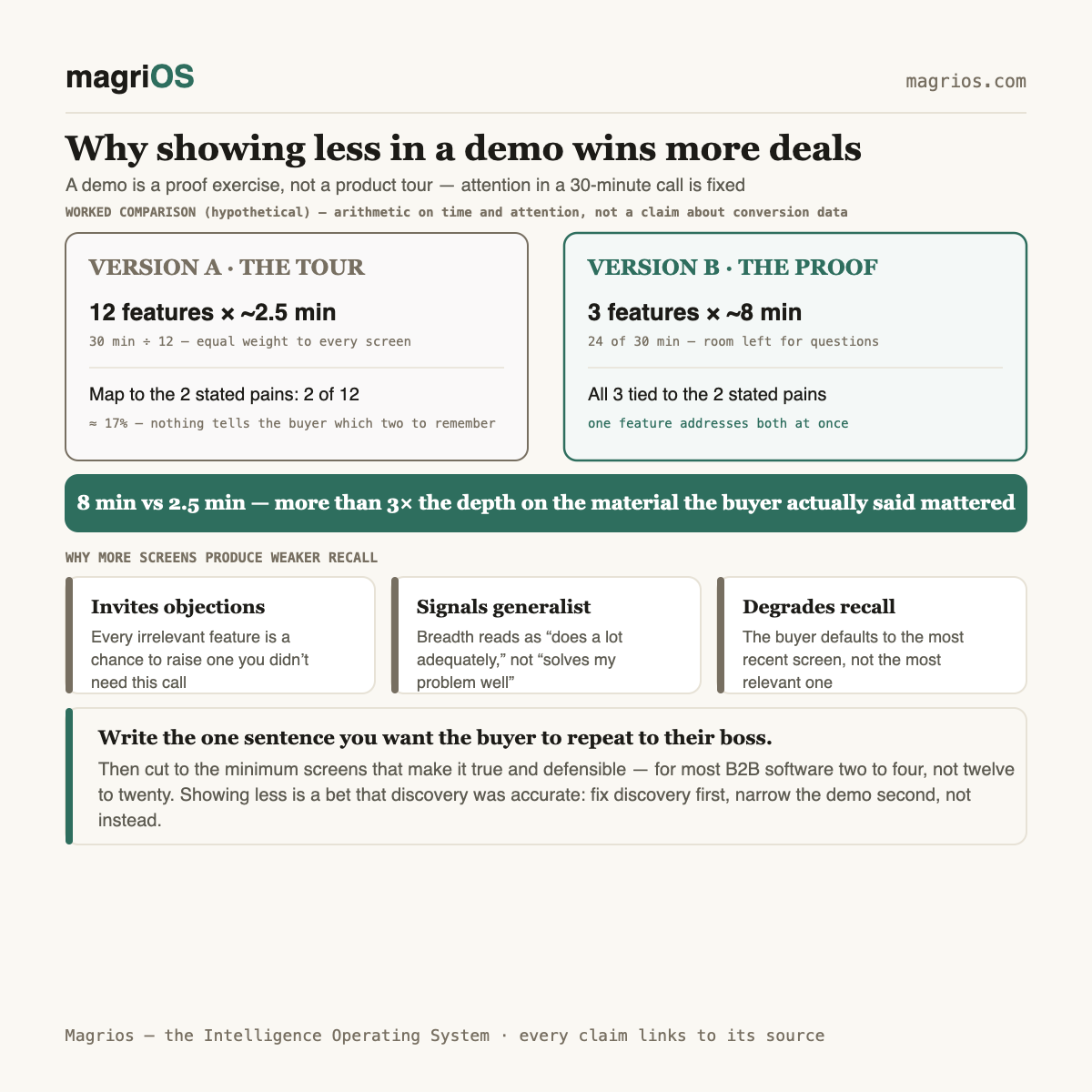
The demo is a proof exercise, not a product tour
A sales demo has one job: make a specific claim credible enough that a buyer is willing to attach their name to an internal approval request. That is the entire function. It is not an inventory of what the product does. The moment you treat it as an inventory — walking through modules in the order your product team built them — you have swapped your goal, belief, for the engineering team's goal, coverage.
Attention in a 30-minute call is fixed. You do not get more of it by adding more screens; you get less depth on each one. A buyer who sees three features explained fully leaves able to repeat one or two of them to their VP in the buyer's own words. A buyer who sees eighteen features explained in passing leaves able to repeat none of them, because nothing crossed the line from "shown" to "understood well enough to re-explain."
Why more screens produce weaker recall
Three mechanical reasons a longer, broader demo leaves the buyer able to re-explain less of what they saw than a narrow one does:
- Every irrelevant feature is a chance to raise an objection you did not need this call. Show a reporting dashboard nobody asked about and you invite "does this export to our BI tool?" — a legitimate question, but one that has nothing to do with why the buyer took the call. Now the call is defending scope instead of proving the one thing that mattered.
- Breadth signals generalist, not built-for-you. A tour through every module reads as "this does a lot of things," which a buyer correctly translates to "this does a lot of things adequately," not "this solves my specific problem well."
- Cognitive load degrades recall, not just attention. A buyer who watched a broad demo has to reconstruct, unaided and after the call ends, which of the eighteen things actually mattered to their situation. Most people do not do that reconstruction. They default to whatever is easiest to recall — usually the most recent screen, not the most relevant one.
What "showing less" means in practice
Showing less does not mean the same content compressed into a shorter window. It means fewer things, each shown to completion: the buyer sees the feature, sees the outcome it produces, and sees exactly how that outcome maps to the problem they described on the discovery call.
A useful filter before anything goes into a demo script: can you tie this screen to a sentence the buyer said out loud on the discovery call? If a feature does not trace back to something the buyer told you mattered, it does not belong in this demo. It might belong in a follow-up email, a trial environment, or the documentation — but not in the finite window where you have the buyer's full attention.
A worked comparison
Two versions of the same 30-minute call, worked through as a hypothetical to make the mechanics concrete — this is not a claim about real conversion data, just arithmetic on time and attention:
Version A, the tour. Twelve features shown, roughly 2.5 minutes each (30 minutes / 12). Two pain points were mentioned on the earlier discovery call. Features shown that map directly to those two pains: 2 of the 12, or about 17%. The other ten get the same pacing and the same visual weight as the two that matter, so nothing in the call tells the buyer which two to remember.
Version B, the proof. Three features shown, roughly 8 minutes each (24 of the 30 minutes, leaving room for questions), all three tied explicitly to the two stated pains — one feature addresses both at once. Time spent per relevant feature: 8 minutes versus Version A's 2.5 minutes, more than three times the depth on the material the buyer actually said mattered.
Same call length, same rep, same product. The only variable that changed is what got left out.
What you give up, and why it can still be worth it
Cutting a demo down means some real things go unshown: a feature a second stakeholder in the room might have cared about, a capability that differentiates you from a specific competitor, a screen that would have made the product look more mature than three features alone suggest. These are genuine costs, not imagined ones — do not pretend the trade is free.
The trade only pays off if discovery was done well enough to know which two or three things are load-bearing for this specific buyer. Showing less is a bet that discovery was accurate. If discovery was thin — if you genuinely do not know what this buyer's stated problem is — a broad demo functions as a hedge against that gap, and narrowing the demo just removes the hedge without fixing the underlying problem. Fix discovery first. Narrow the demo second, not instead.
Building a demo script around one claim
A practical way to build the cut: write down the one sentence you want the buyer to say to their boss after the call ends. Not a feature list — one sentence, in the buyer's language, about an outcome. Then work backward: what is the minimum number of screens required to make that sentence true and defensible under questioning? For most B2B software the honest answer is two to four screens, not twelve to twenty.
Everything that does not serve that sentence still exists — it just moves. It goes into a follow-up email, a sandbox the buyer can explore on their own time, or a second call with a different stakeholder who has a different pain and therefore needs a different sentence. Nothing gets deleted from the sales process. It gets sequenced to when it is relevant, instead of broadcast to everyone regardless of relevance.
The signal this sends about the product itself
There is a second-order effect worth naming: a demo that shows less also implicitly claims the seller understands the buyer's problem well enough to be selective. That selectivity is itself evidence of fit. A rep who can say "I'm not going to show you the other fourteen things because none of them solve what you told me about" is making a credible claim about listening that a full-coverage tour cannot make, no matter how impressive the tour is. Buyers read confidence-through-omission as a signal that the seller has actually done the discovery work, not skipped it.