Why your middle pricing tier is doing the wrong job
Guide · Pricing Intelligence · 5 min read · last verified 2026-08-11
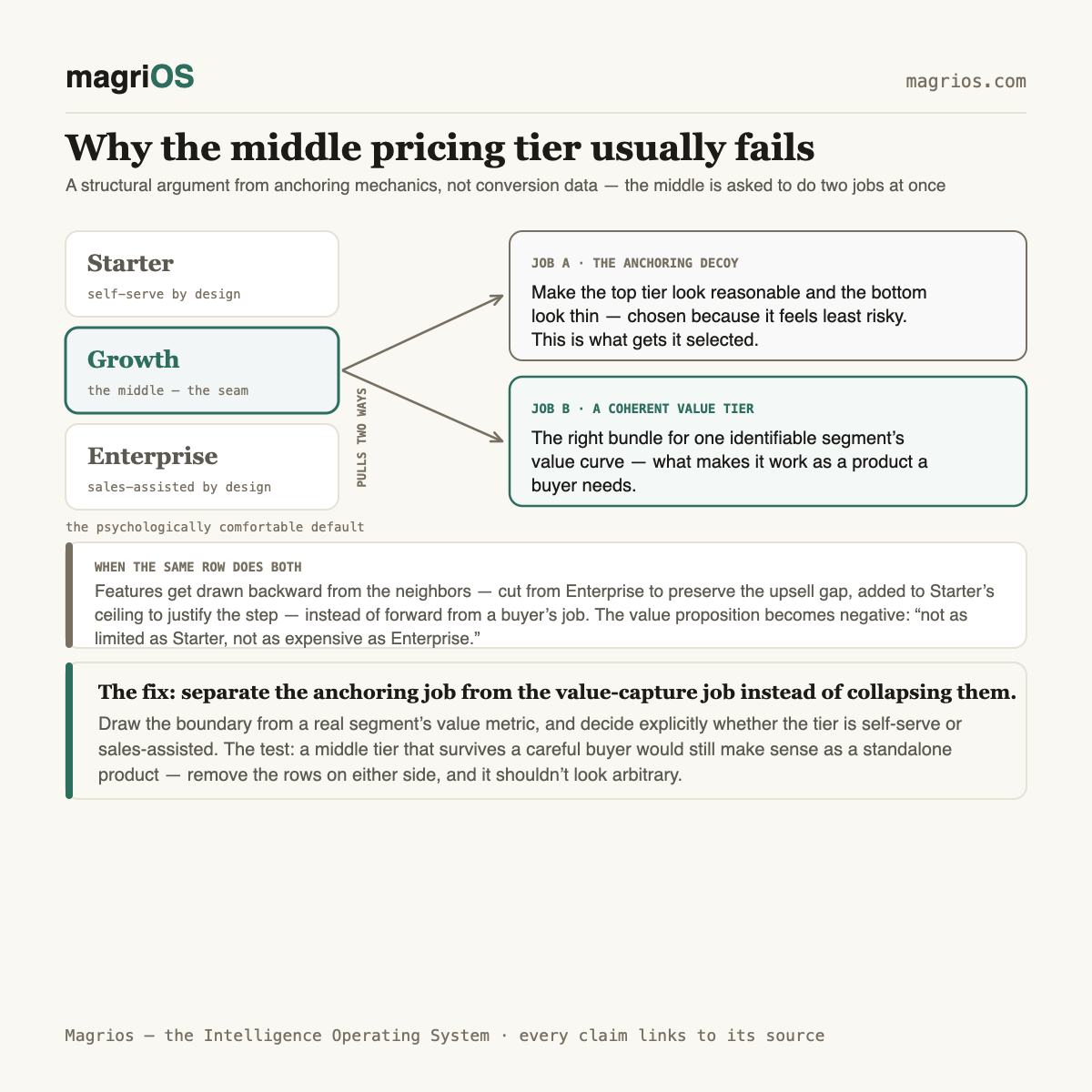
The middle tier in a three-tier pricing table usually underperforms because its job is structural, not commercial: it exists to make the top tier look reasonable and the bottom tier look thin, pulling its feature set away from matching any one buyer segment's real value curve.
The mechanism: why a middle tier exists at all
A three-tier pricing table — commonly labeled something like Starter, Growth, Enterprise — is built around a well-documented behavioral pattern: buyers presented with three options and no other reference point tend to avoid the extremes and gravitate toward the middle, because the middle carries the least perceived risk of either overpaying or under-provisioning. This is the same mechanism behind price anchoring in SaaS — the presence of a premium tier changes how reasonable the middle tier looks, independent of what the middle tier actually contains.
That's the mechanism that gets a middle tier chosen. It is not the same mechanism that makes a middle tier work as a product a specific buyer needs. The two jobs — being the psychologically comfortable default, and being a coherent value proposition for an identifiable segment — are frequently assigned to the same tier, and they pull in different directions.
What the decoy job does to the middle tier's features
When a middle tier is designed primarily to make the top tier look reasonable by comparison — a classic decoy or compromise-effect structure — its feature list gets built backward from the tiers around it rather than forward from a buyer's job-to-be-done. Features land in the middle tier because they were cut from Enterprise to preserve the upsell gap, or added to Starter's ceiling to justify the price step, not because a real segment of buyers asked for exactly that bundle.
The result is a middle tier whose value proposition is defined negatively: it is "not as limited as Starter" and "not as expensive as Enterprise," rather than "built for this kind of team doing this kind of work." A value metric that scales cleanly across a product line will usually justify tier boundaries on its own; a middle tier that instead relies on arbitrary feature-gating — a seat cap, a support-tier line, an integration count — to create separation is signaling that the tiers were drawn for anchoring purposes first.
Where the anchoring math and the value-capture job collide
Anchoring theory explains selection — which tier a buyer's eye lands on first. It says nothing about whether that tier's price matches what the buyer who lands there is actually willing to pay for what's inside it. A middle tier can be extremely effective at making the top tier look reasonable while being simultaneously mispriced relative to its own contents, because those are two separate design problems solved by the same row in the table.
This is where the failure becomes structural rather than incidental. If the middle tier is priced to sit at a psychologically comfortable ratio beneath the enterprise tier — a deliberate anchoring convention — and the feature line inside it was drawn for separation rather than coherence, there's no guarantee the resulting price-to-value ratio holds up once buyers compare it against list price vs. street price reality — what similar accounts actually end up negotiating toward. Buyers who read past the table — the ones evaluating the product seriously rather than picking by gut instinct — are the ones most likely to notice the mismatch, and they are disproportionately the buyers a growth-stage SaaS company most needs to convert.
The self-serve/sales-assisted seam that runs through the middle
There's a second structural problem specific to SaaS pricing tables: the middle tier is frequently the seam between self-serve and sales-assisted motion. Starter is self-serve by design; Enterprise requires a sales conversation by design. The middle tier inherits both sets of expectations at once — buyers expect to be able to self-serve into it, because it's adjacent to Starter, while the company often wants a sales touch on it, because it's adjacent to enterprise-scale revenue. That tension shows up as friction in exactly the tier meant to be the easy, obvious choice: unclear checkout paths, "contact sales" gates on features the price nominally includes, or a plan that's self-serve to start but requires a call to actually use fully.
None of this is a failure of execution that better copywriting fixes. It's a consequence of asking one row in a pricing table to be a decoy, a value tier, and a motion boundary simultaneously.
What a middle tier looks like when it doesn't fail
The structural fix follows directly from the diagnosis: separate the anchoring job from the value-capture job instead of collapsing them into the same tier. That means drawing the middle tier's feature boundary from an actual segment's value metric — the unit that scales with the value a mid-market buyer gets — rather than from what needs to be withheld to make the top tier look bigger. It also means deciding explicitly whether the middle tier is self-serve or sales-assisted, rather than letting it drift into both by default.
A middle tier that survives contact with a careful buyer is one whose contents would still make sense as a standalone product, with or without the tiers on either side of it. If removing the top and bottom rows from the table would leave the middle tier looking arbitrary or incomplete, that's the signal the tier was never really designed to stand on its own — it was designed to make its neighbors look better.
FAQ
Does having a middle tier automatically create a decoy effect?
Not automatically, but a three-tier structure is the most common setup that produces it. The decoy effect specifically requires an option that's dominated on some dimensions and comparable on others — a middle tier only functions as a decoy if its feature set is deliberately positioned to make another tier look better by comparison.
Should companies just remove the middle tier?
Not necessarily — removing it can hurt conversion by removing the anchoring benefit entirely. The fix isn't eliminating the tier, it's making sure its contents are drawn from a real buyer segment's needs rather than purely from the gap between the other two tiers.
How does the middle tier connect to discounting behavior?
Sales teams often discount the top tier down toward the middle tier's price to close deals, which quietly erodes the separation the table was built on. That pattern is closer to discount leakage than to legitimate tier design, and it accelerates when the middle tier's boundaries were arbitrary to begin with.
Is the middle-tier problem specific to three-tier tables?
The mechanism is sharpest in three-tier tables because the compromise effect requires exactly one option on each side, but any pricing table with a tier whose primary job is comparative rather than segment-specific can develop the same mismatch, regardless of how many tiers surround it.