Commit plus overage vs pure usage pricing: which one your buyer can approve
Comparison · Pricing Intelligence · 6 min read · last verified 2026-08-11
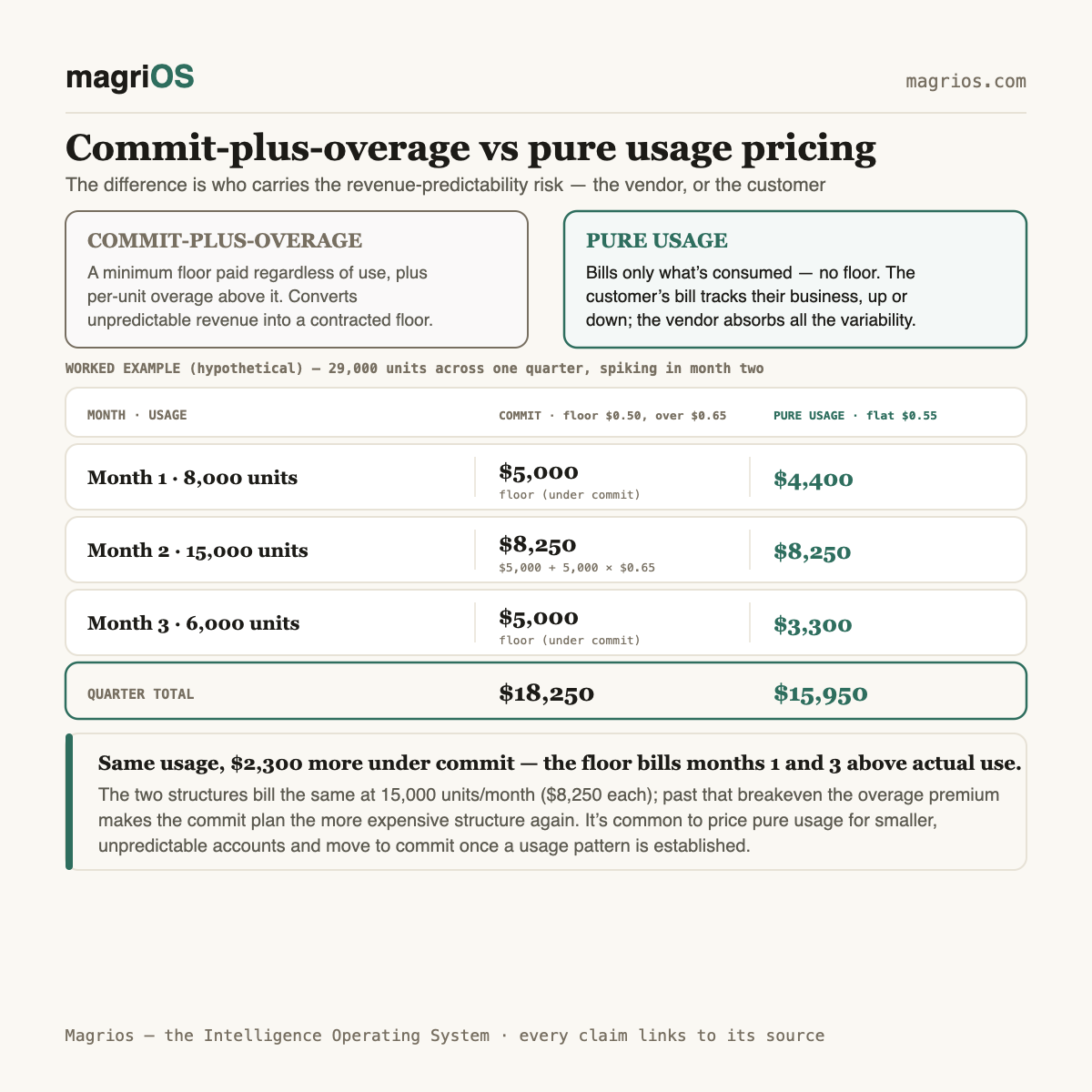
Commit-plus-overage pricing charges a customer a minimum contracted amount up front, then bills separately for usage beyond that commitment; pure usage pricing bills only for what's consumed, with no floor. The difference is who carries the revenue-predictability risk — the vendor, or the customer.
How each model actually bills
Commit-plus-overage pricing and pure usage pricing are both forms of usage-based pricing — both bill against a value metric that scales with consumption rather than seats or a flat fee. They diverge on one structural question: does the customer pay for a baseline whether or not they use it?
- Commit-plus-overage: the customer commits contractually to a minimum spend — a dollar amount or a unit volume — paid up front or on a fixed schedule, regardless of actual usage. Usage above that commitment is billed separately, typically at a per-unit overage rate. Usage below the commitment doesn't roll over or refund — the commitment is a floor, not a bucket of prepaid credits with rate parity.
- Pure usage pricing: there is no minimum. The invoice each period is a direct function of consumption — usage units multiplied by the per-unit rate, with no contracted floor and, typically, no negotiated overage rate, because there's no committed tier for usage to overage past.
What commit-plus-overage optimizes for
The commitment exists to solve a specific problem for the vendor: pure usage revenue is only as predictable as the customer's usage, and usage can swing with the customer's own business cycle, seasonality, or product engagement — none of which the vendor controls. A committed floor converts part of that unpredictable revenue into contracted, forecastable revenue, which matters directly for a vendor's own planning and, at scale, for how its revenue is perceived by anyone underwriting the business.
It also changes the negotiation at signature: the overage rate is frequently priced at a premium to the effective committed rate, which itself often functions as a form of street price — negotiated below the nominal per-unit rate in exchange for the commitment. That gives the customer a built-in incentive to size their commitment accurately rather than under-committing and paying overage rates on a predictable portion of their usage. This is a deliberate use of a price fence — the lower effective rate is fenced behind a specific commitment, not available to usage that falls outside it.
What pure usage pricing optimizes for
Pure usage pricing optimizes for the opposite thing: alignment with the customer's actual value received, with no floor the customer pays regardless of outcome. For a customer with genuinely variable or unpredictable usage — seasonal, early-stage, or piloting the product — a commitment is a bet on a usage level they can't yet forecast, and pure usage pricing removes that bet entirely. The customer's bill tracks their business, up or down, with no penalty for a slow period and no forfeited prepayment.
The trade is that the vendor absorbs all the revenue variability the commitment would otherwise have converted into a floor. A vendor with a large enough, sufficiently diversified customer base can absorb that variability in aggregate even if no individual account is predictable; a vendor without that scale is taking on real forecasting risk by pricing this way.
Where each model breaks
Commit-plus-overage breaks down in two specific ways:
- Chronic under-commitment: if commitments are consistently sized too low, a large share of revenue ends up in overage billing, which the customer often experiences as an unpredictable, unbudgeted cost even though the vendor considers it fully priced — a perception gap that shows up at renewal as resistance to the next commitment level.
- Chronic over-commitment: if commitments are sized too high relative to actual usage, the customer is effectively paying for unused capacity, which is functionally identical to a discount the vendor never intended to give and creates the kind of value-for-price resentment that drives non-renewal even without a single price increase involved.
Pure usage pricing breaks down differently:
- Revenue unpredictability compounds at the portfolio level if usage across the customer base is correlated rather than independent — for instance, if most customers' usage tracks a shared external cycle, the vendor's revenue swings with that cycle rather than averaging out.
- Budgeting friction on the buyer side: procurement and finance teams that need to forecast their own costs sometimes resist a model with no ceiling or floor, since it pushes forecasting risk onto them instead of the vendor — a friction pure usage pricing without even a soft cap doesn't solve.
Worked example: the same usage pattern billed both ways (hypothetical)
Take a hypothetical customer whose usage across a quarter looks like this: 8,000 units in month one, 15,000 units in month two, and 6,000 units in month three — 29,000 units total, averaging under 10,000 a month but spiking well above it in month two.
Under a commit-plus-overage structure with a 10,000-unit monthly commitment at $0.50/unit ($5,000/month floor) and a $0.65/unit overage rate:
- Month one (8,000 units, under commitment): bills at the floor, $5,000.
- Month two (15,000 units, 5,000 over commitment): $5,000 floor + (5,000 × $0.65) = $8,250.
- Month three (6,000 units, under commitment): bills at the floor, $5,000.
- Quarter total: $18,250.
Under pure usage pricing at a flat $0.55/unit — priced slightly higher than the committed rate above, since there's no floor protecting the vendor's revenue:
- Month one: 8,000 × $0.55 = $4,400.
- Month two: 15,000 × $0.55 = $8,250.
- Month three: 6,000 × $0.55 = $3,300.
- Quarter total: $15,950.
In this hypothetical, the commit-plus-overage structure produces $2,300 more in vendor revenue over the quarter ($18,250 vs. $15,950) for identical usage, because months one and three were billed at the floor rather than at actual, lower consumption. In this hypothetical the two structures bill the same at 15,000 units a month ($8,250 each); past that breakeven the overage premium makes the commit plan the more expensive structure again — the floor only adds revenue in periods where actual usage falls under the commitment.
FAQ
Is commit-plus-overage always more expensive for the customer than pure usage pricing?
Not always — it depends on how usage compares to the commitment. As the worked example above shows, a commitment only costs more than pure usage pricing in periods where actual usage falls below the committed floor; in a period well above the commitment, the two can converge or even reverse depending on the overage rate.
Why would a vendor charge a lower rate for committed usage than for overage?
The lower committed rate compensates the customer for taking on a fixed obligation regardless of actual usage, while the overage rate reflects usage the vendor didn't get certainty about in advance — it's priced as unplanned capacity, not planned capacity.
Which model is easier for a customer to budget against?
Commit-plus-overage gives the customer a known floor to budget for, with variable cost only above that floor. Pure usage pricing gives no floor at all, which can be harder to forecast for a finance team even though it removes any risk of paying for unused capacity.
Can a vendor offer both models to different customers?
Yes — it's common to offer pure usage pricing to smaller or newer accounts with unpredictable consumption, and move accounts to a commit-plus-overage structure once their usage pattern is established enough to size a commitment accurately.