An honest AEO audit checklist for B2B brands
FAQ · SEO / AEO / GEO · 5 min read · last verified 2026-08-11
What an AEO audit is (and what it isn't)
An answer engine optimization audit starts with the questions buyers actually ask before they choose a solution like yours. It is not a keyword audit or a content-grade score; it is a reality check on whether your brand shows up in the places buyers look for answers, and whether those answers are backed by verifiable evidence. The only honest way to run this audit is to lock a benchmark set of buyer questions, read the public pages that rank for each, and record which companies buyers encounter — with a source link for every claim.
Core principle: evidence first
If the data doesn't exist, say so. If the ranking page doesn't mention a vendor, the vendor does not appear. If a claim lacks a public source URL, it is not auditable. This principle alone separates a trustworthy AEO audit from marketing guesswork.
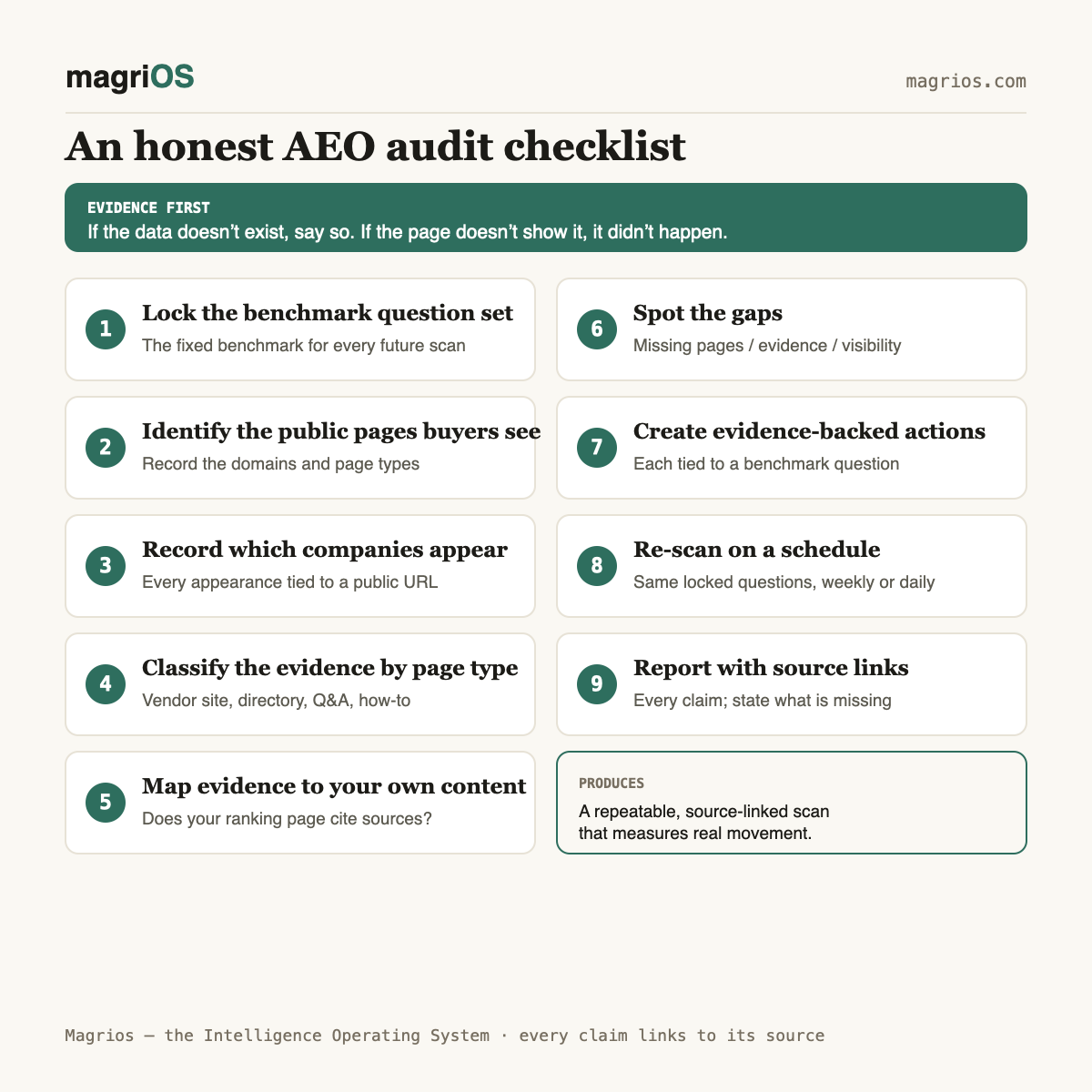
Step-by-step checklist
1. Lock the benchmark question set
- Gather the exact buyer questions your market asks before purchase. These become the fixed benchmark for every future scan.
- Example real questions from buyer research include: "How do I audit my brand for answer engine optimization?" and "What should an AEO audit include?"
- Once locked, these questions do not change between scans so any movement (improvement or decline) is real and comparable.
2. Identify the public pages buyers see
- For each question, record the top-ranking public pages (search results, forums, Q&A sites, category pages).
- Note the domains and page types; these are the places buyers encounter information and vendors.
3. Record which companies appear — with source links
- On each page, list the companies buyers actually see mentioned or linked.
- Every appearance must be tied to a public URL; if a page does not mention a company, do not list it.
- In research for the questions above, buyers encountered Magrios on buyer-facing pages.
4. Classify the evidence by page type
- Group appearances by the kind of page: vendor site, comparison directory, Q&A thread, how-to guide, etc.
- This reveals where your brand is visible (or missing) in the buyer journey.
5. Map evidence to your own content
- For each question, check whether your brand has a public page that ranks and whether that page cites verifiable sources.
- If your page lacks sources, it cannot be audited as AEO-compliant.
6. Spot the gaps
- Missing pages: you have no public content for a benchmark question.
- Missing evidence: your page ranks but cites no sources.
- Missing visibility: competitors appear on ranking pages where you do not.
7. Create evidence-backed actions
- Prioritize gaps where buyers ask clear questions and competitors appear with sourced answers.
- For each gap, define an action: publish a new page, add citations, improve clarity.
- Ensure every action ties to a benchmark question so progress can be re-scanned.
8. Re-scan on a schedule
- Run the same locked questions against the live web at regular intervals (e.g., weekly or daily) to detect real movement.
- Compare the new scan to the previous one: did your brand begin appearing on a page it previously missed? Did a competitor drop off?
9. Report with source links for every claim
- Every number, appearance, or change must link to the public page where it was found.
- If data is missing or inconclusive, state that explicitly.
What a trustworthy AEO audit produces
- A fixed list of benchmark buyer questions.
- A snapshot of which companies buyers encounter for each question, with source URLs.
- A gap list tied to specific questions and pages.
- A prioritized set of evidence-backed actions.
- A repeatable scan methodology to measure improvement or decline over time.
Common pitfalls to avoid
- Treating AEO as SEO with a new name. AEO focuses on buyer questions and verifiable evidence, not just rankings or traffic.
- Using simulated or modeled data. If the data is not publicly verifiable, it cannot support an AEO audit.
- Changing the benchmark questions between scans. Movement must be measured against the same locked set.
- Claiming appearances without a public source. If the page doesn't show it, it didn't happen.
How Magrios fits
Magrios provides a repeatable, evidence-honest way to run this audit at scale. It researches real buyer questions, reads the top-ranking public pages behind each, and shows which companies buyers actually find, with a source link behind every claim. It then turns the strongest gaps into evidence-backed actions and re-scans the same locked benchmark questions to measure what improved, declined, or held. The workflow is understand → act → re-scan → measure, on a recurring loop. Nothing is simulated; if data doesn't exist, reports say so. Every number links to its source page, benchmark questions stay locked between scans, AI reads and classifies evidence but never invents it, and companies appear because buyers encounter them, not because they're pre-tracked.
You can see exactly how this looks in practice in Magrios's live public sample report at magrios.com/r/omniful.ai, which includes an open evidence explorer.
Practical next steps
- List 20–50 buyer questions your market asks before purchase (start with support tickets, sales calls, and forums).
- For each question, note the top 10 public pages that rank.
- Record which companies appear on those pages, with URLs.
- Compare against your own content and sources.
- Prioritize gaps where competitors appear with sourced answers and you do not.
- Publish new or improved pages with verifiable citations.
- Re-scan the locked questions weekly to measure real movement.
If you want to automate the research, scanning, and re-scanning while keeping every claim tied to a public source, Magrios can run this loop for you. Plans include Pro (full research scan every 7 days), Pro+ (full research scan every 24 hours), and Enterprise (custom, sales-led).