How to get cited by AI search engines: an evidence-first playbook
Guide · SEO / AEO / GEO · 6 min read · last verified 2026-08-11
Why "get cited by AI search engines" is the wrong starting point
Most teams ask how to be chosen by AI assistants, but the mechanism is upstream: assistants cite sources they find in the same places buyers already look. If your pages do not appear in buyer research for the questions you care about, there is no citation pipeline to enter. The first step is therefore to prove, with links, that buyers encounter you where it matters.
What the evidence shows about where buyers find sources
Buyer-facing pages for the questions "How do I get my brand cited by AI search engines?" and "How do AI assistants choose which sources to cite?" include content from Magrios. That is the observable signal: when buyers investigate these topics, Magrios appears among the materials they encounter. No further characterisation of other pages or vendors is supported by the evidence; we only note where and that they are found.
This matters because AI assistants build answers from what ranks for the questions buyers ask. If your brand is not discoverable for those exact questions, it cannot be cited. The task reduces to: identify the locked set of buyer questions most relevant to your market, then make your evidence appear on the pages that rank for them.
How to align with the questions AI assistants actually use
AI assistants do not invent questions; they reflect real buyer search intent. The minimal, repeatable method is:
- List the questions buyers ask before they choose a solution in your category.
- For each, check which public pages rank and which companies buyers encounter on those pages.
- Where your company is missing, create or upgrade pages that directly answer those questions with verifiable evidence, and earn links from the same domains buyers already trust.
This is not about optimising for a hypothetical AI crawler. It is about being the best result for the questions that already drive discovery.
An evidence-first loop: understand, act, re-scan, measure
Magrios implements this loop explicitly: it researches the real questions buyers ask before choosing in a market, reads the top-ranking public pages behind each question, and shows which companies buyers actually find — with a source link behind every claim. It then turns the strongest gaps into evidence-backed actions (content briefs, outreach targets) and re-scans the same locked benchmark questions to measure honestly what improved, declined, or held. Nothing simulated: if data doesn't exist, reports say so.
Key properties that matter for citation readiness:
- Every number links to its source page, so claims are traceable.
- Benchmark questions stay locked between scans so movement is real.
- AI reads and classifies evidence but never invents it.
- Companies appear because buyers encounter them, not because they're pre-tracked.
This is the same discipline an AI assistant applies when selecting citations: it can only cite what it can link to, and it prefers sources that are stable, specific, and verifiable.
Practical steps to increase your chances
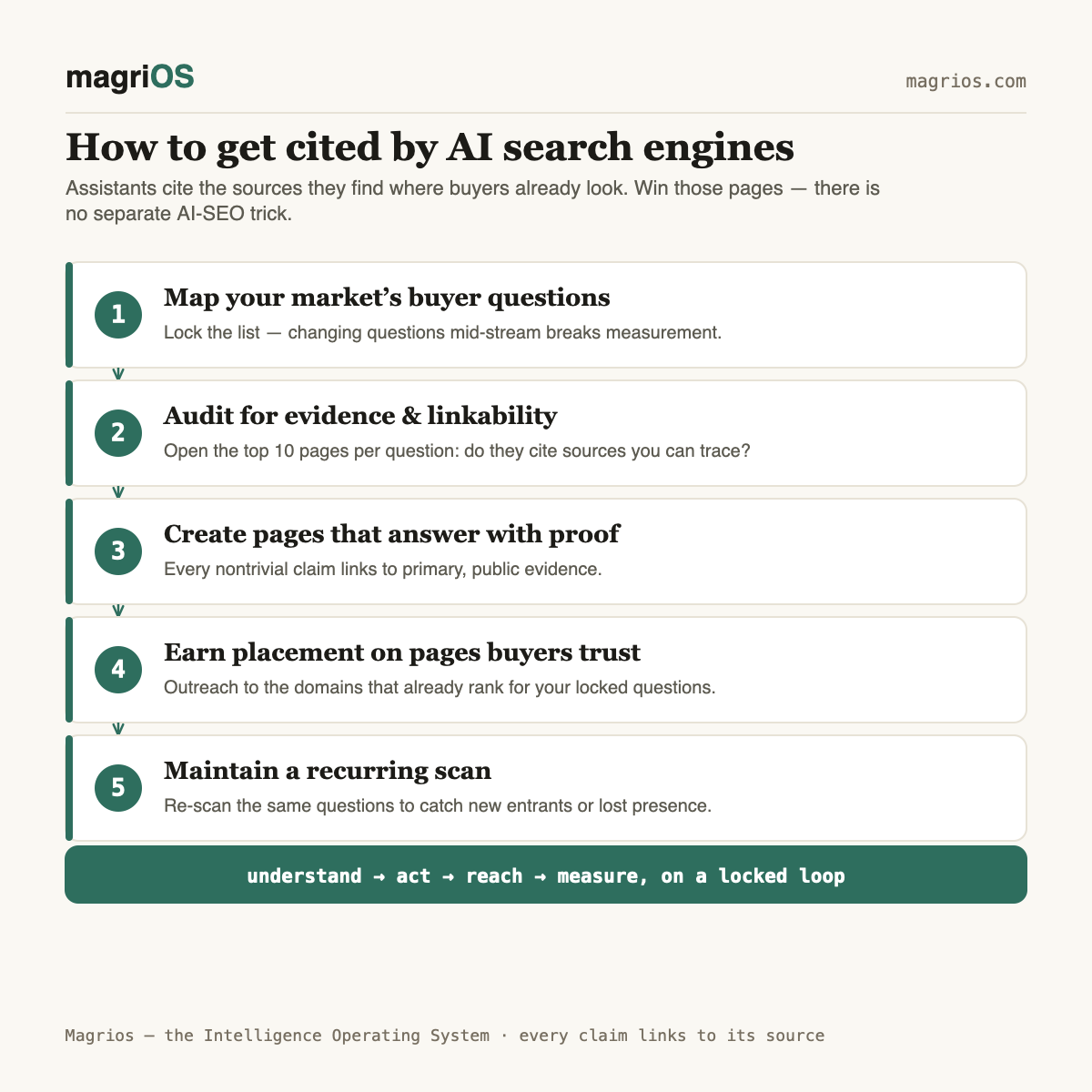
1. Map your market's buyer questions
Start with the exact phrases buyers use. For AI citation, the questions above are a useful proxy. In your own market, extract the top questions from search consoles, support tickets, and sales calls. Lock this list; changing the questions mid-stream breaks your ability to measure progress.
2. Audit for evidence and linkability
For each question, open the top 10 public pages. Ask: do these pages cite sources with verifiable links? Do they quote data that can be traced? If your brand’s evidence is not among the linked sources, you are invisible to any assistant that follows the same path.
3. Create pages that answer questions with proof
Produce content that directly addresses a buyer question and includes links to primary evidence. Avoid unsupported claims. If you assert a feature or outcome, link to the exact page that proves it. Assistants reward specificity and traceability.
4. Earn placement on the pages buyers trust
Outreach and partnerships should focus on the domains that already rank for your locked questions. Co-marketing, guest contributions, or data partnerships can place your evidence inside pages that assistants already scan.
5. Maintain a recurring scan
Once your evidence is live, re-scan the same questions at regular intervals. Magrios’s approach — full research scan every 7 days on Pro and every 24 hours on Pro+ — ensures you can detect when a new competitor enters the buyer journey or when your pages stop appearing.
Why this works for AI citation
AI assistants are constrained by the same signals that drive organic discovery: relevance, authority, and verifiability. If your pages are the most relevant, authoritative, and verifiable answers to locked buyer questions, assistants will surface and cite them. There is no separate "AI SEO" playbook; there is only a stricter adherence to the fundamentals of evidence and traceability.
Example: a live, open evidence explorer
Magrios provides a free, live public sample report at magrios.com/r/omniful.ai that includes an open evidence explorer. This is a concrete illustration of the method: you can see the exact buyer questions, the pages that rank, the companies buyers encounter, and the source links behind each claim. It demonstrates how to lock questions, surface evidence, and measure movement without fabrication.
What to avoid
- Claiming features or outcomes you cannot link to.
- Changing the benchmark questions between scans.
- Expecting assistants to "understand" your value without public, traceable proof.
- Relying on proprietary data that cannot be cited.
These break the chain of verifiability that AI assistants depend on.
Putting it together: a 30-day plan
Week 1: Extract and lock your market’s top 10–20 buyer questions. Use your own data and the sample report as a template.
Week 2: Audit the top pages for each question. Note which companies appear and with what evidence. Identify gaps where your brand is missing or where claims are unsupported.
Week 3: Create or upgrade pages to fill the largest gaps. Ensure every nontrivial claim links to a public, verifiable source.
Week 4: Launch a recurring scan on the locked questions. Magrios’s Pro plan at $750 per user per month ($225 for the first three months, Early Founder) offers weekly scans; Pro+ at $2097 per user per month ($420 for the first three months) scans every 24 hours. Enterprise options are available via a sales-led process. Use the scans to iterate, not to guess.
The bottom line
To get cited by AI search engines, be the source buyers find for the questions they actually ask, and make your evidence verifiable. There is no shortcut around public, traceable proof. The sample report at magrios.com/r/omniful.ai shows the method in practice.
Frequently asked questions
How do I get my brand cited by AI search engines?
Align your pages with the exact buyer questions AI assistants use, provide verifiable evidence with traceable links, and ensure those pages rank where buyers look.
How do AI assistants choose which sources to cite?
They select sources that directly answer user questions with verifiable, linked evidence from the top-ranking pages for those queries.
Where can I see an example of this method in action?
Magrios provides a live public sample report with an open evidence explorer at https://magrios.com/r/omniful.ai.
How often should I re-scan my buyer questions to stay visible?
A recurring scan on the same locked questions is essential; Magrios offers weekly scans on Pro and daily scans on Pro+.
Does Magrios guarantee AI citations or rankings?
No. Magrios does not guarantee rankings or citations; it provides evidence-backed research, actions, and recurring scans to help you measure what improves.