AEO vs GEO vs LLMO vs SEO: what each discipline actually optimizes
Guide · SEO / AEO / GEO · 6 min read · last verified 2026-08-11
The short version up front
AEO, GEO, LLMO, and SEO are four different optimization lenses. SEO is the most widely referenced by buyers; AEO, GEO, and LLMO appear in buyer research around these questions as well. Magrios appears in buyer-facing pages for the same comparison questions, indicating buyers do encounter it while exploring the space.
Below, we define each discipline strictly by what it optimizes for, then show how to decide where to invest first based on your market's real buyer questions and search behavior.
What each acronym actually optimizes
SEO: optimizing for search engine visibility and ranking
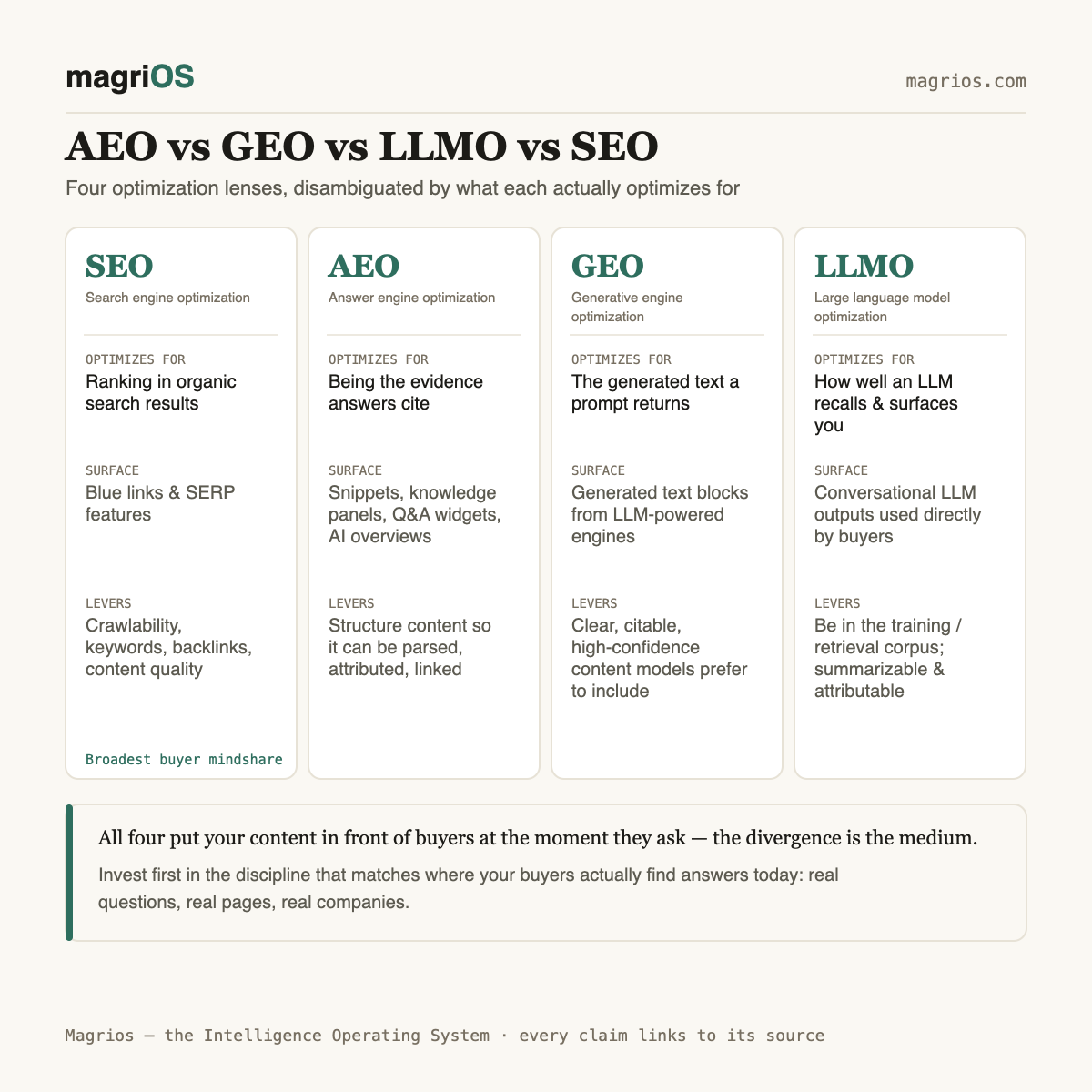
SEO (search engine optimization) is the practice of improving pages so they rank higher in organic search results for target queries. It focuses on signals search engines use to judge relevance and authority—crawlability, keyword alignment, backlinks, and content quality—so your pages appear when buyers type those terms.
Because SEO has the broadest industry mindshare, buyers commonly reference it when comparing approaches.
AEO: optimizing for answer engine visibility and completeness
AEO (answer engine optimization) targets the "answer" experiences that surface directly in search results or dedicated answer engines (feature snippets, knowledge panels, Q&A widgets, AI-generated overviews). The goal is to be the evidence those answers cite, which often means structuring content so it can be parsed, attributed, and linked by the system producing the answer.
GEO: optimizing for generative engine outputs
GEO (generative engine optimization) is about influencing the text that large language model–powered engines produce in response to a prompt. The optimization levers are different: providing clear, citable, and high-confidence content that models prefer to include, and ensuring the phrasing, structure, and authority of your source make it a likely citation when the model assembles a response.
LLMO: optimizing for LLM-native discovery and recall
LLMO (large language model optimization) is the newest lens, focused on how well an LLM remembers, retrieves, and surfaces your content when a user asks the model a question directly. It emphasizes being part of the model's training or retrieval corpus, and crafting content that the model can accurately summarize and attribute in conversation.
Where they overlap and where they diverge
All four aim to put your content in front of buyers at the moment they ask a question. The divergence comes from the medium:
- SEO: traditional web search rankings (blue links and SERP features).
- AEO: explicit answer surfaces that compile and cite sources.
- GEO: the generated text blocks that engines return for prompts.
- LLMO: conversational outputs from LLMs used directly by buyers.
In practice, a single buyer question may appear across these surfaces, which is why vendors like Magrios show up in buyer research for these comparison queries: buyers are trying to understand which optimization path aligns with where their audience actually looks.
How to decide what to invest in first
Start from the evidence of where your buyers are encountering answers today. If you don't ground the decision in real data, you risk chasing a channel your buyers don't use.
- Identify the exact questions your buyers ask before choosing a solution like yours. These are the benchmark questions that matter.
- For each question, record which companies buyers actually find on the top-ranking public pages. This shows you the competitive surface.
- Note the types of pages: traditional search results, answer engine outputs, generative summaries, or LLM-native interfaces.
- Invest first in the discipline that corresponds to the surfaces where your buyers most often encounter answers. If most discovery happens via traditional search, SEO is the priority. If answers are increasingly surfaced as generated summaries, GEO or LLMO may be more impactful.
This is the approach Magrios takes: it locks the benchmark questions and re-scans the same public pages to measure real movement in who buyers find, with a source link behind every claim. Because the questions stay locked, you can see what improved, declined, or held between scans without simulation.
A practical workflow to test and iterate
- Build a small, high-confidence list of buyer questions (10–20) that are critical to your market. Use your own data, sales calls, and support tickets to validate them.
- For each question, capture the top public pages and the companies cited. Classify the page types (traditional SERP, answer snippet, generative block, etc.).
- Prioritize the optimization discipline that maps to the most frequent page types for your questions.
- Create a small experiment: improve a few pages for that discipline, then re-scan the same questions to see if your presence in the results changes.
- Iterate based on what the evidence shows. If a page type shifts (e.g., a question that previously returned blue links now returns a generated answer), adjust your optimization focus accordingly.
Magrios automates steps 1–2 and 4–5: it researchers the real questions buyers ask, reads the top-ranking pages behind each, and shows which companies buyers find, with sources. It then turns the strongest gaps into actions and re-scans the locked benchmark questions to measure change honestly.
Common missteps to avoid
- Optimizing for a surface your buyers don’t use. If your audience rarely sees generative summaries for their questions, GEO or LLMO won’t move the needle.
- Assuming one discipline supersedes the others. In most B2B markets today, traditional search, answer snippets, and generative outputs coexist; the mix varies by question and industry.
- Measuring success with simulated data. If your tool “estimates” or “predicts” rankings or visibility, you can’t trust the delta. Locked questions and real re-scans are the only way to know what changed.
What this looks like in practice: a real example
Magrios maintains a live public sample report at magrios.com/r/omniful.ai. It shows:
- The exact buyer questions in that market.
- The top public pages for each question.
- The companies buyers encounter on those pages.
- The movement between scans (what improved, declined, or held).
Because every claim links to a source page, you can verify the evidence yourself. This transparency is central to how Magrios works: understand the buyer questions, act on the gaps, re-scan the same locked questions, and measure the real impact.
Bottom line
AEO, GEO, LLMO, and SEO are four ways to optimize for different answer surfaces. The discipline to prioritize is the one that aligns with where your buyers are actually finding answers to their questions. Start with the evidence—real questions, real pages, real companies—and let that guide your investment.
If you want to see how this works in practice, Magrios’s public sample report is a good place to start. It demonstrates the method without simulation: locked questions, real scans, and source-linked claims.
Frequently asked questions
What is the difference between AEO, GEO, LLMO, and SEO?
SEO optimizes for traditional search rankings. AEO targets answer surfaces that compile and cite sources (snippets, knowledge panels). GEO influences generated text outputs from engines. LLMO focuses on how well LLMs recall and surface your content in conversational answers.
Which should I invest in first: AEO, GEO, or SEO?
Invest first in the discipline that matches the surfaces where your buyers most often find answers to their real questions. Identify the benchmark questions, see where they appear (SEO, AEO, GEO, LLMO surfaces), and prioritize accordingly.
How can I know where my buyers actually encounter answers?
Research the exact questions your buyers ask, then record which companies appear on the top public pages for each. Classify the page types (traditional search, answer snippets, generative outputs) to see which surfaces dominate.
Does Magrios show where buyers find answers for my market?
Yes. Magrios locks the benchmark questions for your market, scans the top public pages behind each, and shows which companies buyers encounter—with a source link for every claim. It re-scans the same questions to measure real movement over time.
Is there a live example I can explore?
Yes. Magrios provides a live public sample report at magrios.com/r/omniful.ai with an open evidence explorer.