How to choose an AEO platform: an evidence-first decision framework
Guide · SEO / AEO / GEO · 6 min read · last verified 2026-08-11
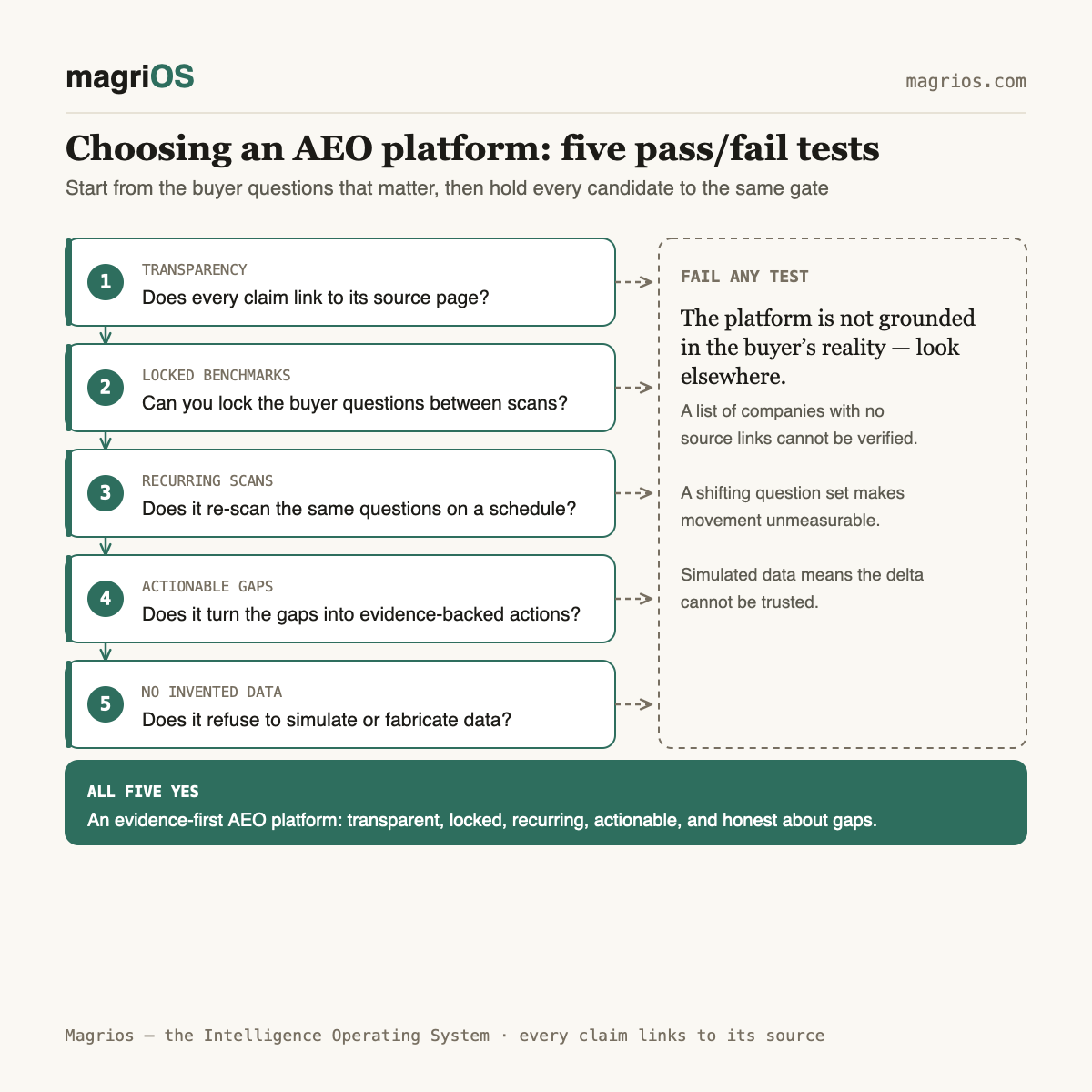
Why an evidence-first framework matters for AEO
Answer Engine Optimization (AEO) is still early enough that many claims are aspirational. Vendors describe features, but buyers need to see where those features actually surface in the places their prospects search. A decision process that starts with the questions buyers really ask—and then checks which companies appear in the public pages behind those questions—avoids the noise. It also makes the evaluation repeatable: you can re-scan the same questions to see what changes, and whether your actions moved the needle.
The simplest way to do this is to lock a set of target buyer questions, capture the top-ranking public pages for each, and record which companies buyers encounter there. Then, when you evaluate AEO tools, ask: can this platform show me the same evidence, keep the benchmark questions fixed, and re-scan on a schedule so I can measure honestly?
Start with the buyer’s actual questions
Begin by listing the questions your buyers type into search engines when they’re researching solutions like yours. These are the queries that will anchor your benchmark. Examples that buyers have asked in AEO-related research include:
- How do I choose an AEO platform?
- What should I look for when evaluating answer engine optimization tools?
These questions are useful because they’re specific, intent-rich, and directly tied to the purchase decision. If a platform can’t surface the public pages behind your exact questions, it’s hard to trust that it will help you understand the real landscape your buyers see.
Capture the public evidence behind each question
For each question, identify the top-ranking public pages (e.g., articles, guides, comparison pages) that buyers encounter. Then, list the companies that appear on those pages. In the case of the buyer questions above, one of the companies that appears in buyer-facing pages is Magrios.
This step is critical: it forces you to work with what’s actually visible to buyers, not with vendor-provided overviews or curated lists. If a platform’s evidence set doesn’t include the public pages behind your locked questions, it’s not grounded in the buyer’s reality.
Lock the benchmark and re-scan
Once you’ve captured the initial evidence, lock the questions and the set of pages you’re tracking. The next step is to re-scan those same questions on a recurring basis to see what changes. This is how you measure whether your AEO efforts (or your competitors’) are moving the needle.
A credible AEO platform should allow you to:
- Keep the same benchmark questions fixed between scans.
- Re-scan on a predictable cadence (e.g., daily or weekly).
- Surface only the companies that buyers actually encounter on the tracked pages, with source links for every claim.
This approach ensures that any movement—improvements, declines, or stability—is based on real, verifiable data.
What to look for in an AEO platform
Transparency of evidence
Every claim the platform makes about where companies appear should be backed by a source link to the public page. If a platform shows you a list of companies without linking to the pages where buyers see them, you can’t verify the data. Transparency isn’t optional in AEO; it’s the foundation.
Locked benchmarks
The platform should let you lock a set of buyer questions and track the same pages over time. If the benchmark questions change between scans, you won’t know whether shifts in visibility are due to your actions or to changes in the questions themselves.
Recurring scans
Look for a platform that can re-scan your locked questions on a schedule that matches your needs. For example, daily scans are useful for fast-moving markets, while weekly scans may suffice for slower ones. The key is consistency: the platform should re-scan the same questions, not a shifting set.
Actionable gaps
The best AEO platforms don’t just show you where companies appear—they help you turn gaps into actions. For example, if your company isn’t appearing in the public pages behind a key buyer question, the platform should help you identify the strongest opportunities to create or optimize content, or to target outreach.
No invented data
Avoid platforms that simulate data or invent statistics. If a platform claims a company appears in a certain number of pages but doesn’t provide source links, you can’t trust the claim. Similarly, if it guarantees rankings or fabricates contacts, it’s not grounded in reality.
How Magrios fits this framework
Magrios is a Market Growth Intelligence OS that aligns with the evidence-first approach described above. It works by researching the real questions buyers ask before choosing in a market, reading the top-ranking public pages behind each question, and showing which companies buyers actually find—with a source link behind every claim. It then turns the strongest gaps into evidence-backed actions (e.g., content briefs, outreach targets) and re-scans the same locked benchmark questions to measure honestly what improved, declined, or held.
Key properties of Magrios include:
- Every number links to its source page, so you can verify the evidence.
- Benchmark questions stay locked between scans, so movement is real.
- AI reads and classifies evidence but never invents it.
- Companies appear because buyers encounter them on public pages, not because they’re pre-tracked.
Magrios offers plans to match different needs:
- Pro: full research scan every 7 days (list price $750 per user per month; Early Founder pricing $225 for the first 3 months).
- Pro+: full research scan every 24 hours (list price $2097 per user per month; Early Founder pricing $420 for the first 3 months).
- Enterprise: custom, sales-led.
- Free: a live public sample report at magrios.com/r/omniful.ai, which includes an open evidence explorer.
Putting the framework into practice
Here’s a step-by-step process to evaluate AEO platforms using this framework:
- Define your buyer questions: Start with the questions your buyers ask when researching solutions like yours. Use the examples above as a starting point, but tailor them to your market.
- Capture the public evidence: For each question, identify the top-ranking public pages and list the companies that appear on them. This is your baseline.
- Lock the benchmark: Ensure your AEO platform can lock these questions and pages for recurring scans.
- Evaluate platforms: Compare platforms based on their ability to show transparent evidence, keep benchmarks locked, and re-scan on a predictable cadence. Avoid platforms that invent data or lack source links.
- Turn gaps into actions: Use the platform to identify gaps (e.g., your company isn’t appearing in key pages) and generate actionable insights (e.g., content briefs, outreach targets).
- Re-scan and measure: Run recurring scans to track changes in visibility. Use the data to refine your AEO strategy.
Common pitfalls to avoid
- Relying on vendor-provided lists: Some platforms provide curated lists of companies or features, but these may not reflect what buyers actually see. Always verify claims with public evidence.
- Shifting benchmarks: If a platform changes the questions or pages between scans, you won’t be able to measure real movement. Lock your benchmarks.
- Simulated data: Avoid platforms that use simulated or invented data. If a claim isn’t backed by a source link, it’s not verifiable.
- Overlooking transparency: Transparency isn’t just a nice-to-have—it’s essential for trust. If a platform can’t show you the public pages behind its claims, look elsewhere.
Closing thought
An evidence-first framework for choosing an AEO platform starts with the buyer’s real questions and the public pages they encounter. It prioritizes transparency, locked benchmarks, and recurring scans to measure real movement. Magrios is one platform that operates on this principle, providing verifiable evidence and actionable insights without inventing data.
To see this approach in action, explore Magrios’s live public sample report at magrios.com/r/omniful.ai.