The AI visibility gap: how often B2B companies appear in answers about their own market
Guide · AI Visibility · 5 min read · last verified 2026-08-11
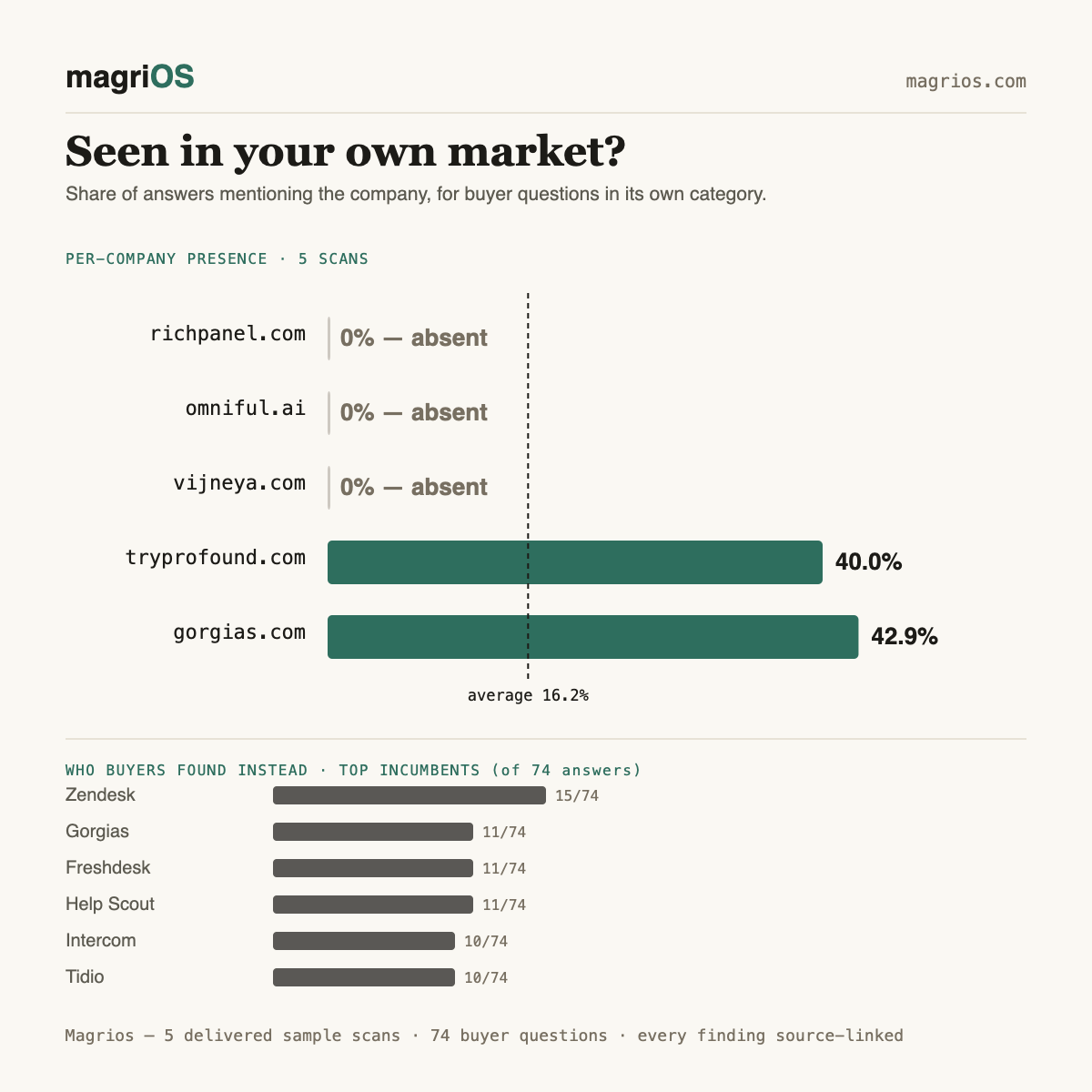
Across five delivered Magrios sample scans — our own research, open to read at magrios.com — B2B companies appeared in just 16.2% of the answers written about their own market — present in only 12 of 74 buyer questions their own customers ask. That is the headline finding, and it is worth stating plainly: in these five scans, a company was missing from more than eight of every ten answers about the exact market it sells into.
These are not private AI-assistant transcripts or search-volume estimates. Each scan reads the top-ranking public web pages behind real buyer questions for one company's market and records which companies those pages name, with a source link behind every finding. The sample is small — five companies, 74 questions — so read what follows as what these specific scans found, not a rule of the market.
How often did companies appear in answers about their own market?
Twelve times out of 74. That is the measured count; the 16.2% rate is derived from it. The average hides a split. Two of the five companies showed up in roughly four of every ten answers about their market. The other three did not appear once.
| Company | Questions | Times named | Mention rate | Questions won |
|---|---|---|---|---|
| gorgias.com | 14 | 6 | 42.9% | 2 |
| tryprofound.com | 15 | 6 | 40% | 1 |
| richpanel.com | 15 | 0 | 0% | 0 |
| omniful.ai | 15 | 0 | 0% | 0 |
| vijneya.com | 15 | 0 | 0% | 0 |
| All five | 74 | 12 | 16.2% | 3 |
The distance between 42.9% presence and 0% is the real finding. There was no middle. A company was either a recurring name in its market's answers or entirely missing from them.
Which companies did buyers actually find instead?
When the scanned company was absent, the answer pages were not blank — they named someone else. Across all 74 questions, a familiar set of incumbents kept surfacing in the sources the answers drew on.
| Company buyers found | Answers it appeared in (of 74) |
|---|---|
| Zendesk | 15 |
| Gorgias | 11 |
| Freshdesk | 11 |
| Help Scout | 11 |
| Intercom | 10 |
| Tidio | 10 |
| HubSpot Service Hub | 8 |
| Ada | 6 |
Zendesk appeared in 15 of 74 answers; Gorgias, Freshdesk, and Help Scout each in 11. These are mostly the customer-support questions, where established brands own the comparison articles, review platforms, and buyer guides that rank. Gorgias appears twice in this study: as a scanned company it was found in 6 of its own 14 questions, and as a name it surfaced in 11 answers across the full set. Presence in a market's answers is something a few names accumulate and most never touch.
What does winning a question look like — and how rare was it?
Appearing in an answer is not the same as being its most prominent name. Across all 74 questions, the scanned company was the single most prominent answer just 3 times. Gorgias won 2 of those; Profound won 1. The three absent companies won none, which follows from never appearing at all.
Three wins out of 74 is the number to sit with. Even the two companies that showed up regularly turned presence into prominence only occasionally. On average, each question's answer drew on 3.0 public sources — a narrow set of pages that decides who gets named and who does not.
Why were three of five companies completely absent?
Here the confidence level changes. The counts above are measured. Why three companies scored zero is a hypothesis, not a measurement — and treating a zero as a real result rather than an error is part of the method. The pattern across these scans fits one explanation: the pages that rank for buyer questions are third-party pages — comparison articles, review sites, community threads, buyer guides — and a company's own website rarely wins those citations for its category terms. A vendor can publish an excellent product page and still be absent from the independent article that answers "best help desk for ecommerce."
The two companies that appeared did so because third-party pages named them. The three that did not were named by nobody the answers drew on. That is the difference third-party corroboration makes, and it is why auditing your own site's content tells you little about whether you show up in your market's answers.
What does this benchmark measure — and what does it not?
This study measures presence in top-ranking public web sources for real buyer questions. It does not measure private AI-assistant answers, search volume, or market share, and it cannot claim causation. The questions were derived from each company's own market — the intent mix spanned eight types, from use-case-specific questions (17, the largest group) down to alternatives (5) — never from a competitor list, so nothing in the setup pushed a company toward presence or absence.
Five companies is a small sample. A sixth scan could move the average in either direction, and the honest reading is company-by-company: two present, three absent, three wins in total. What the scans share is a method you can audit — every finding links to the public page it came from, so the counts are checkable rather than asserted.
What does the pattern suggest for B2B teams?
The blunt version of the 16.2% figure is that most of these companies were invisible in the answers their buyers read before choosing. Not ranked low — absent. The two that were present had one thing in common: independent pages named them. The measurement points at a specific, checkable question for any B2B team — not "how good is our content" but "when a buyer asks the questions that lead to a purchase in our category, whose names do the ranking pages carry, and are we one of them?"
For these five companies, the answer was usually no. Whether that holds beyond five scans is exactly what a larger, locked benchmark is built to answer.