The market metric your board doesn't track yet: presence in AI answers
Guide · AI Visibility · 4 min read · last verified 2026-08-11
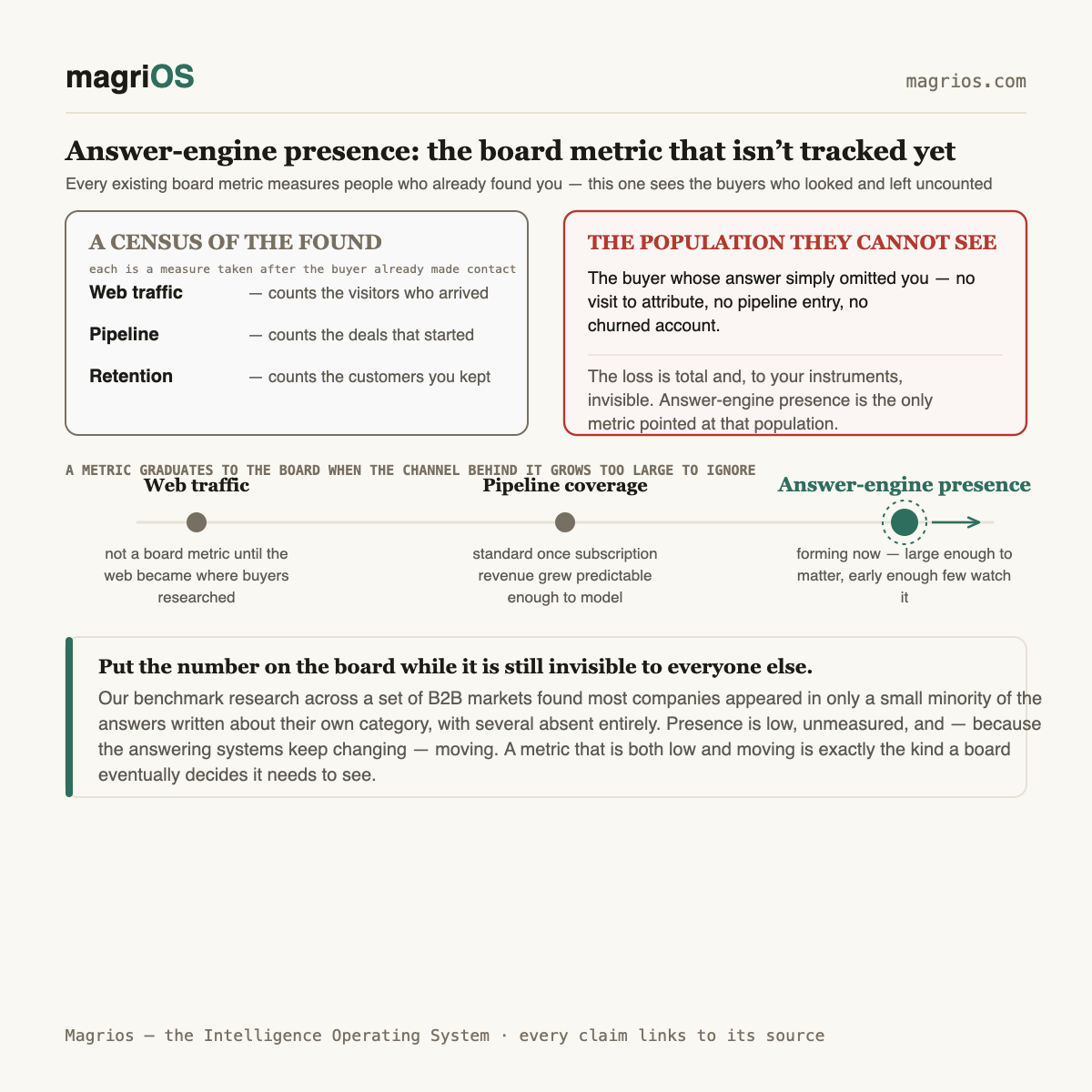
Boards watch a standard set of numbers — revenue, pipeline, retention, web traffic. A new one is forming that most of them do not track yet, and within a few years it will sit alongside the others: how often your company appears when buyers, and the AI assistants they increasingly rely on, ask questions in your market. Call it answer-engine presence. It is not a marketing vanity number. It is a leading indicator of whether buyers can find you at the moment they are deciding — and today, for most companies, it is unmeasured.
Why does a new board metric appear at all?
Board metrics are not chosen so much as forced into existence. A number graduates to the board when the channel behind it grows large enough that ignoring it becomes a visible risk. Web traffic was not a board metric until the web became where buyers researched; then, quite suddenly, every executive team had a slide for it. Pipeline coverage became standard when subscription revenue grew predictable enough to model. In each case the metric did not create the shift — it caught up to one that had already happened.
Answer-engine presence is on that same path, for the same reason. A growing share of buying journeys now begins with a question typed into a search engine or an AI assistant, which composes an answer from a specific set of public pages. That answer either includes you or it does not, and the buyer rarely looks past it. When enough decisions start that way, "are we in the answer?" stops being a curiosity and becomes a number someone has to own.
What does this metric actually measure?
Something narrower and more decisive than the familiar marketing measures. Not brand awareness, not sentiment, not share of voice in the old media sense. It measures this: when a buyer asks a real question in your category, does an answer surface your company, and how prominently? It is closer to shelf placement than to advertising — a question of whether you are physically present at the point of decision, not whether someone somewhere has heard of you.
That makes it unusually honest as metrics go. You are either in the answer or you are not. There is little room for the flattering interpretation that vanity metrics invite.
Why don't existing metrics catch it?
Because every one of them measures people who already found you. Traffic counts the visitors who arrived. Pipeline counts the deals that started. Retention counts the customers you kept. Each is a measure taken after the buyer has already made contact. None of them can register a buyer whose answer simply omitted you. That person leaves no trace on any dashboard — no visit to attribute, no pipeline entry to forecast, no churned account to explain. The loss is total and, to your instruments, invisible.
This is the structural blind spot. Your existing metrics are, by construction, a census of the found. The one population that most threatens future revenue is the one they cannot see: the buyers who looked, in the place buyers now look first, and did not find you. Answer-engine presence is the only metric pointed at that population.
How wide is the gap today?
Wide enough to matter and early enough that few are watching it. Our own benchmark research across a set of B2B markets found that most companies appeared in only a small minority of the answers written about their own category, and several were absent from those answers entirely — the specific figures are in the benchmark report. The exact number for any one company matters less than the shape of the finding: presence is low, it is unmeasured, and because the answering systems keep changing, it moves. A metric that is both low and moving is precisely the kind a board eventually decides it needs to see.
What should a leader do about it now?
Treat it like any leading indicator that has not yet become standard: start measuring it before you are forced to. Fix a set of the buyer questions that actually matter in your market, measure how often and how prominently you appear in the answers to them, and watch the trend rather than any single reading. Assign it an owner, the way traffic and pipeline have owners. The mechanics of doing this well — locking the question set, reading movement honestly, separating a real change from a change in the answering model — are their own subject; the decision that comes first is simply to put the number on the board.
Every metric a board watches today was once a thing nobody tracked, until the channel behind it grew too large to ignore. Answer-engine presence is at that stage now — large enough to matter, early enough that most of your competitors are not watching it either. The advantage does not go to the company with the best answer-engine strategy. It goes to the one that started measuring while the number was still invisible to everyone else.