Benchmark questions: how buyers calibrate what good looks like
Guide · Frameworks · 3 min read · last verified 2026-08-11
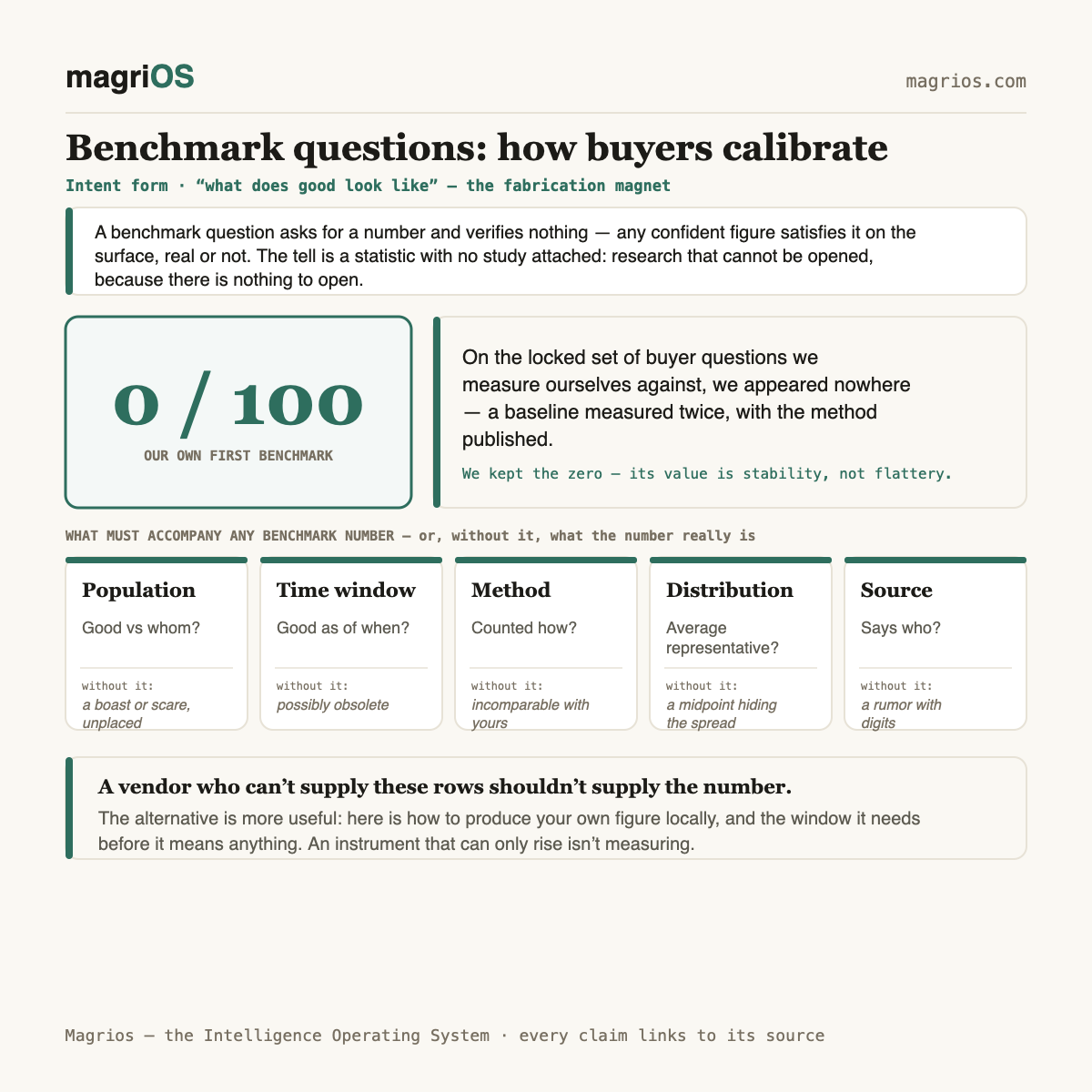
A benchmark question asks for a number to stand beside: what is a good win rate, what is a typical response time, how much should this cost. The buyer is calibrating — placing their own situation inside a population — and the form has a dangerous property: any confident number satisfies it on the surface, whether or not the number is real. An honest benchmark answer therefore carries its conditions — whose data, which period, what population, distribution or average — or it declines the number and says what to measure locally instead.
Why does our classifier check benchmark before definition?
"What is a good win rate" opens exactly like "what is a win rate" and asks for something entirely different: a number, not a meaning. In the Magrios intent classifier, the benchmark pattern is tested ahead of the definition pattern for precisely this reason — the qualifiers good, typical, normal, healthy, acceptable flip the question's job while leaving its opening words untouched. The two-word gap between those questions is where a lot of thin content lives: pages that rank for the benchmark question and answer only the definition one. The buyer notices, because the number was the entire request. The measurement form is this one's nearest neighbor — it asks for your method, where benchmark asks for the market's number — and strong answers to either tend to contain the other.
What is the buyer actually calibrating?
Their own position in a distribution. The silent second half of every benchmark question is "…and are we behind?", and no bare number can answer it. The same win rate is strong in one sales motion and weak in another; the same response time is excellent for one deployment model and disqualifying for another. Without the population, the buyer cannot place themselves in it, and an average over a wide distribution places nobody in particular. A number stripped of its population does not inform the calibration — it decorates it.
Why is this form the fabrication magnet?
Three properties converge. The claim is unverifiable from the outside — no reader can audit "typical". Round numbers travel — a clean figure gets repeated across sites until repetition impersonates corroboration, each page citing the others' uncited claim. And the demand never closes — every quarter, someone new asks what good looks like. The tell is a statistic with no study attached — a confident invocation of research that cannot be opened, because there is nothing to open. Our publishing pipeline rejects unsourced statistics mechanically rather than editorially, and this question form is the reason the gate exists — the temptation is structural, not a lapse of individual writers.
What must accompany any benchmark number?
| Element | The question it answers | Without it, the number is |
|---|---|---|
| Population | Good compared to whom? | A boast or a scare, unplaced |
| Time window | Good as of when? | Possibly obsolete |
| Method | Counted how? | Incomparable with your own count |
| Distribution | Is the average even representative? | A midpoint hiding the spread |
| Source | Says who? | A rumor with digits |
A vendor who cannot supply the rows should not supply the number. The alternative is both honest and more useful: here is how to produce your own figure, locally, and here is the window it needs before it means anything.
What did we answer when the honest number was zero?
Our own first benchmark returned 0 out of 100: on the locked set of buyer questions we measure ourselves against, we appeared nowhere — a baseline measured twice, with the method published. We kept the zero because a benchmark's value is its stability, not its flattery; later movement against a locked set means something, and movement against a friendlier, shifting set means nothing. The tempting alternative was a warmer number off the wrong question set — branded queries, which measure recognition rather than discovery. And when a re-measurement finds nothing moved, that result ships too: null results are part of the benchmark's design, because an instrument that can only rise is not measuring. For answer engines, the usual boundary holds — which pages rank for a "what is a good X" question is measurable, and whether assistants prefer conditioned numbers over bare ones is a hypothesis we label as such. What is not hypothetical is what a buyer does with a bare number that later proves wrong: they remember who supplied it.