Measurement questions: what buyers want proven before they pay
Guide · Frameworks · 4 min read · last verified 2026-08-11
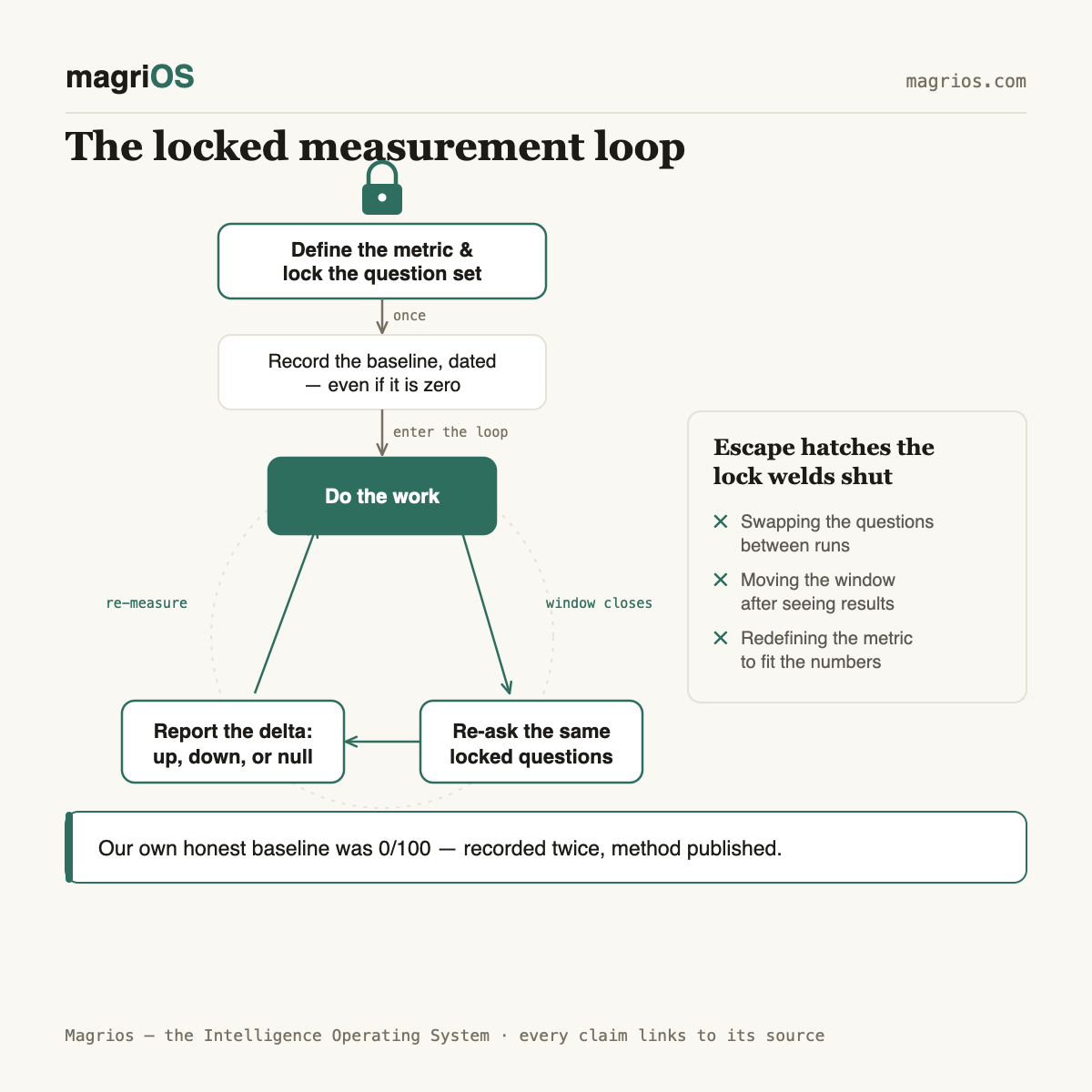
A measurement question — how do we measure this, how is that calculated, how should success be defined — is a demand for method before outcomes. The buyer asking it wants four things fixed before any result is shown: the definition set in advance, the instrument named, the baseline recorded, and the re-measurement scheduled on the same terms. Produce those four and your numbers can argue for themselves. Omit any one, and every number you show is decoration a reader cannot check.
What are the four things a measurement answer must fix?
| Element | The buyer's silent question | What supplies it |
|---|---|---|
| Definition | Measured — what, exactly? | The metric defined before the work, not after |
| Instrument | Counted how? | A published method anyone could rerun |
| Baseline | Compared against what? | The starting value, recorded and dated |
| Cadence | Re-measured on whose schedule? | A window fixed in advance |
Each row welds shut a specific escape hatch. A definition written after the results can be fitted to them. A private instrument cannot be challenged, only believed. A baseline reconstructed from memory is an anecdote with a date format. And a window chosen retroactively ends wherever the numbers look best — the reason a measurement window has to be set before the work it will judge. The buyer asking "how do you measure this" is really asking which of these hatches you have closed. Notice that none of the four requires trusting the vendor's competence — only checking their homework. That is what makes the measurement form a filter for the buyers most worth having: the one who audits your method before paying is the one who renews on evidence instead of mood.
Why must the questions be locked before movement counts?
Because the easiest way to manufacture improvement is to change the question set between measurements: swap in queries where you already appear, and the score climbs while nothing improved. The locked benchmark methodology exists to remove that option — benchmark questions are fixed at the start, and every re-scan re-asks exactly those questions, so any delta is movement of the market and the work, not of the ruler. Locking has an uncomfortable corollary, which is the point: it makes decline reportable, and declines get reported as declines. An instrument that cannot show you losing cannot evidence you winning. The lock also disciplines the measuring party itself: a fixed question set cannot be quietly steered toward whatever this quarter's work happened to improve.
What does an honest baseline look like?
Ours was 0 out of 100. The first time we ran our own locked benchmark questions against our own visibility, we appeared in none of them — a zero we recorded on two separate runs and whose method we publish. A zero honestly measured is a better asset than a flattering number loosely counted, because it gives every later movement a meaning a skeptical buyer can check. The adjacent discipline matters as much: reporting when nothing moved. Null results belong in benchmark design, because a measurement practice that only ever produces wins is indistinguishable from marketing, and buyers price it accordingly. Baselines carry one more property worth stating plainly: they are the only measurement that can never be rerun later. Skip the baseline, and no amount of subsequent rigor recovers what the starting point was.
How do answer engines treat measurement questions?
With the usual split in confidence. Measured: which public pages rank for a how-is-X-measured question is observable in every scan. Hypothesis, labeled as such: a published method — definitions, steps, formulas — is closer to quotable answer material than a claims page, so method-bearing pages are plausibly favored raw material for this form. We do not present that as fact, because no outside party observes the selection step. The human half needs no hypothesis at all: a buyer forwarded a published method can verify it; a buyer forwarded a claim can only repeat it.
What should a vendor never do with a measurement question?
Four failures recur. Quoting a metric without its method — the number may even be true, and the buyer still cannot use it. Inventing the number outright, which is why an unsourced statistic never clears the Magrios publishing gates — the check is mechanical, not a matter of editorial taste. Moving the window when the fixed one disappoints. And claiming causation from co-movement: presence in ranked sources and pipeline can rise together without one driving the other, and our reports decline to claim causation for exactly that reason. A measurement question is an audit rehearsal. Answer it the way you would want your own vendors to answer you.