Tooling questions: what buyers ask when they want to know if it fits
Guide · Frameworks · 4 min read · last verified 2026-08-11
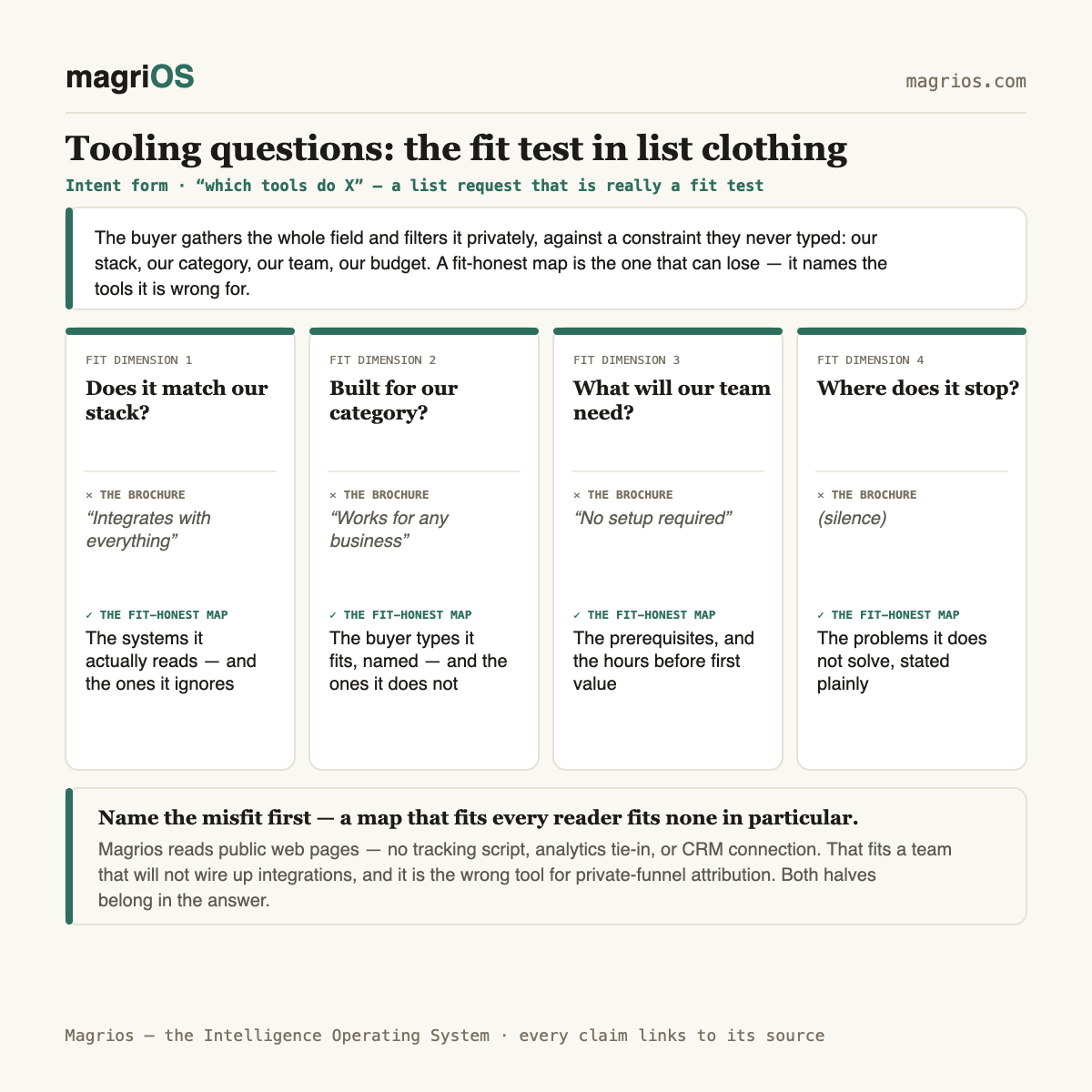
A tooling question — "which platforms do this," "what software handles that" — reads like a request for a list, but the buyer running it is testing fit. They are mapping which products exist so they can find the one that survives contact with their own stack, category, and team. The useful reply is not a longer inventory; it is a map honest enough to include the tools that do not fit them, and the conditions under which each one does.
What is a tooling question actually asking?
For the shape of a category, filtered through a constraint the buyer has not said out loud. Underneath "which tools do X" sits "which of them would work here" — with our data, our team's skills, our budget, the rest of what we already run. The buyer cannot type that constraint into a search box, so they gather the whole field and filter it privately, the same way they later strip a shortlist back to its criteria. A vendor who answers only the words on the page — here is the list, and here we are on it — has handed over half a map and pocketed the compass.
Why is "which tools do X" not the same as "which should we pick"?
Because one asks what exists and the other asks for a verdict on a set already known. The twelve-shape classifier tests the tooling pattern before the selection pattern for exactly this reason: "which platforms support X" opens with the word "which," the same word a pick opens with, yet it wants an inventory, not a choice. The order matters past grammar. Answer a mapping question with a ranked recommendation and you have marched the buyer past the survey they came to run — they wanted to see the category before trusting anyone to narrow it, and a vendor who narrows too early reads as a vendor with something to hide in the part they skipped.
What does a fit-honest answer put on the table?
The dimensions the buyer is quietly checking, each answered against a real constraint rather than a slogan.
| The buyer's fit question | The brochure inventory | The fit-honest map |
|---|---|---|
| Does it match our stack? | "Integrates with everything" | The systems it actually reads, and the ones it ignores |
| Is it built for our category? | "Works for any business" | The buyer types it fits, named — and the ones it does not |
| What will our team need to run it? | "No setup required" | The prerequisites, and the hours before first value |
| Where does it stop? | Silence | The problems it does not solve, stated |
The right column shares one discipline with an honest comparison: it can lose. A tool map that fits every reader fits none of them in particular, and the boundary — who this is wrong for — is the part carrying the information.
How should a vendor answer "will it fit us"?
Name the misfit first. State the buyer profiles the product is wrong for, the stacks it will not read, the point where a different class of tool takes over — in language a reader can check against their own situation without booking a call. Our own version is a standing refusal to claim universal fit. Magrios reads public web pages and needs no tracking script, analytics tie-in, or CRM connection, which is a genuine fit fact in both directions: it fits a team that cannot or will not wire up integrations, and it is the wrong tool for a buyer who wants private-funnel attribution, because it measures presence in public sources, not your pipeline. Both halves belong in the answer. The buyer testing fit is assembling the case they will defend to whoever asks "why this one," and a fit claim that does not survive their own stack is the quickest way off that list.
How do answer engines treat tooling questions?
Draw the line where the evidence ends. Measured: which public pages surface for a "which tools do X" question is observable in every scan, and category maps and listings tend to populate that surface. Labeled hypothesis: an assistant assembling an answer to a category question needs a source that lays out the field with enough neutral structure to reuse, so a page mapping the category — competitors included — is plausibly better raw material than a page mapping only itself. We hold that as a hypothesis, not a finding, because the selection step inside a model is not observable from outside. One effect needs no model at all: a category map hosted by one of its own entries carries the discount a reader applies to any self-interested list, and the more honest the map, the smaller that discount runs.
Once the field is mapped and the misfits are gone, the buyer stops asking what exists and starts asking which of the survivors to choose, then what separates the final two, then whether to commit at all. Tooling is where that funnel opens — and the vendor who draws the widest honest map is the one still on it when the questions turn narrow.