Seats, scans, and outcomes: a pricing-model teardown for intelligence tools
Guide · Enterprise · 4 min read · last verified 2026-08-11
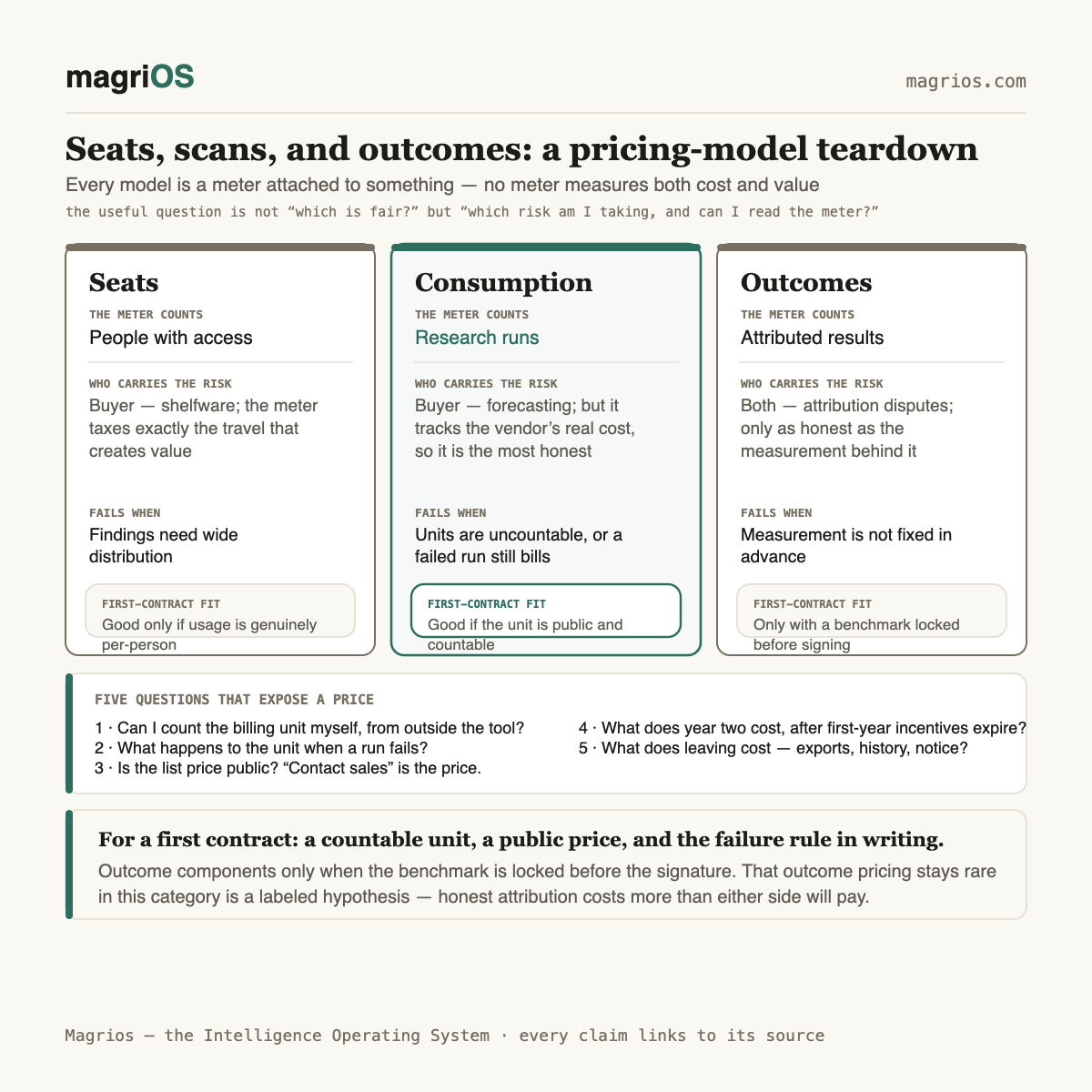
Intelligence tools price on three meters: seats (who can look), consumption (how much research runs), and outcomes (what the tool claims it caused). Seat pricing buys budget predictability but taxes the distribution of findings; consumption pricing tracks the vendor's real costs but moves forecasting risk onto you; outcome pricing sounds aligned and is the hardest to verify honestly. For a first contract, prefer a price whose unit you can count yourself.
What is the meter actually measuring?
Every pricing model is a meter attached to something. The vendor's cost driver in this category is research compute — the scanning, retrieval, and classification that produce findings. The buyer's value driver is decisions supported. No meter measures both, so every model is a compromise, and the useful question is not “which model is fair?” but “which risk am I taking, and can I read the meter?”
When does seat pricing make sense?
Seats are the familiar meter: predictable, procurement-friendly, easy to budget. The problem is what they measure. Intelligence creates value when findings travel — into the board deck, the roadmap review, the sales call — and per-seat pricing charges you for exactly that travel. The perverse result is teams rationing access to research they bought in order to distribute it.
Seat pricing fits when usage genuinely is per-person and continuous: analysts working in the tool daily. For research meant to circulate, look for models that admit readers cheaply and meter the research itself.
When does consumption pricing make sense?
Consumption models — scans, credits, queries — attach the meter to the vendor's real cost, which makes them the most honest of the three. They are also the easiest to obscure. Three questions separate an honest consumption price from a credits maze:
- What exactly consumes a unit? If the answer needs a diagram, the meter was not built for reading.
- Can I count units from outside the tool? A billing unit visible only on the invoice is not a meter; it is a bill.
- What happens on failure? A failed run that bills is a pricing model with a bug in the buyer's ledger.
As a worked example of a common hybrid: Magrios prices per user per month with a fixed research cadence — one plan scans weekly, the other daily — with both list prices public and a stated rule that a failed scan never consumes the allowance. The unit (a completed scan) is countable from outside the vendor's invoice, which is the property worth demanding whoever the vendor is.
Can outcome pricing be verified?
Outcome pricing — pay for improvement in visibility, pipeline, rankings — is the model that sounds most aligned and behaves worst under audit. The problem is attribution: an outcome meter is only as honest as the measurement behind it, and if the measurement method can move after signing, the price is renegotiable after the fact by whoever runs the measurement. If you accept an outcome component at all, fix the measurement in the contract: a benchmark locked in advance, identical between measurements, with declines reported as declines. A reasonable hypothesis, covering the rarity itself as much as its cause: outcome pricing stays rare in this category because honest attribution at contract granularity costs more than either side will pay for it.
How do the three models compare?
| Model | Meter | Who carries the risk | Fails when | First-contract fit |
|---|---|---|---|---|
| Seats | People with access | Buyer (shelfware) | Findings need wide distribution | Good if usage is genuinely per-person |
| Consumption | Research runs | Buyer (forecasting) | Units are uncountable or bill on failure | Good if the unit is public and countable |
| Outcomes | Attributed results | Both (attribution disputes) | Measurement is not fixed in advance | Only with a pre-locked benchmark |
Which five questions expose a price?
- Can I count the billing unit myself, from outside the tool?
- What happens to the unit when a run fails?
- Is the list price public? A hidden price is also information — “contact sales” is the price reads that signal.
- What does the second year cost, after first-year incentives expire?
- What does leaving cost — exports, history, notice periods?
For scaling contracts, the practical middle between a fixed commitment and open-ended usage is a commit with overage terms; commit-plus-overage vs pure usage pricing takes that trade apart.
Which model fits a first contract?
A countable unit, a public price, and the failure rule in writing. In practice: seats with bundled research cadence, or plain consumption with a visible meter — and outcome components only when the benchmark is locked before the signature. One role note to close: whether the price matches the value is the economic buyer's judgment, not the process-runner's — procurement vs the economic buyer — and if the pricing exercise reveals no decision worth paying for, not buying is a legitimate result.