Confidence with a basis: measurement versus derivation
Guide · AI Visibility · 5 min read · last verified 2026-08-11
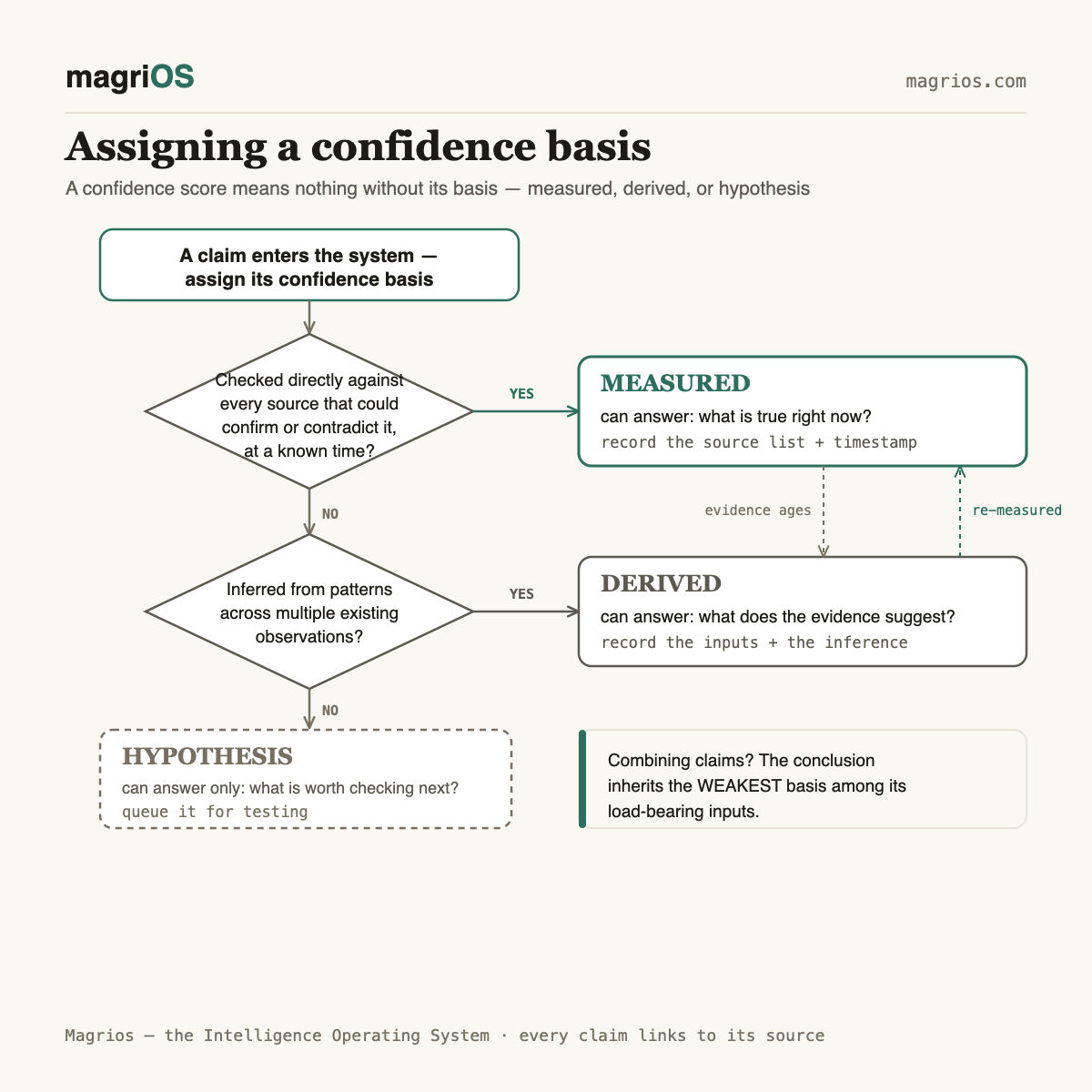
A confidence score without a stated basis is decoration, not information. The basis answers the one question the number itself cannot — how does the system know? — and there are only three honest answers: direct measurement, where the claim was checked against every relevant source; derivation, where it was inferred from patterns across observations; and hypothesis, where it is plausible but untested. A confidence label means something only when it carries one of these, because the same level of confidence demands entirely different action depending on how it was earned.
Why undifferentiated confidence misleads
Most tools that report confidence present it as a single dial, as if certainty were one substance varying only in quantity. It is not. A high-confidence claim that means "we checked this against the sources that could contradict it" and a high-confidence claim that means "the model produced this fluently and nothing contradicted it" look identical on a dashboard. They are not the same asset. The first can absorb the weight of an irreversible decision; the second cannot, however polished it appears.
The damage is behavioural. When operators cannot distinguish the two, they either trust everything the dial endorses — and eventually act on an untested inference as if it were a verified fact — or they learn to trust nothing, and the score degrades into a number everyone scrolls past. Both outcomes destroy the point of scoring at all. This is the same structural weakness that makes conversational tools unreliable as a system of record: fluency reads as certainty, and nothing in the interface says otherwise — the argument developed in Why AI chat alone cannot carry strategic decisions.
The three bases, and what each can honestly answer
Measured. The claim was checked directly against every source that could confirm or contradict it, at a known time. Measurement is the only basis that can honestly answer "what is true right now?" Its authority is narrow and dated: it speaks for the sources consulted, at the moment of consultation, and nothing more.
Derived. The claim was inferred from patterns across multiple observations, none of which states it directly. Derivation can honestly answer "what does the accumulated evidence suggest?" It is genuine knowledge — often the most valuable kind — but its confidence is conditional on the inference holding, not merely on the inputs being sound.
Hypothesis. The claim is plausible, consistent with what is known, and untested. A hypothesis can honestly answer only one question: "what is worth checking next?" Systems that refuse to label hypotheses as such end up laundering guesses into findings. Keeping the three bases visibly distinct in the product is the practical core of what Evidence-first AI: what it means and how to verify a vendor's claim to it describes at the vendor level.
Deep dive: how confidence should propagate
The hard cases are not single claims but chains. A recommendation almost never rests on one basis: it combines a measured fact (this appeared in these answers, on this date) with a derived pattern (claims of this shape have recurred across the cluster) and sometimes a hypothesis about why. What basis does the conclusion carry?
The only defensible rule is that a chain inherits its weakest basis. If any load-bearing link is derived, the conclusion is derived; if any link is a hypothesis, the conclusion is a hypothesis, no matter how thoroughly the other links were measured. The tempting alternative — letting the strongest input colour the whole chain — is a lie with a mechanism. Measured components are the most visible and most impressive parts of an argument, so surfacing their basis makes the entire recommendation look verified. The operator sees "measured" and hears "checked", when what was actually checked is one premise of an inference that was never tested.
Two refinements keep the rule honest rather than merely conservative. First, weakest-basis applies only to load-bearing links: a hypothesis mentioned as context does not demote a conclusion it does not support. Deciding which links actually carry load is precisely why the reasoning chain must be inspectable — the case made in What is decision traceability, and why enterprises should demand it. Second, bases move. Re-measurement upgrades: a derived claim that is subsequently checked against sources becomes measured from that moment, and every chain resting on it strengthens with it. Time downgrades: a measurement ages back into a derivation, because "we checked in March" supports "probably still true" only as an inference. A system that never demotes stale measurements is quietly converting facts into folklore while the labels still say "measured".
Five questions to ask of any confidence claim
The score itself tells you almost nothing. Ask the vendor:
- What is the basis? Measured, derived, or hypothesis — and is the distinction visible in the product, or only in the sales conversation?
- What exactly was checked, and when? A measurement without a source list and a timestamp is a derivation wearing a costume.
- Does confidence decay? If a score never changes as its evidence ages, it is not tracking anything.
- How does it propagate? Ask what basis a conclusion carries when it combines checked facts with inferred patterns. Weakest-basis is the honest answer; silence is also an answer.
- Can you walk the chain? If there is no path from the score back to the observations that produced it, the basis is unverifiable — which in practice means it is absent.
When derived confidence is genuinely enough
The argument cuts both ways. Measurement is expensive — it costs queries, time, and attention — and demanding it everywhere is its own failure mode. For low-stakes, reversible decisions, a derived basis is not a compromise; it is the correct engineering choice. Choosing which cluster to investigate next, which draft to prioritise, which anomaly deserves a second look: these calls are cheap to reverse, and the cost of measuring first exceeds the cost of occasionally being wrong. A team that insists on measured confidence before every move does not become rigorous; it becomes slow, and its operators eventually route around the system.
The discipline is therefore not "measure everything". It is: never let a label conceal its basis, reserve measurement for claims that carry irreversible weight, and treat any score that cannot say how it knows as exactly what it is — decoration.