Evidence-chain architecture: from source to recommendation
Guide · AI Visibility · 3 min read · last verified 2026-08-11
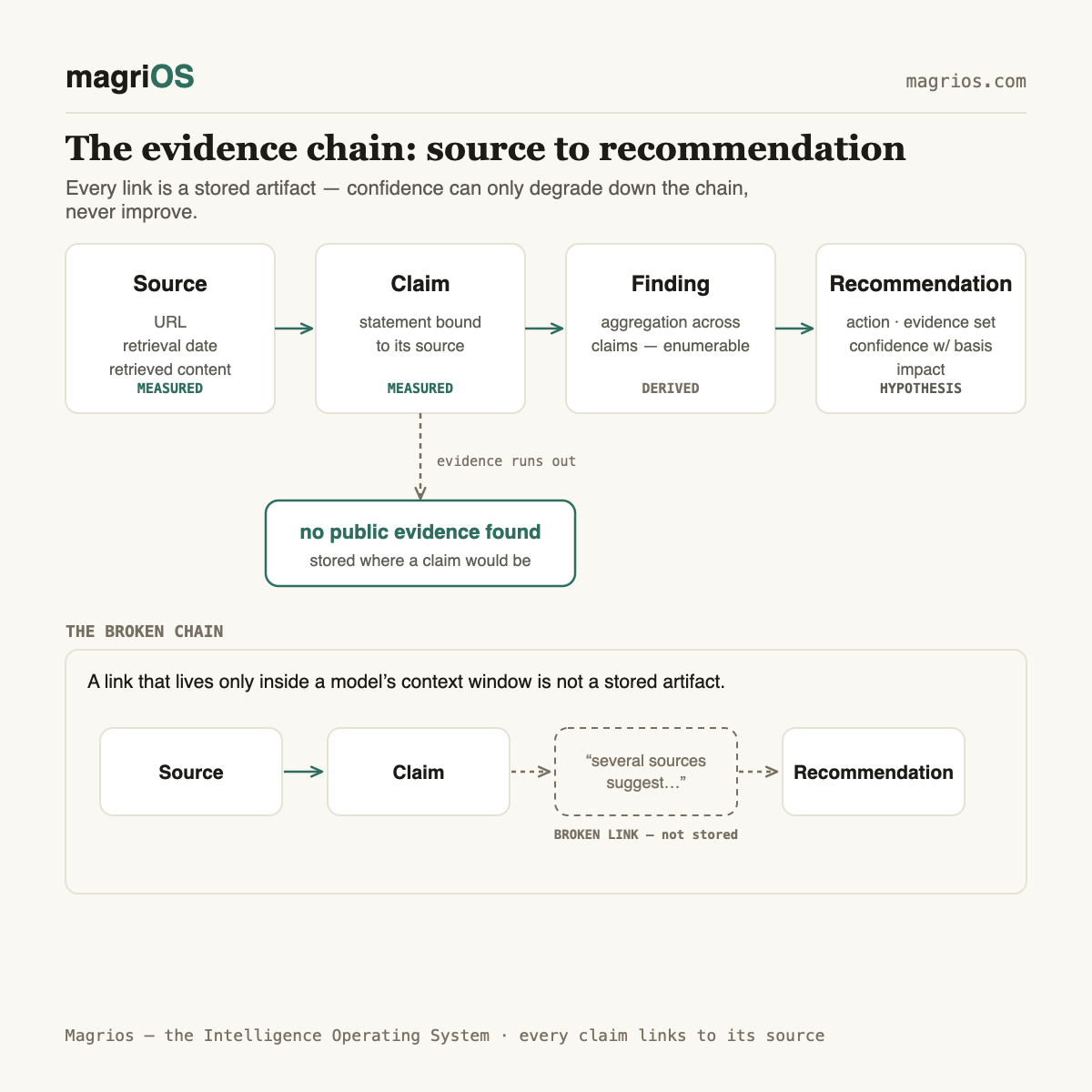
An evidence chain is the unbroken, inspectable path from a source document to the recommendation an AI system makes: source, extracted claim, aggregated finding, recommendation — each link stored as an artifact, none re-generated on demand. The test is short: pick any recommendation and walk backwards until you reach a URL a human can open. If any link along the way exists only inside a model's context window, the chain is broken at that link.
What are the links in the chain?
| Stage | Artifact stored | The question it answers later |
|---|---|---|
| Source | The page itself: URL, retrieval date, retrieved content | What did the system actually read? |
| Claim | An extracted statement bound to its source | What did that page say? |
| Finding | An aggregation across claims, with the claims enumerable | What pattern emerged, from which claims? |
| Recommendation | Action plus evidence set, confidence with basis, expected impact | Why this action, on what grounds? |
Each stage must reference the previous one by identity, not by description. A finding that says “several sources suggest” without enumerable claims has already left the chain; so has a recommendation whose evidence is a summary paragraph rather than a set of stored claims. The stored path is what an evidence trail names at the report level — the chain is the architecture that produces it.
Why must the chain be stored, not narrated?
Because a system can always explain itself after the fact, and the explanation can be excellent without being true. A model asked “why did you recommend this?” produces narrative — fluent, plausible, and unverifiable, since nothing pins it to what actually drove the output. An evidence-chain architecture removes the need to ask: the recommendation was assembled from stored claims, so the answer to “why?” is a lookup, not a generation.
This is why Magrios's decision traces expose evidence, sources, confidence with its basis, impact, and action — and never model chain-of-thought. The first five are checkable artifacts. Chain-of-thought is prose about artifacts, and prose does not audit. Storage also buys durability: the artifacts survive model upgrades, so the answer to “why?” reads the same next quarter as it did on the day of the recommendation.
Where do confidence labels attach?
At every link — and confidence can only degrade as it moves down the chain, never improve. A fact read directly from a source is measured. An aggregation across claims is derived: sound method, one step from the ground. Anything that crosses an inference gap is a hypothesis and must say so at the point of crossing, not in a footnote. A single confidence number attached to the final recommendation, with no per-link basis, is a summary of nothing; confidence with a basis draws the measured/derived line in detail.
What happens when evidence runs out?
The chain must be able to terminate visibly. The honest terminal state is a recorded null — in Magrios reports, the literal statement “no public evidence found,” stored exactly where a claim would have been. An architecture without a visible null state has one alternative when evidence runs out: filling the gap. And a gap filled at the claim stage poisons every stage downstream while looking, at the recommendation layer, exactly like research. Refusal behavior is an architectural property, not a tone choice; refusals and receipts makes the enterprise case for it.
How do you inspect a vendor's chain in ten minutes?
Take a live output — not a demo — and walk one recommendation backwards. One check per stage:
- Recommendation: is the evidence an enumerable set, or a paragraph?
- Finding: can you list the claims behind it and count them?
- Claim: does it name its source, with a retrieval date?
- Source: does the link resolve to the claimed page — not a homepage, not a search result?
Failure at any stage is the finding. Magrios keeps the evidence explorer open in its pre-purchase sample reports precisely so this inspection needs no NDA and no sales call; evidence-first AI generalizes the same inspection to any vendor's claim of being evidence-based. Whatever the tool, the architecture either survives the walk backwards or it does not — and ten minutes with a real output settles which.