Pooled vs named CSM coverage: which model fits your book
Comparison · Customer Success · 6 min read · last verified 2026-08-11
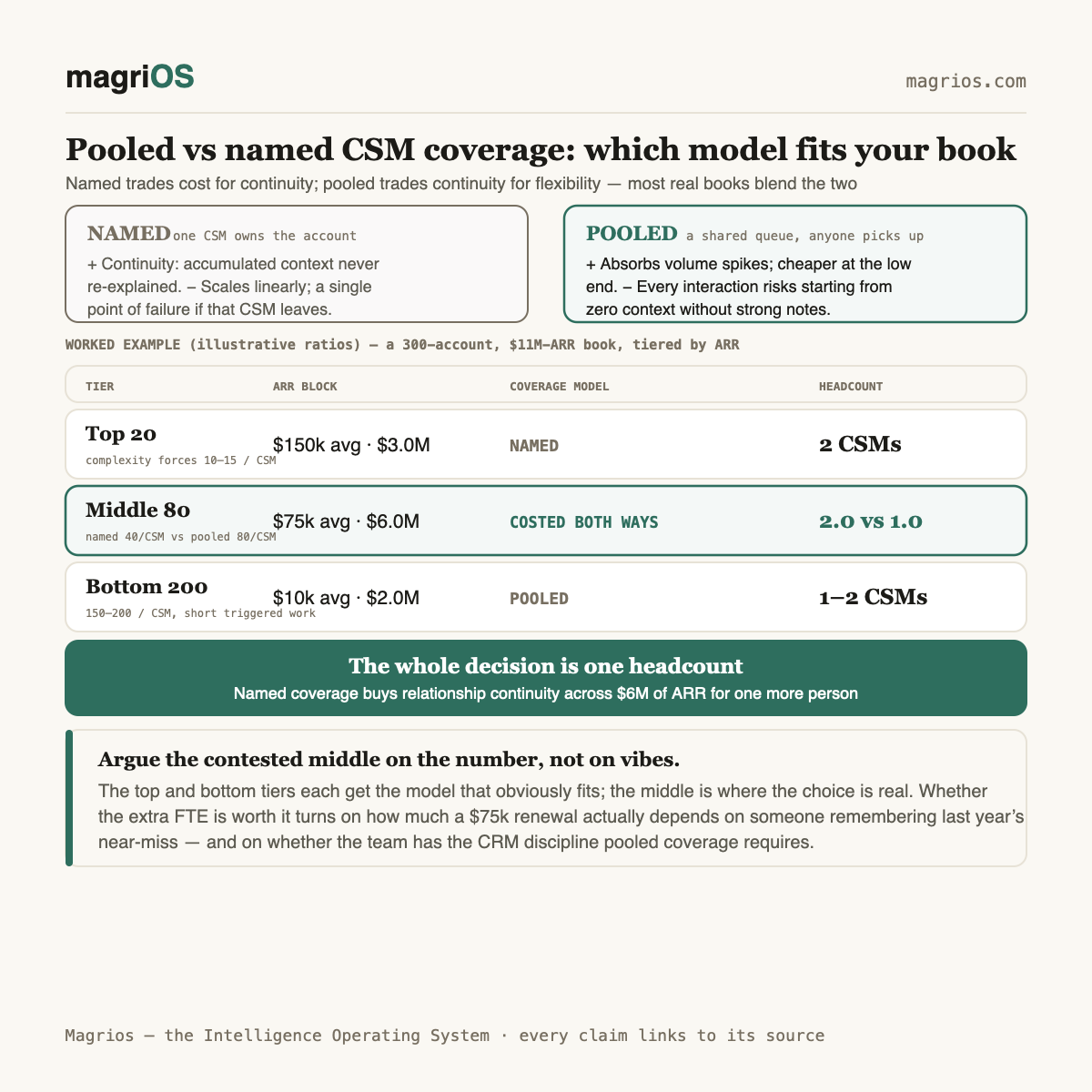
Two different answers to "who owns this account"
Pooled and named coverage are the two dominant ways to assign customer success responsibility across a book. Named coverage assigns each account to one specific CSM, who owns every interaction with that account for as long as it's under contract. Pooled coverage assigns accounts to a shared queue that any CSM on the team can pick up, so the same account might talk to a different person on its next inbound request.
Neither model is universally better. They trade off relationship continuity against flexibility and cost, and the right choice depends on account size, complexity, and how much of the customer's value depends on someone remembering the history.
How named coverage works
One CSM is the named owner of an account for the life of the relationship. They run the onboarding, the QBRs, the renewal conversation, and every escalation in between. The customer typically knows this person's name and email, and expects to reach them directly rather than a shared inbox.
Strengths: Continuity. The CSM accumulates context — what the customer tried before, who the real decision-maker is, what almost made them churn last year — that never has to be re-explained. This matters most for accounts where the relationship itself is part of the value delivered, and where a wrong answer from someone unfamiliar with the account's history creates real risk.
Costs: Named coverage scales linearly with headcount. Every new account added to the book adds directly to some CSM's load, and there's no way to absorb a spike in one account's needs without pulling that CSM's attention away from their other named accounts. It also creates a single point of failure — if the named CSM leaves or is out, the account effectively loses its institutional memory until a replacement ramps up.
How pooled coverage works
Accounts are not permanently assigned to one person. Requests come into a shared queue — often triggered by usage drops, support escalations, or scheduled check-in cadences — and whichever CSM has capacity picks it up. Some pooled models still assign a nominal "primary" contact for administrative purposes, but day-to-day interaction can come from anyone on the team.
Strengths: Pooled coverage absorbs volume variability well. If one account spikes in need, any available CSM can respond instead of overloading a single named owner. It also scales more efficiently at the low end of account size, where the relationship-continuity value of a named owner doesn't justify the cost of dedicating a person to remembering one small account's history.
Costs: Every interaction risks starting from zero context unless the team has strong shared documentation. A customer who has to re-explain their setup to a different person each time they reach out experiences that as a worse relationship, even if each individual interaction is competently handled. Pooled models depend heavily on CRM notes and account history being complete and current — a discipline that degrades quickly under load.
A worked example: tiering, and the one tier worth costing both ways
Take a hypothetical book of 300 accounts split by ARR tier, to make the trade-off concrete. Every ratio below is illustrative — chosen to keep the arithmetic legible, not lifted from a benchmark.
Tier structure: 20 accounts averaging $150,000 ARR each (20 × $150,000 = $3,000,000), 80 accounts averaging $75,000 ARR each (80 × $75,000 = $6,000,000), and 200 accounts averaging $10,000 ARR each (200 × $10,000 = $2,000,000). Total book: $3,000,000 + $6,000,000 + $2,000,000 = $11,000,000 ARR across 300 accounts.
Top 20, named. At a named ratio of 20 accounts per CSM, the top tier needs 20 / 20 = 1 CSM. But given the complexity typical of $150,000+ accounts, a more conservative 10–15 accounts per CSM is the likelier planning assumption, and that changes the answer: 20 / 15 = 1.33 and 20 / 10 = 2.0, a range of 1.33–2.0 FTE. Note that the bottom of that range is already above one person, so the honest headcount is 2 CSMs — there is no version of this tier that one CSM covers at the conservative ratio.
Bottom 200, pooled. At a pooled ratio of 150–200 accounts per CSM — sustainable because most interactions are triggered and short rather than relationship-deep — 200 / 200 = 1.0 and 200 / 150 = 1.33, a range of 1.0–1.33 FTE, or 1–2 CSMs. Here the bottom of the range genuinely is one person, because 200 / 200 divides exactly.
The middle 80, costed both ways. The two tiers above illustrate tiering, not a model comparison — each one gets the model that obviously fits. The middle tier is where the choice is actually contested, so it is the one worth costing under both models. It is also the largest ARR block in the book at $6,000,000, more than the top and bottom tiers combined ($3,000,000 + $2,000,000 = $5,000,000).
- Named, at an illustrative 40 accounts per CSM for a $75,000-ARR segment: 80 / 40 = 2.0 FTE, which puts $6,000,000 / 2 = $3,000,000 of ARR behind each CSM.
- Pooled, at an illustrative 80 accounts per CSM: 80 / 80 = 1.0 FTE, which puts $6,000,000 / 1 = $6,000,000 of ARR behind the single CSM.
The gap is exactly 2.0 − 1.0 = 1.0 FTE. That is the whole decision expressed as a number: on this tier, named coverage buys relationship continuity across $6,000,000 of ARR for one additional person. Whether that is worth it depends on how much of the renewal on a $75,000 account actually turns on someone remembering last year's near-miss — not on which model reads better in the abstract. Most teams argue this tier on vibes and then discover they were arguing about one headcount.
The book totalled. Carrying all three tiers through, with a named middle: 1.33 + 2.00 + 1.00 = 4.33 FTE at the low end, and 2.00 + 2.00 + 1.33 = 5.33 FTE at the high end. With a pooled middle: 1.33 + 1.00 + 1.00 = 3.33 FTE to 2.00 + 1.00 + 1.33 = 4.33 FTE. Rounding each tier up to whole people, because fractional CSMs aren't hireable, that is 5–6 CSMs against 4–5 — one person of difference on an $11,000,000 book, attributable entirely to how you decide to cover the middle 80.
This arithmetic is illustrative, built to show how tiering and model choice move headcount math — the actual ratios your team should use depend on your own product complexity and touch model, as covered in the CSM coverage ratio definition.
When each model fits
- Use named coverage for accounts where switching cost of losing institutional memory is high: complex implementations, multi-stakeholder enterprise relationships, or accounts with a history of near-churn that requires someone who remembers why.
- Use pooled coverage for accounts where interactions are short, well-documented in the product itself, and don't depend heavily on relationship history — typically smaller accounts on standardized plans.
- Use a hybrid, tiered model for most real businesses: named coverage for the top ARR tier where continuity pays for itself, pooled coverage for the long tail where it doesn't. This is the most common real-world setup because pure named or pure pooled rarely fits an entire book evenly.
A quick decision checklist
- Does losing institutional memory on this account create real renewal risk? If yes, lean named.
- Is the account's ARR high enough to justify a dedicated fraction of a CSM's time? If yes, lean named.
- Is interaction volume spiky and hard to predict per account? If yes, lean pooled.
- Is the product simple enough that most requests can be resolved without deep account history? If yes, lean pooled.
- Does the team have the CRM discipline to keep shared notes current? If no, pooled coverage will underperform regardless of how well-suited it looks on paper.