Why NPS does not predict renewal
Guide · Customer Success · 5 min read · last verified 2026-08-11
Start with what the question actually asks
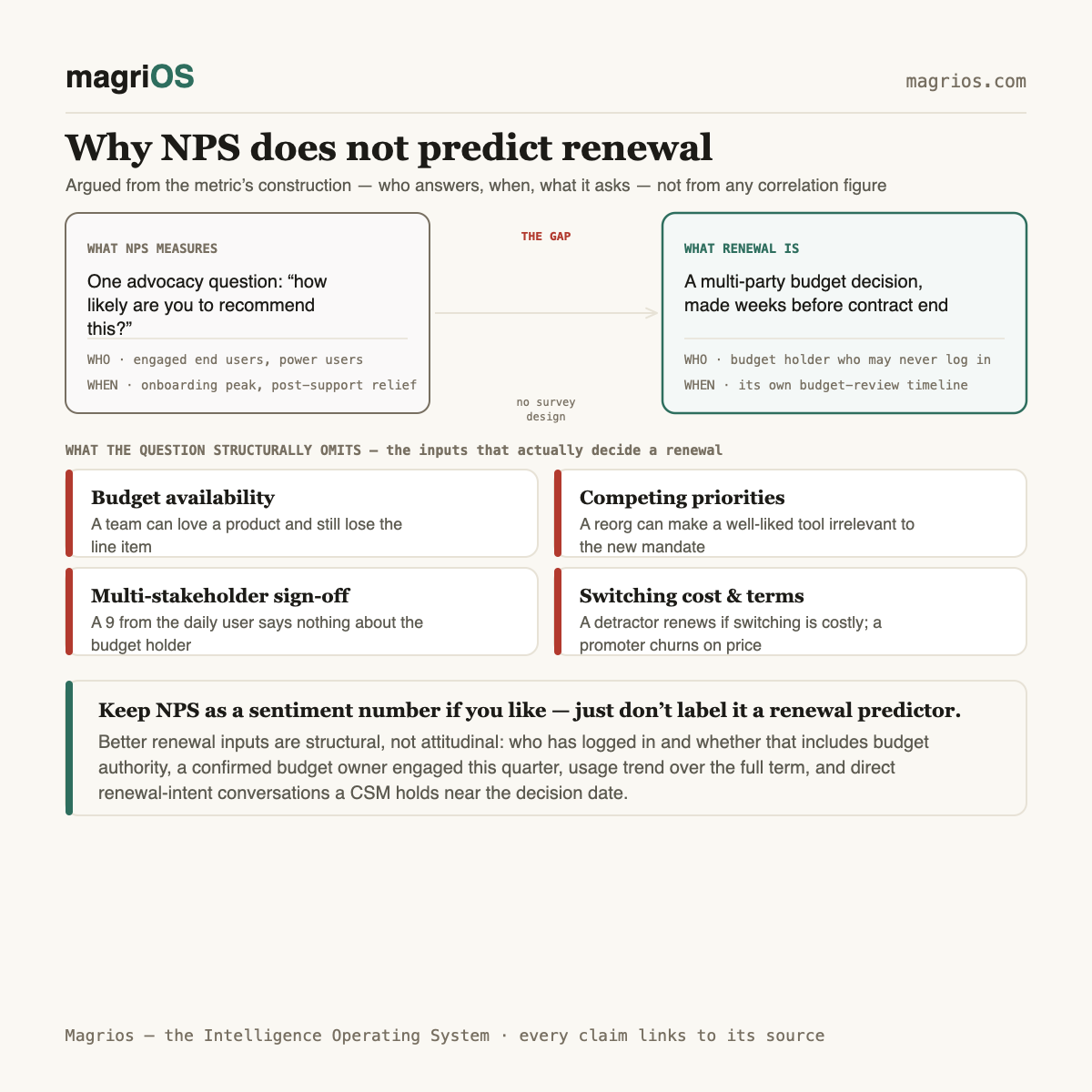
Net Promoter Score is built from one question: "How likely are you to recommend [product] to a friend or colleague?" That is an attitudinal question about advocacy. Renewal is a budget decision made by an organization, usually involving procurement, a champion, and a manager who controls a line item. Those are not the same event, and no amount of survey design fixes that gap, because the gap is in what the question measures, not in how well it's asked.
This piece argues from the construction of the metric — who answers it, when, what it asks, and what it structurally cannot capture — rather than from any claimed correlation between NPS and retention. No such figure is used here, deliberately: a single self-reported attitude question was never built to forecast a multi-party budget process, and no correlation study, real or invented, changes that architectural mismatch.
Who answers the survey
NPS surveys go to whoever is willing to click through an email or in-app prompt. In B2B software that population skews toward whoever uses the product most and has the least friction responding — often a power user or the original champion, not the economic buyer, not the newer stakeholder who inherited the relationship, and rarely the procurement or finance contact who actually signs the renewal.
This matters because renewal in B2B is a decision made by people with budget authority, who may never see the product, let alone an NPS prompt. A score built entirely from the opinions of engaged end users tells you about end-user sentiment. It tells you nothing about whether the budget holder — who might check the tool's usage report once a quarter and nothing else — sees enough value to keep paying for it.
When it's asked
Most NPS programs survey shortly after onboarding, at a fixed cadence (quarterly or twice yearly), or right after a support interaction closes positively. Each of these timing choices biases the score toward a moment that is not the renewal decision itself:
- Post-onboarding surveys catch peak enthusiasm. New users are typically most optimistic before they've hit the product's real limitations or before organizational usage has settled into its steady state.
- Fixed-cadence surveys catch whoever happens to be paying attention that week. A user mid-crisis with an unrelated deadline skips the survey; a user with a quiet week responds. The sample is not the same population each time, so score movement across periods conflates sentiment change with response-population change.
- Post-support surveys catch relief, not durable satisfaction. A ticket that just got resolved produces a short-lived positive spike that has little to do with the customer's baseline view of the product ninety days later, which is closer to what a renewal decision draws on.
None of these moments line up with the actual renewal event, which typically happens weeks before contract end, driven by a budget review that has its own timeline, its own stakeholders, and its own criteria — none of which the NPS survey was designed to capture.
What the question omits entirely
Even a perfectly timed, perfectly sampled NPS score omits the structural inputs that actually decide a renewal:
- Budget availability. A team can love a product and still lose the line item in a budget cut. NPS has no mechanism to detect this because it never asks about budget.
- Competing priorities. A reorg that shifts a team's mandate can make a well-liked tool irrelevant to the new mandate, independent of how anyone feels about the product itself.
- Multi-stakeholder agreement. Renewal usually requires sign-off from more than the person who answered the survey. A 9 on the recommend question from the day-to-day user says nothing about whether the manager who controls the budget has ever formed an opinion.
- Switching cost and contract terms. Auto-renewal clauses, competitive alternatives, and procurement cycles all shape the renewal outcome independent of satisfaction. A detractor can renew because switching is expensive; a promoter can churn because a competitor undercut on price.
A worked example
Two hypothetical accounts where the recommend question came back an 8, to make the construction problem concrete rather than abstract. Note that an 8 is not itself an NPS — NPS is a net figure, the percentage of promoters minus the percentage of detractors, running from -100 to +100. An 8 is one respondent's rating, and under standard bucketing it falls in the passive band, counting toward neither side of that subtraction.
Account A. The 8 came from the champion who set up the account eighteen months ago and still logs in daily. The budget holder, a VP who approves the renewal, has never used the product and bases their decision on a usage report showing declining adoption across the rest of the team. The survey measured the one person whose opinion isn't the one that decides the outcome.
Account B. The 8 came from a respondent who genuinely represented the buying group, including the budget holder's own view. But three months later the company undergoes a reorg, the sponsoring department is dissolved, and the tool has no obvious home in the new structure. The rating was accurate the day it was collected and is now irrelevant, because it never asked about organizational stability — because it isn't designed to.
Same rating, two different reasons it fails to predict the actual outcome. The failure isn't measurement error in either case. It's that the question was never built to hold the information renewal depends on.
What to track instead, or alongside it
None of this means sentiment data is worthless — it means NPS specifically, as a single number collected the way most teams collect it, is the wrong tool for renewal forecasting. Better inputs tend to be structural rather than attitudinal:
- Who has logged in, and does that list include anyone with budget authority — not just total seats active.
- Contract and stakeholder mapping: is there a confirmed budget owner for the renewal, and have they engaged with the account in the last quarter.
- Usage trend over the full contract term, not a point-in-time snapshot, since a single usage number carries the same timing bias as a single survey score.
- Direct renewal-intent conversations held by a CSM close to the actual decision date, where the questions asked can be about budget, competing priorities, and stakeholder sign-off — the things NPS structurally cannot ask.
If a team wants a single sentiment number for internal reporting, that's a reasonable thing to keep. It should not be labeled or used as a renewal predictor, because its construction — who answers, when, what it asks — was never aimed at that target.