Advisory equity rarely pays for itself
Guide · Founder · 5 min read · last verified 2026-08-11
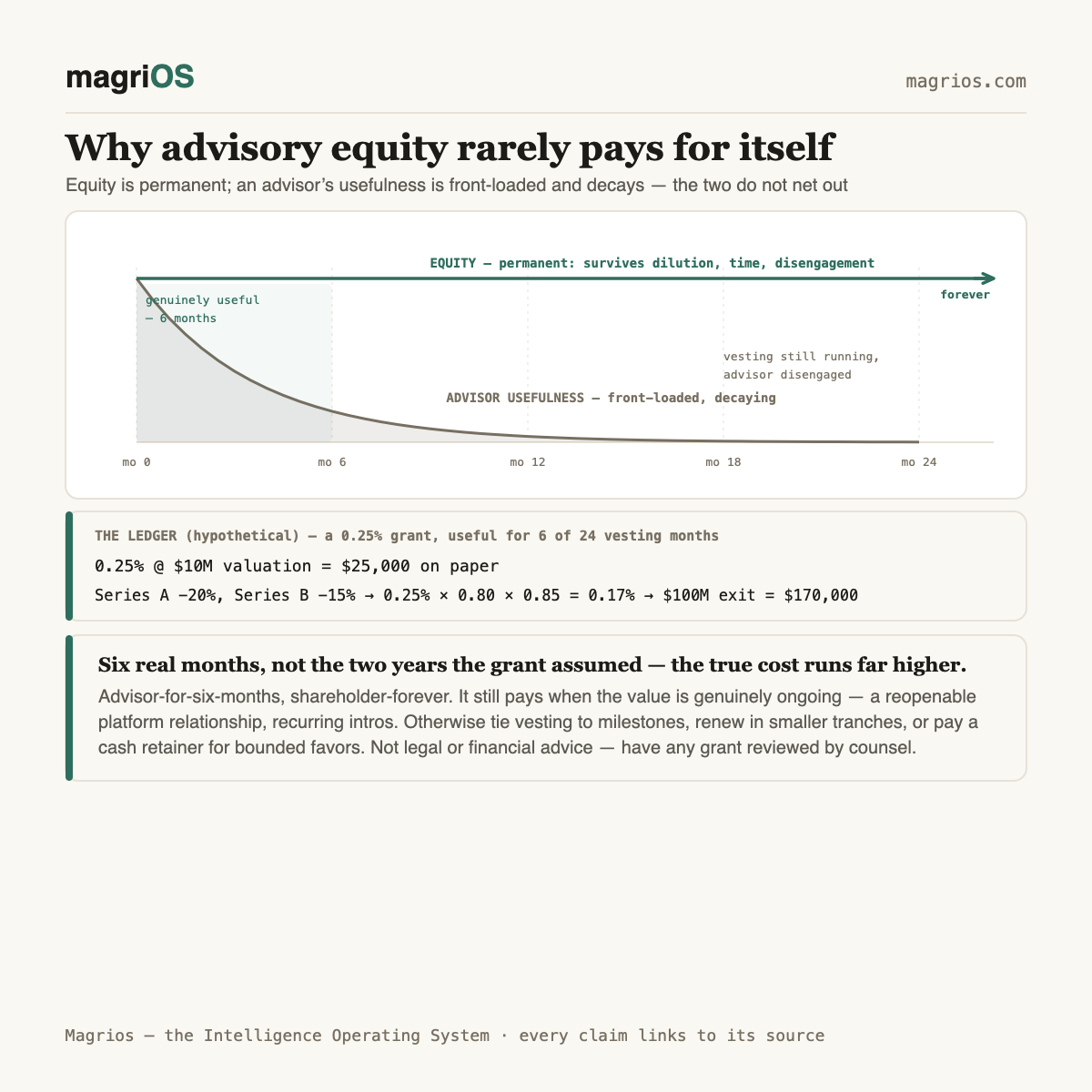
Advisory equity is a grant of stock or options given to an advisor in exchange for ongoing guidance, and the deal rarely nets out in the founder's favor once the numbers are run forward. The mechanism is simple: equity is permanent — it survives dilution, time, and disengagement — while an advisor's actual usefulness tends to peak early and decay as the company outgrows whatever specific expertise they contributed. Founders who model the grant as paying for two years of advice are usually, in practice, paying full price for six months of it.
What an advisory grant actually is
An advisory grant is typically structured as options or restricted stock, representing a small slice of fully diluted equity, vesting over a set period rather than being handed over all at once. Standard advisor grants are commonly discussed in the 0.1%–1% range of fully diluted equity, depending on the stage of the company and how much involvement is expected — that's a commonly discussed range in founder and advisor circles, not a measured or audited figure, and actual grants vary widely around it. Alongside the grant, companies typically sign an advisor agreement describing what's expected: periodic calls, occasional intros, review of specific materials like a pitch deck or a hire.
The mechanism: why equity is permanent and advice is not
Once granted, equity is a claim on the company that keeps existing regardless of whether the advisor stays engaged after their shares finish vesting — standard time-based vesting has no built-in mechanism that removes shares just because the advisor stopped being useful. Compare that to a consulting fee paid per unit of actual work: it stops the moment the work stops. Equity doesn't work that way. It converts a relationship into permanent ownership, and permanent ownership doesn't care whether the relationship continued.
Advice, meanwhile, is rarely evenly useful across the life of a grant. An advisor's specific value — a warm intro, credibility by association, expertise that matches exactly where the company is right now — tends to be front-loaded, concentrated in the early months of the relationship. As the company's problems move past whatever that person specifically knows, the advisor's marginal usefulness drops, often well before their equity finishes vesting, and almost always well before that equity stops existing on the cap table.
Hypothetical: running the numbers on a 0.25% grant
Suppose a founder grants an advisor 0.25% of the company, structured as options, at a moment when the company is valued at $10,000,000 on a fully diluted basis. At the time of grant, that 0.25% represents 0.25% × $10,000,000 = $25,000 of paper value. The options vest monthly over 24 months, so roughly 0.25% ÷ 24 = about 0.0104% of the company vests to the advisor every month.
Now suppose the advisor is genuinely useful for the first six months — two solid customer introductions and a thorough pass on the fundraising deck — and then largely stops responding to outreach for the remaining 18 months of vesting and beyond, since a standard grant carries no obligation of continued engagement once the shares have vested.
The company later raises a Series A that dilutes existing holders by 20%, and a Series B that dilutes by another 15%. The advisor's 0.25% becomes 0.25% × (1 − 0.20) × (1 − 0.15) = 0.25% × 0.80 × 0.85 = 0.17% from the hypothetical above by the time of an eventual exit. If the company exits for $100,000,000, that stake is worth 0.17% × $100,000,000 = $170,000.
Set that $170,000 outcome against the actual engaged period: six months of real activity out of a 24-month vesting term is 25% of the vesting window, and the advisor held vested, unrestricted shares for years afterward with zero further obligation. Priced against six months of real engagement rather than the two years of engagement the grant implicitly assumed, the effective cost of that advice is far higher than most founders model at the moment they hand the grant out — because they're pricing it as advisor-for-two-years, when the actual delivery was advisor-for-six-months, shareholder-forever.
Why this isn't apples to apples with a salaried hire or consultant
A consultant paid hourly or monthly stops costing money the instant they stop being useful — the founder simply doesn't renew the engagement. An advisor holding vested equity keeps their claim on the company's future value no matter what happens next, because the $170,000 outcome from the hypothetical above wasn't contingent on any of the eighteen quiet months that followed the six active ones. That asymmetry — cost that's permanent, value that's front-loaded and decaying — is the entire argument against treating advisory equity as a cheap, low-risk way to buy occasional guidance.
When advisory equity is still worth it
The case for advisory equity holds up best when the advisor's specific value is genuinely ongoing and hard to replace: a named platform relationship the advisor can reopen at will, a board seat elsewhere that keeps generating relevant intros over years rather than months, or domain expertise the company will keep needing well past the first six months. It also holds up better when the grant is structured to match that reality — milestone-based vesting tied to specific deliverables rather than a blanket time-based schedule, or a smaller grant sized toward the lower end of the commonly discussed range rather than the higher end.
What to negotiate instead of a standard time-vested grant
Founders can often get the same guidance for a smaller permanent cost by tying vesting to milestones or renewing it in smaller tranches rather than locking in two years upfront, sizing the grant toward the lower end of what's commonly discussed rather than the higher end, offering a cash retainer or a flat fee for specific, bounded favors instead of equity, and writing explicit check-in expectations into the advisor agreement so a lapse in engagement is visible and can be tied to an actual consequence rather than discovered years later on the cap table. This is the same logic that shows up in what-is-a-founder-vesting-refresh: equity that's supposed to track ongoing contribution needs a vesting structure that actually enforces that, not one that assumes it. It's also worth reading alongside what-is-the-option-pool-shuffle, since advisor grants usually come out of the same pool being resized at every round, and what-is-a-liquidation-preference-stack, since what that 0.17% is actually worth at exit depends on where it sits relative to preferred stock. And because advisory grants often get added quietly around the same time as a bridge-round-vs-priced-round decision, it's worth checking both at once rather than layering one more dilutive commitment onto a cap table already under pressure.
None of this is legal or financial advice. Advisor agreements, vesting terms, and clawback provisions vary by company and by jurisdiction — any specific grant should be reviewed with a qualified attorney before it's signed.